
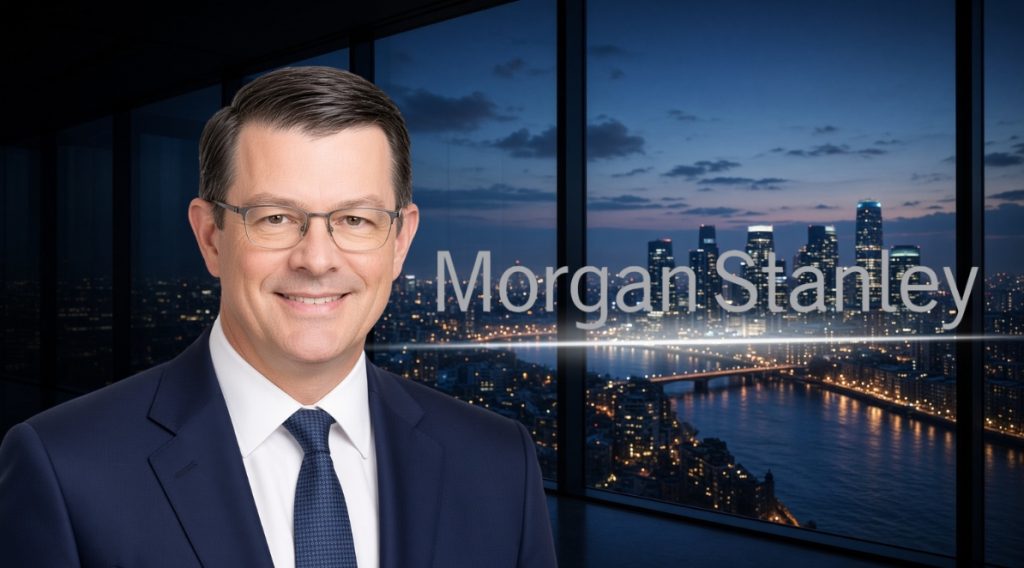
Tom Miles is global co-head of mergers and acquisitions at Morgan Stanley, a role he has shared with John Collins since July 2024. In the first quarter of 2026 the bank led the European M&A adviser table by value.
Miles spent sixteen years in JPMorgan’s M&A group before joining Morgan Stanley. He ran industrials M&A at Morgan Stanley, then became head of Americas M&A, before the global job.
Who runs Morgan Stanley’s global M&A group?
Miles was still head of Americas M&A in July 2024 when Morgan Stanley’s chief executive, Ted Pick, moved him up to the global co-head role. Pick had taken the job on 1 January 2024 after running Institutional Securities, the division that houses investment banking. The reshuffle six months later was the first serious reset of the M&A unit on his watch. It put Miles alongside John Collins and was framed as pulling capital markets and advisory closer together.
Collins had been in and around the firm much longer. He joined as an analyst in 1990, made managing director in 2004, left for Moelis & Company in 2010 and returned in 2013. He co-headed global healthcare banking after that and was in the global M&A role from around 2022.
Jan Weber runs Europe M&A under the two co-heads.
Tom Miles’s career: from JPMorgan M&A to Morgan Stanley
Miles read economics and political science at Duke. JPMorgan kept him in M&A from 1994 until 2010. Reporting at the time of the Morgan Stanley hire mentioned work on takeovers including UAL. His public biography lists industrials M&A after he arrived, Americas M&A from 2018, and the global co-head title from 2024.
Morgan Stanley tops Europe’s M&A league table in Q1 2026
GlobalData’s Q1 2026 adviser table had Morgan Stanley first in Europe by value at $56.3bn. Citi was on $40.4bn, Barclays on $37.3bn, then Lazard and Rothschild & Co. Eighteen deals in the quarter. Eleven of them above $1bn, one of them above $10bn. Value was more than four times the year-earlier quarter.
Goldman Sachs led North America at $189bn. JPMorgan was second at $178.1bn. Morgan Stanley was fourth, at $92.3bn. The U.S. M&A book was still a fight with Goldman and JPMorgan. The four-fold jump was in the European numbers.
Energy M&A has been a similar split for longer. GlobalData’s 2025 oil and gas ranking put Morgan Stanley first by value at $57.3bn, the only adviser above $50bn, on ten billion-dollar deals and two megadeals. RBC led by volume. JPMorgan, Evercore and Goldman followed on value.
Tom Miles on the 2026 M&A outlook
Miles does not give many interviews. The ones he does give tend to be about the cycle. In Morgan Stanley’s 2026 M&A outlook he described 2025 like this:
“A more predictable regulatory backdrop and years of pent-up consolidation demand unlocked a wave of large-cap deals, making 2025 the second most active year in the past decade.”
The supporting numbers in that note were a 40 per cent rise in global M&A volume and 60 deals above $10bn. For 2026 he said he expected the rebound to run for more than one year, “helped by more certainty on policies and regulations, lower rates and an IPO revival.” Collins, in the same piece, talked about liquidity needs, AI and international activity.
On private equity sponsors the line has been consistent. Funds are sitting on companies they have held too long, and on more than $4 trillion of dry powder they still need to put to work. “That dual dynamic is setting the stage for a very active year,” he said in the outlook.
In 2023 he had four headings for an M&A recovery: cash-rich corporates, funded sponsors, shareholder activism, and cross-border deals coming back. AI now sits on top of that list.
Asked in April about geopolitics and energy prices, he said: “Companies are setting their long-term strategies, M&A is definitely a part of that.” In January he was asked whether a European cross-border deal was still possible in the current political weather. He said cross-region volumes had been up 40 per cent the year before, and that the United States was still the main target market by a wide margin.
Women in investment banking leadership
The 2024 promotions that took Miles to the global job did not include any senior women. Morgan Stanley declined to comment.
That is not a point about Miles. The European Banking Authority’s latest sweep of EU banks and investment firms found that almost half still have no women on the executive board, and that women hold about a fifth of those seats. HM Treasury’s Women in Finance review keeps putting the global and investment banks at the bottom of its tables, around 30 per cent female representation.
What a large M&A process actually requires
For a board preparing an acquisition, a disposal or a demerger, the question is practical rather than biographical.
First-half 2026, on Morgan Stanley’s own figures, saw about $2.5 trillion of announced M&A volume and 45 deals above $10bn. AI infrastructure is pulling power, semiconductors and property into the same conversations.
The European value table, the 2025 energy M&A book and the 2024 promotion all sit with the same co-heads. Some companies still try to run a multi-billion transaction with corporate development and an adviser they already use. At that scale the process usually needs the people who run the M&A group.
Morgan Stanley M&A in the rest of 2026
The rest of 2026 will test three things Miles has already put on the record. Whether the rebound he described holds through the second half. Whether a lead in European M&A shows up as any real share against Goldman Sachs in the US. And whether the AI stack (data centres, power, chips, software infrastructure) changes which parts of the bank take the work.
Data centres stopped being a landlord story the moment the finished buildings needed a buyer and the construction loans were still sitting with the same banks, which is the problem we looked at in Blackstone’s $185bn book.
Miles has been in investment banking for three decades. The open question for the firm is whether the European quarter holds in the US tables as well.
Author: Tejas Bansal
See also:
Did Blackstone Really Get the Data Center Risk Off Bank Balance Sheets? | Disruption Banking
Who Are the Firms Dominating Private Credit Markets? | Disruption Banking