
- The Executive Board of the International Monetary Fund (IMF) concluded the 2026 Article IV consultation with Brazil on July 20, 2026.
- Brazil’s economy has remained remarkably resilient in the face of multiple shocks. Growth is projected to rise in 2026 and strengthen to about 2.5 percent over the medium term supported by structural factors, including the ongoing implementation of the landmark 2023 VAT reform.
- Inflation is expected to temporarily pick up in 2026, reflecting high global oil prices. Interest rate cuts have been consistent with Brazil’s well-established inflation targeting framework. Maintaining flexibility on next steps is appropriate given high global uncertainty and inflation pressures from global energy prices.
- To put public debt on a firmly downward path and open space for priority investments, saving oil-related revenue windfalls and implementing a more ambitious fiscal effort are warranted, while protecting targeted social spending.
Washington, DC – July 23, 2026: The Executive Board of the International Monetary Fund (IMF) completed the Article IV Consultation for Brazil.[1] The authorities have consented to the publication of the Staff Report prepared for this consultation.[2]
Brazil’s economy has shown remarkable resilience despite a series of shocks, and is relatively cushioned from global oil price increases stemming from the war in the Middle East by its status as a net oil exporter and the high share of electricity from renewable energy sources. The 2026 Financial Sector Assessment Program (FSAP) found that the financial sector remains resilient with systemic risks contained.
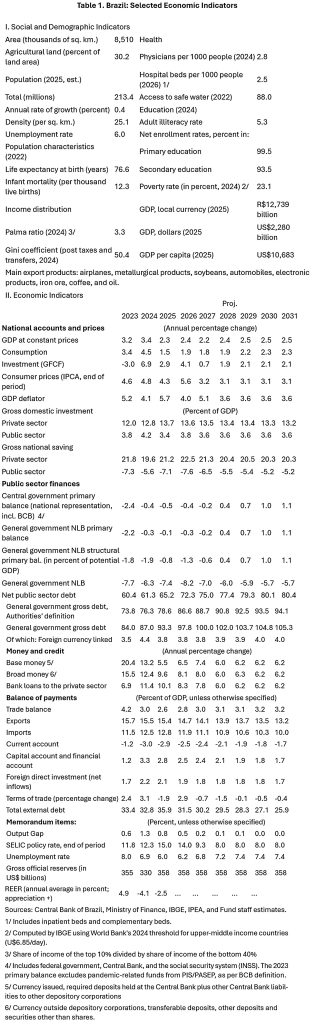
Growth is projected to rise to 2.4 percent in 2026, amid positive terms of trade associated with higher global oil prices and fiscal support, before easing in 2027 on account of still‑restrictive monetary conditions aimed at returning inflation to target. Over the medium term, growth is forecasted to recover to 2.5 percent, supported by the normalization of monetary policy and structural factors, notably the implementation of the efficiency-enhancing VAT reform approved in 2023, and the acceleration in hydrocarbon production. Inflation is expected to reach 5.6 percent by end-2026, before gradually converging to the 3 percent target by mid-2028.
Risks to the growth outlook are tilted to the downside amid heightened global uncertainty. The main risk is an escalation of geopolitical tensions, especially in the Middle East, which could increase inflation and, through tighter financial conditions and lower global demand, reduce economic activity. Global trade tensions could weigh on foreign investment and trade. Domestically, a weaker‑than‑envisaged fiscal effort could increase uncertainty and add to inflationary pressures, resulting in higher borrowing costs and, ultimately, weaker growth. Upside risks to growth include stronger-than-expected household consumption in the context of a still tight labor market and, over the medium term, from faster implementation of productivity-enhancing reforms and the ecological transformation.
Executive Board Assessment[3]
Executive Directors welcomed Brazil’s continued economic resilience, despite the challenging external environment, alongside declining poverty and inequality. Positively noting Brazil’s strong buffers and policy frameworks, Directors encouraged the authorities to strengthen fiscal sustainability, ensure inflation converges to target, and advance structural reforms to boost inclusive growth.
Directors commended the authorities’ ongoing efforts and welcomed their continued commitment to improving the fiscal position over the medium term. They broadly agreed that, amid persistent fiscal pressures and elevated interest costs, a more ambitious fiscal effort would help place public debt on a firm downward path and create space for priority investments. Saving oil‑related revenue windfalls, reducing spending rigidities, enhancing expenditure efficiency, and phasing out inefficient tax expenditures—while protecting targeted social spending—would support these objectives. Directors also saw merit in strengthening the fiscal framework, including through comprehensive spending limits, a binding medium‑term debt anchor, and linking spending growth to structural revenues. Incorporating oil price volatility considerations into the fiscal framework would also be important.
Directors commended the Central Bank of Brazil’s commitment to price stability and agreed that a slower normalization of monetary policy than expected before the Middle East war was appropriate. They stressed that monetary policy should remain data‑dependent and flexible amid elevated global uncertainty. Directors also noted that a stronger fiscal stance would support disinflation and pave the way for lower interest rates. They agreed that the flexible exchange rate regime and adequate international reserves remain important shock absorbers. Directors recommended phasing out the multiple currency practice and exchange restriction arising from the financial transaction tax.
Directors welcomed that the financial system remains resilient, with banks well‑capitalized, liquid, and systemic risks contained. They encouraged further strengthening banking and securities market supervision, including by completing the bank resolution framework and enhancing supervisory capacity. Directors welcomed the authorities’ deployment of the macroprudential toolkit and supported additional steps to address rising household indebtedness. They also welcomed the authorities’ efforts to strengthen crypto asset regulation and address cybersecurity risks.
Directors welcomed the authorities’ progress in their structural reform agenda. They agreed that continued implementation of the landmark 2023 VAT reform, improvements in the business environment, stronger governance, and greater labor force participation, particularly among women, would help raise productivity and medium‑term growth. Directors also emphasized continuing to strengthen anti‑corruption and AML/CFT frameworks and advancing skills development and AI adoption. They positively noted Brazil’s leadership in the climate agenda and encouraged continued implementation of the Ecological Transformation Plan. Directors also welcomed progress in deepening and diversifying trade linkages, including through recent trade agreements, and commended Brazil’s commitment to multilateralism and its important role in supporting an open, rules‑based trading system.
[1] Under Article IV of the IMF’s Articles of Agreement, the IMF holds bilateral discussions with members, usually every year. A staff team visits the country, collects economic and financial information, and discusses with officials the country’s economic developments and policies. On return to headquarters, the staff prepares a report, which forms the basis for discussion by the Executive Board.
[2] Option 1: Under the IMF’s Articles of Agreement, publication of documents that pertain to member countries is voluntary and requires the member consent. The staff report will be shortly published on the www.imf.org/Brazil page.
[3] At the conclusion of the discussion, the Managing Director, as Chairman of the Board, summarizes the views of Executive Directors, and this summary is transmitted to the country’s authorities. An explanation of any qualifiers used in summings up can be found here: http://www.IMF.org/external/np/sec/misc/qualifiers.htm.
See also:
IMF Executive Board Concludes 2026 Article IV Consultation with France | Disruption Banking
IMF Executive Board Concludes 2026 Article IV Consultation with Sweden | Disruption Banking
IMF Executive Board Concludes 2026 Article IV Consultation with Austria | Disruption Banking