
- The French economy has remained resilient but faces a more challenging environment as headwinds from the Middle East war have started to weigh on activity and higher energy prices have pushed up inflation.
- The authorities’ response to the energy shock has so far been appropriate and should remain limited, temporary, and targeted towards the most vulnerable, while preserving market incentives and containing fiscal costs.
- Amid high fiscal deficits, modest growth, and rising spending pressures, the upcoming electoral cycle provides an important opportunity for France to articulate a well‑defined multi‑year strategy to unlock its growth potential and support fiscal consolidation.
Washington, DC – July 22, 2026: The Executive Board of the International Monetary Fund (IMF) completed the Article IV Consultation for France on July 17, 2026.[1] The authorities have consented to the publication of the Staff Report prepared for this consultation.
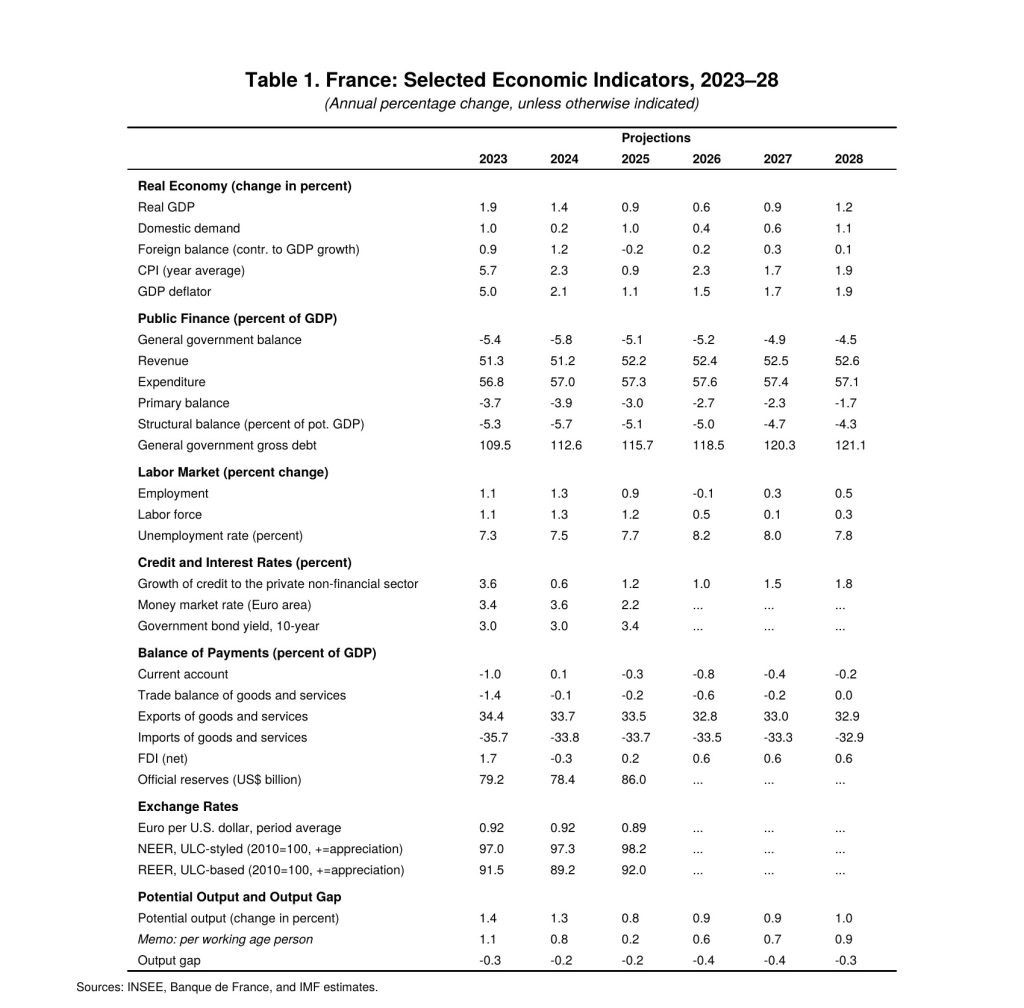
The French economy expanded at a moderate pace in 2025, despite domestic and external shocks, while inflation remained contained. However, headwinds from the Middle East war have started to weigh on activity, while higher energy prices have pushed up inflation. France’s fiscal stance strengthened in 2025, after two consecutive years of slippages, with the deficit declining to
5.1 percent of GDP—below the initial budget target—reflecting proactive spending management. The banking sector remained resilient, with financial stability risks contained, supported by solid buffers and proactive supervisory efforts.
Real GDP growth is projected to remain modest in 2026, slowing from 0.9 to 0.6 percent, as spillovers from the Middle East war raise inflation and dampen domestic demand. While growth is projected to recover gradually in 2027 as external conditions stabilize, rising geoeconomic tensions, including in the Middle East, the potential for a disorderly AI correction, and heightened political uncertainty ahead of next year’s presidential elections pose significant downside risks. By contrast, easing geoeconomic tensions and renewed political consensus around ambitious structural reforms—supported by deeper EU coordination—could boost confidence, investment, and overall growth.
Executive Board Assessment[2]
Executive Directors agreed with the thrust of the staff appraisal. They welcomed the French economy’s continued resilience, despite a succession of external shocks, including the Middle East war, and domestic policy uncertainty. Against the backdrop of high public debt, modest growth, rising spending pressures, and downside risks, Directors encouraged the authorities to press ahead with fiscal consolidation while pursuing ambitious structural reforms to unlock France’s potential and support durable, inclusive growth.
Directors highlighted the need for credible, growth-friendly, and expenditure-led fiscal consolidation to bring the deficit below 3 percent of GDP by 2029 and durably entrench debt sustainability. They welcomed the 2025 fiscal overperformance and considered the authorities’ response to the energy shock as appropriate, agreeing that any further measures should remain limited, temporary, and targeted to the most vulnerable, while preserving market incentives and containing fiscal costs. They concurred that fiscal adjustment should be anchored in a clearly specified multi-year strategy composed of high-quality measures and structural reforms to reprioritize spending, improve efficiency, address aging pressures, and preserve room for priority needs, while protecting the most vulnerable. They underscored the importance of robust contingency planning.
Directors agreed that ambitious domestic and EU-level reforms would strengthen France’s economic resilience and growth performance. They welcomed efforts to reduce regulatory barriers, mobilize private financing, and deploy well-targeted instruments to support innovation and the green transition. Directors stressed that deepening the single market would amplify the impact of domestic reforms.
Directors emphasized that a coherent policy mix is essential to support France’s labor force amid demographic pressures and the green and digital transitions. Building on recent reforms, they supported measures to strengthen work incentives, foster longer and less fragmented careers, support female labor force participation, and better integrate migrants. Directors also recommended more effective skills development aligned with AI and digital demands, alongside efforts to ease bottlenecks and support labor mobility.
Directors noted that financial stability risks remain contained, supported by proactive supervisory efforts. In line with the 2025 FSAP recommendations, they welcomed ongoing vigilance and efforts to deepen supervisors’ understanding of risks from investment funds and broader financial sector linkages, and to strengthen cyber preparedness.
Directors commended France’s leadership in multilateral cooperation, including in addressing global challenges related to debt, climate, and global imbalances and through official development assistance.
[1] Under Article IV of the IMF’s Articles of Agreement, the IMF holds bilateral discussions with members, usually every year. A staff team visits the country, collects economic and financial information, and discusses with officials the country’s economic developments and policies. On return to headquarters, the staff prepares a report, which forms the basis for discussion by the Executive Board.
[2] At the conclusion of the discussion, the Managing Director, as Chair of the Board, summarizes the views of Executive Directors, and this summary is transmitted to the country’s authorities. An explanation of any qualifiers used in summings up can be found here: http://www.IMF.org/external/np/sec/misc/qualifiers.htm.
See also:
IMF Executive Board Concludes 2026 Article IV Consultation with Sweden | Disruption Banking
IMF Executive Board Concludes 2026 Article IV Consultation with Austria | Disruption Banking
IMF Executive Board Concludes 2026 Article IV Consultation with United Kingdom | Disruption Banking