IMF Executive Board Concludes 2026 Article IV Consultation with the Czech Republic
Washington, DC – March 23, 2026: The Executive Board of the International Monetary Fund (IMF) completed the Article IV Consultation for the Czech Republic(see point 1 below)
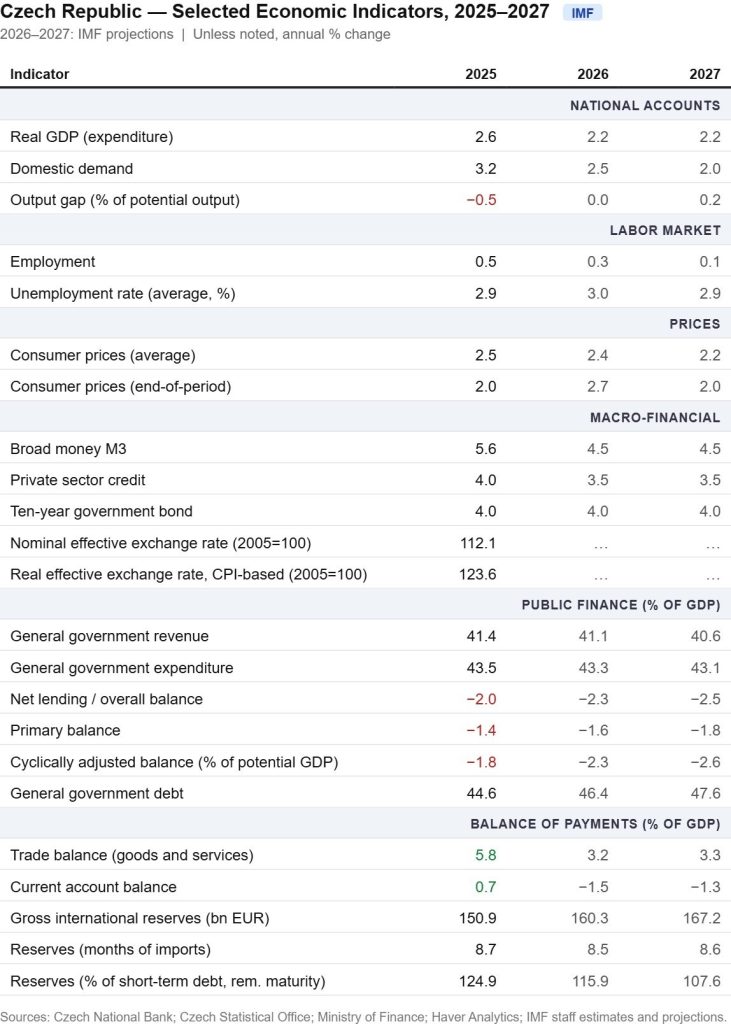
The Czech economy expanded in 2025, driven primarily by domestic demand. Growth was robust, averaging an estimated 2.6 percent as real wages continued to recover, supporting consumption, while public investment benefited from strong EU funds absorption. In contrast, private investment and exports softened amid global policy uncertainty and rising trade barriers. Headline inflation has eased to 1.4 percent in February, reflecting lower energy and food prices and the transfer of the renewable energy surcharge to the state budget. However, core inflation remains elevated at 2.7 percent, driven by persistent services price pressures, including housing-related costs, and nominal wage growth of around 7 percent.
Following the energy shock from the war in the Middle East, growth forecasts have been lowered and inflation projections raised. Based on staff’s preliminary assessment, growth is projected to remain above potential at 2.2 percent in 2026, closing the output gap, with consumption supported by recovering real wages and a modest decline in the saving rate. Investment should strengthen as interest rates fall, while exports recover more gradually from recent disruptions. Over the medium term, growth is expected to ease toward its 1.8 percent potential, constrained by demographics and modest productivity gains. Headline inflation is projected to average 2.4 percent this year, as higher energy prices outweigh the effect of transferring the renewable energy surcharge and earlier koruna appreciation, while core inflation remains sticky amid persistent wage and housing related pressures.
Risks are elevated and, in the near term, shifting upward for inflation and downward for growth, on rising geopolitical risks and further intensification of military conflicts. On the other hand, a more expansionary fiscal stance could temporarily lift growth above potential and add to price pressures, requiring tighter monetary policy, while global uncertainty or financial market corrections could dampen activity and heighten inflation volatility.
Executive Board Assessment(see point 2 below)
Executive Directors welcomed continued robust activity and economic resilience amid structural challenges, noting that growth is expected to moderate toward potential over the medium term. Directors highlighted that the outlook is subject to considerable uncertainty and that medium-term risks are tilted to the downside, including from intensification of conflicts, global policy uncertainty, and trade tensions, which could weigh on activity and increase inflation. Against this backdrop, they underscored the need to continue implementing prudent policies, advancing structural reforms, and deepening integration with the EU Single Market to raise potential growth.
Directors emphasized the importance of preserving fiscal space amid rising medium-term spending pressures. Noting that demographic trends and sizable investment needs are expected to increasingly strain public finances, Directors recommended gradual and sustained fiscal adjustment to contain debt and financing needs. Important measures include restraining wage bill growth, better-targeting social spending, and strengthening expenditure efficiency. They stressed that any changes to the recent pension reform should be carefully assessed. Directors welcomed the authorities’ efforts to strengthen tax compliance and encouraged a rebalancing of the tax system away from labor toward property taxation.
Directors agreed that the current monetary policy stance is broadly appropriate, given persistently elevated core inflation and a narrowing output gap. They welcomed the authorities’ commitment to a data-driven approach to monetary policy. Directors emphasized that tighter monetary policy and clear communication to anchor expectations would be necessary should fiscal developments exacerbate macroeconomic imbalances. They welcomed the central bank’s review of its monetary-policy analytical and modeling framework and underscored the importance of maintaining strong analytical frameworks in an environment of heightened uncertainty. Directors generally noted the benefits of central bank balance sheet normalization, while many Directors also recommended caution in reducing FX reserves, highlighting the importance of appropriate timing, given elevated global uncertainty.
Directors welcomed that financial stability risks remain contained, supported by a resilient banking system. They nonetheless called for continued vigilance amid rapid property price growth and increased interconnectedness. Directors saw scope for targeted macroprudential measures should risks intensify and supported ongoing efforts to strengthen the AML/CFT framework, particularly in higher-risk sectors.
Directors underscored that advancing structural reforms is essential to raise potential growth and ease the burden of fiscal consolidation. They emphasized the importance of reducing 2 administrative burdens, accelerating digitalization, and improving the business environment to enhance competitiveness domestically and within the EU single market. Measures to strengthen labor market participation and modernize vocational training and public education are also important. Directors highlighted the need for sustained efforts to strengthen energy security, manage rising aging-related costs, and expand affordable housing to better position the economy to navigate structural headwinds and support inclusive, long-term growth.
(1) Under Article IV of the IMF’s Articles of Agreement, the IMF holds bilateral discussions with members, usually every year. A staff team visits the country, collects economic and financial information, and discusses with officials the country’s economic developments and policies. On return to headquarters, the staff prepares a report, which forms the basis for discussion by the Executive Board.
(2) At the conclusion of the discussion, the Managing Director, as Chair of the Board, summarizes the views of Executive Directors, and this summary is transmitted to the country’s authorities. An explanation of any qualifiers used in summing up can be found here.
See also:
- Macroeconomic Developments and Prospects in Low-Income Countries—2026 | Disruption Banking
- IMF Executive Board Concludes 2026 Article IV Consultation with the Slovak Republic | Disruption Banking
- IMF Executive Board Approves US$8.1 Billion under an Extended Fund Facility (EFF) Arrangement for Ukraine | Disruption Banking