

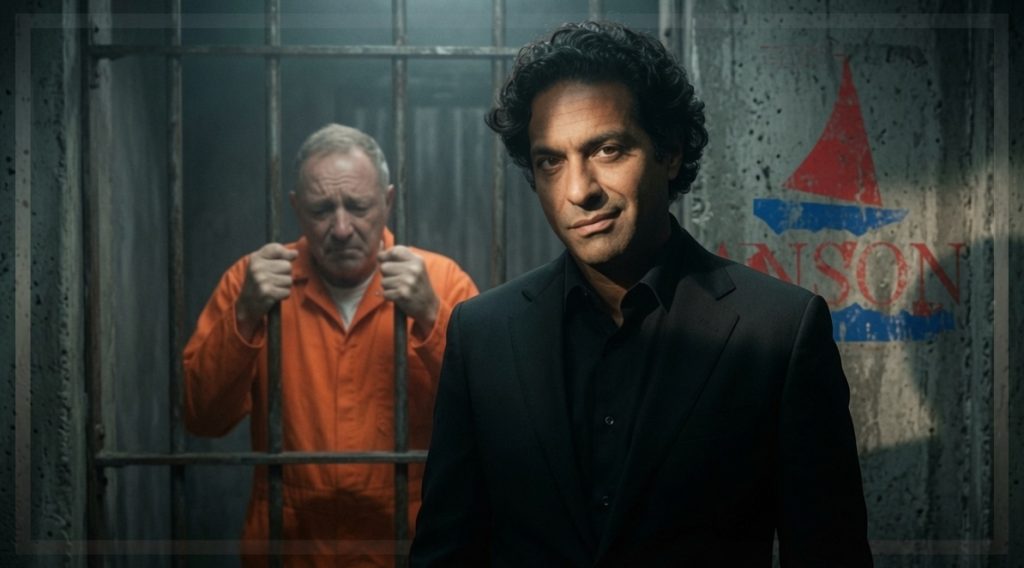
On June 2, a federal jury in Los Angeles found Andrew Left guilty of securities fraud, with prosecutors proving he used his Citron Research platform and cable-news celebrity to move stocks and pocket at least $21 million.
Shortly after Disruption Banking’s article ran, a tip arrived in Disruption Banking’s inbox. It read, in part:
“Left is guilty of the crimes the DOJ charged him with, but he was merely a pawn. The bigger story (that hasn’t been told yet) is who he was working for. For over a decade, Left has been working for Moez Kassam of Anson Funds. Where Left made $20 million, Anson made hundreds of millions. This is also tied into Nate Anderson of Hindenburg Research who also worked for Anson Funds.”
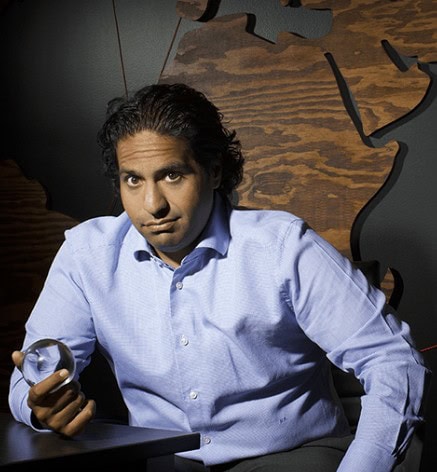
According to the bio on his website, Moez Kassam is a Toronto-based hedge fund manager, venture capitalist, and entrepreneur, pictured holding a crystal ball and wearing a collared shirt and a smirk. He is co-founder and Chief Investment Officer of Anson Funds, which is based in Dallas, Texas. He saw fit to mention various philanthropic activities and “infamous” dinner parties.
Why would a multi-billion-dollar hedge fund that paid for and sat behind the short reports be spared by the Department of Justice? If anything, prosecutors should have used Left, the minor co-conspirator, to target Anson and Kassam, the bigger fish.
Regulators found that they even used trading profits to pay for them and disguised the payments with fake invoices. Heavy stuff, but somehow they haven’t been criminally charged.
Hedge Fund A
In Left’s indictment, there was a “Hedge Fund A” that paid Left through a third-party intermediary, received his bearish publications in advance, shorted the target stocks before publication, and covered after prices fell. Hmm… guess who that was?
Six weeks earlier, the SEC had already told the market who it was, in everything but name. The Commission settled charges against Dallas-based Anson Funds Management and other entities behind the roughly $2.9 billion Anson Investments Master Fund.
According to the SEC’s order, Anson’s flagship fund used a short strategy that involved working with activist short publishers, trading around the publication of their reports. and paying the publishers a share of the fund’s trading profits. Not good. Definitely illegal.
Institutional Investor and Hedgeweek both identified the unnamed publisher as Andrew Left, whose Citron Research published precisely those two companies in exactly that window.
Anson settled without admitting or denying the findings, paying $2.25 million in civil penalties. It was the firm’s second SEC action in eight months: in October 2023, Anson paid a combined $3.33 million in penalties for violating Rule 105, which bars shorting a stock ahead of participating in its public offering.
In His Own Words
The WhatsApp messages attributed to Kassam in the court file speak for themselves:
“Let me cut u a big check and rest is easy.”
“We need to keep this quiet.”
“What do you think you’ve got that isn’t out that will have the most impact. I’ll short some more b4 report.”
So let’s weigh the ledger here. Left is convicted, facing a maximum of 25 years, for his $21 million in profits. The fund the government says paid him, and which, by the arithmetic of any profit-sharing arrangement, kept the far larger share, has paid $5.58 million in regulatory penalties and admitted nothing. Sounds a bit like an Epstein story. People with sufficient wealth just pay their way out, no questions asked.
“I’m Paying u 15% of Profits”
The info comes from the editor of Market Frauds, a website devoted to attacking Anson Funds. However, the documents it points to are real: SEC enforcement orders, a federal indictment, affidavits and deposition transcripts filed with the Ontario Superior Court, and settlement records in federal courts.
If the SEC’s orders describe the business model in dry administrative prose, court filings in Canada show it in the principal’s own words, and Kassam made the deal explicitly clear in his messages:
“I’m paying u 15% of profits, aim is short 20m on Monday itself. And I’ll update u hourly as we get filled.”
On July 7, 2019, Kassam wrote: “Either way we are shorting and our deal is good… Just trying to get Andrew interested,” which the affidavit presents as a reference to bringing Andrew Left into the campaign.
The messages go further than trading. They show Kassam pressing for a “round II” of negative information, pushing for “pressure on banks and regulators,” and emailing underwriters about the class-action lawyers supposedly inundating him, while privately joking, “You trying to start a class action here? Haha just rattling cages. Don’t post that obviously.”
On another occasion, Kassam instructed an associate to obtain inside information from the company by any means available: “Bang some secretary. Make ur moves!” Then, there was a request to find “a mole.”
Deny, Deny, Deny
None of this conduct has resulted in criminal charges against Kassam or Anson. But it makes his sworn testimony in a deposition from the same litigation remarkable to read. Asked directly in a deposition about the practices described above, Kassam denied them:
Q. So when you say you don’t engage in naked short selling, have you ever, have you or any of the Anson entities ever engaged in naked short selling?
A. So us as a regulated entity of the OSC and of the SEC, we are bound by the rules set by both, and we never go outside of those rules.
Q. I understand that, sir. But has Anson, have any of your entities ever engaged in naked short selling?
A. Again, it’s a pretty opaque and subjective term on how people define naked shorting.
Q. Well, I’m not interested in how other people define it. I’m interested in your perspective, your opinions and your facts. Have you ever nakedly shorted a stock?
A. As mentioned, we are bound by all the rules set forward to us by the OSC and the SEC, and as such, we do not engage in anything untoward or outside of those rules, including naked shorting.
Q. I’ll be more specific. When you say you work with them, how do you work with them?
A. We exchange diligence.
Q. And do you often go on deals together? Do you work with them to short stocks together?
A. No, we do not coordinate trading with anyone other than ourselves.
“We do not coordinate trading with anyone other than ourselves” is a difficult sentence to square with “I’m paying u 15% of profits,” or with an SEC order finding that Anson paid a short publisher $1.1 million of trading profits through a disguised intermediary. That contrast is the kind that tends to attract prosecutorial attention. So far, it has attracted civil attention instead.
The $28.5 Million Quiet Exit
In 2022, a shareholder of Genius Brands (now Kartoon Studios, NYSE: TOON) filed Augenbaum v. Anson Investments Master Fund LP et al. in the Southern District of New York, claiming that Anson and a group of allied funds scored short-swing profits trading Genius Brands stock.
Rather than open its trading books to discovery, Anson and its co-defendants settled for almost $28.5 million. Market Frauds reports that Anson’s share was $50 million. A settlement isn’t the same as an admission. But $50 million is a remarkable price to pay.
Nate Anderson’s Silent Partner
The tip makes a further claim that, if ever substantiated, would be the biggest story in the history of activist short selling: that Nate Anderson’s Hindenburg Research, the firm that felled Nikola, shook the Adani empire, and toppled Icahn Enterprises’ share price, was “actually set up by Anson.”
What can be verified is narrower but still striking and isn’t just from anonymous websites. Documents produced by Anson in the Ontario litigation, first reported by BNN Bloomberg and later published by Market Frauds, show communications between Anson personnel and Anderson concerning Facedrive.
Hindenburg attacked Facedrive in 2020 and partnered with Anson to make money off it. The court files show an Anson analyst extracting an admission from a Facedrive partner that the firm would miss its targets, passing it to Anderson, weighing in on how the report should be arranged, and what the price target should be. Basically, this was yet another short-selling pump-and-dump scheme.
A Really Good Lead?
Court documents filed in Ontario litigation (CV-20-00653410-00CL) show that Anson’s Sunny Puri was emailing Nate Anderson at his ClaritySpring address as early as March 2018, feeding him research on cannabis company Aphria days before Hindenburg published two negative reports on the stock. A ClaritySpring invoice addressed to Anson followed weeks later.
By 2020, the arrangement had become more explicit: emails produced as court exhibits show Anson’s Michael Roussel sending Anderson all of the firm’s Facedrive research, with Puri subsequently dictating what to include, what to cut, and what price target to use.
When Puri instructed Anderson to “exclude any pictures of emails to Anson” from the final report, Anderson replied simply: “Ok sounds good.” A separate WhatsApp message from Kassam himself, also filed as a sworn court exhibit, puts it plainly: “I gave Hindenburg his entire file.“
When BNN Bloomberg reported on the court battle in December 2024, Anderson pushed back on X, insisting that Anson was merely “an investor sharing a really good lead” and that Hindenburg “always had full editorial control.” The emails tell a different story.
In one exchange, Anson’s Joshua Fineman writes Anderson ahead of publication: “Hey Nate, latest draft here, believe we are in a much better place now. Looking forward to tomorrow. To full downside.”
Anderson’s reply to Puri and Roussel: “Review attached for any required final edits/changes.” That is not a researcher vetting a tip. It is a contractor submitting copy for client approval, with Anson, not Anderson, holding the pen.
Ok Sounds Good
Anderson has never been charged with any wrongdoing, but he shut down Hindenburg Research about 6 months after the SEC’s Anson order and Left’s indictment. The timing seems suspicious.
This whole situation with Anson, Left, and Anderson’s Hindenburg Research stinks to high heaven. One potential conclusion is that the U.S. regulators punished the small fry and let the big ones off. Another possibility is that the SEC is still investigating.
Andrew Left is facing up to 25 years in prison for running a scheme that, by the government’s own account, required a funding partner, advance intelligence on the research, and a profit-sharing arrangement to operate. That partner paid $2.25 million to the SEC, shook hands, and walked.
The question regulators have not yet answered is whether that settlement was the end of the matter or the beginning of a larger case. Anson has been cooperating, according to people close to the situation, and the DOJ probe that named the firm in 2021 has never been officially closed. They made an example of Andrew Left. Whether they will punish the hedge fund manager who put him up to it remains to be seen.
Author: Tim Tolka, Senior Reporter
#Crypto #Blockchain #DigitalAssets #DeFi
The editorial team at #DisruptionBanking has taken all precautions to ensure that no persons or organizations have been adversely affected or offered any sort of financial advice in this article. This article is most definitely not financial advice.

Tim Tolka
Tim Tolka, Senior Reporter at Disruption Banking, covers digital assets, monetary policy and the politics of global finance. Based in Mexico City, he brings an investigative edge to his reporting, informed by a Master's in International Affairs and his work as an author and screenwriter.
3 Responses
who is paying anson’s legals? citadel and the feds are putting heat on moez,he has a handler bugging him daily. Cannacord paid 120 million for his action.So all you short and distort guys in Canada moez is a pg undercover beware
i know Moez from college. A fat 300lb tubby little hoser. He was always off though. Lots of rumors about him and his wife doing the rounds in Toronto. Maybe she has foundbout about all the escorts
Wow what a hater you are you coward, hiding behind an alias. You gonna make allegations, step out the shadows ho