
2026 started with high expectations. Many investors were still riding the momentum from late 2025, but the first few months have already delivered significant shocks across capital markets. In today’s story we summarise the 7 biggest capital markets disruptors of 2026 so far. In no particular order, we shine a light on the challenges and opportunities that the buy-side, sell-side, and retail investors alike face. From mega-IPOs and eye-watering valuations to market meltdowns and one founder’s late-night X post that stopped a bill in its tracks.
Elon Musk’s SpaceX Confidential IPO Filing (1)
A few days ago SpaceX quietly filed confidentially for what could become the largest IPO in history, targeting a $1.75 trillion valuation and a potential $50–75 billion raise. Having already built one of the most valuable private companies on the planet through Starlink and reusable rockets, Musk is now preparing to bring that rocket fuel to public markets. The move isn’t just about unlocking liquidity for employees and early investors. It could reopen the floodgates for other mega-tech listings waiting in the wings.
OpenAI’s Ridiculous $852 Billion Valuation (2)
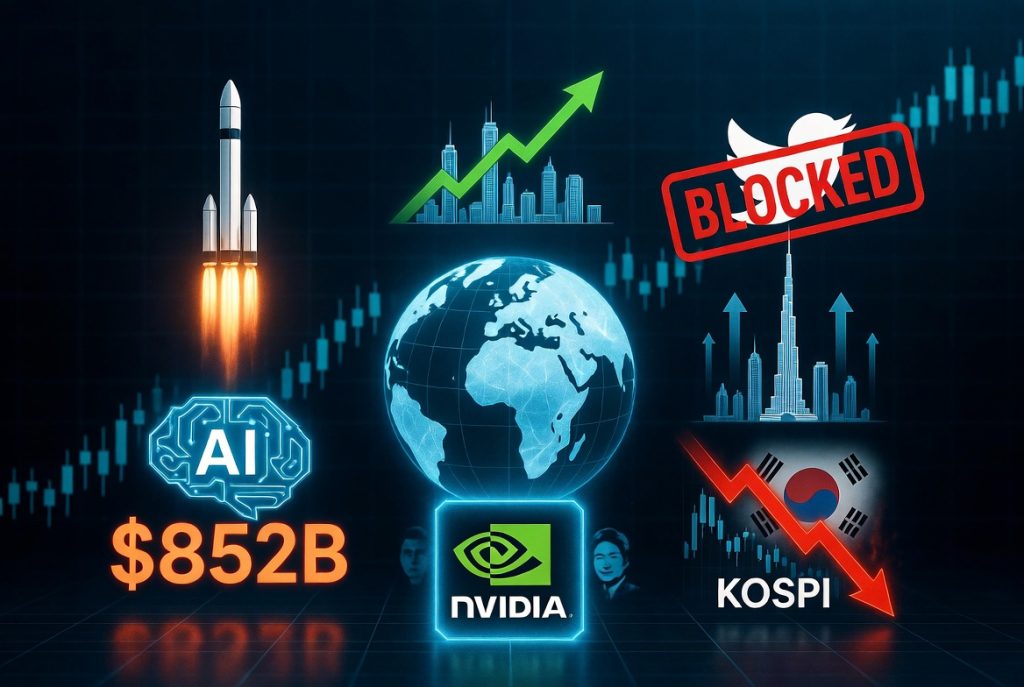
Just when we thought private market valuations couldn’t get any more detached from reality, OpenAI closed a $122 billion funding round in late March at an $852 billion post-money valuation. Co-led by SoftBank and a16z, with heavy participation from Amazon, Nvidia and others, the round highlighted the sheer capital vortex that AI continues to create. While the company talks up transformative productivity gains, it’s still burning cash and tweaking features ahead of a potential IPO. For buy-side investors watching enormous sums flow into private AI plays instead of public equities, this one felt like a classic hype-versus-reality moment. One thing’s clear: the amount of dry powder being sucked into a handful of AI winners is reshaping capital allocation across global markets.
Brian Armstrong Single-Handedly Blocking the CLARITY Act (3)
In January 2026, Coinbase CEO Brian Armstrong took to social media and effectively hit the pause button on a major Senate crypto market structure bill. His public misgivings about the Digital Asset Market Clarity Act, particularly around stablecoin yield provisions and perceived giveaways to traditional banks, split the industry and delayed proceedings. He was particularly against removing stablecoin yield provisions and allowing perceived giveaways to traditional banks. It split the industry and delayed markup. Ripple said yes, but Coinbase walked away, at least initially. The episode showed how one founder’s voice can still paralyze Washington and send ripples through Bitcoin and altcoin prices. Later developments, including Trump’s backing and eventual compromise talks, only underscored the drama.
Clarity Act: Ripple Says Yes, Coinbase Walks Away
— #DisruptionBanking (@DisruptionBank) January 17, 2026
Ripple CEO: “Clarity beats chaos.” Coinbase pulls support over stablecoin rewards & DeFi bans. Senate pushes forward
Who wins?
Full story: https://t.co/whyy7ffl7Z#ClarityAct #Ripple #Coinbase #Crypto pic.twitter.com/ID4YIvzqsm
Jensen Huang & NVIDIA’s AI Supremacy at GTC 2026 (4)
Nvidia CEO Jensen Huang took the stage at GTC 2026 and declared that “compute is the new economy,” laying out a roadmap toward $1 trillion in AI-related revenue over the coming years. With massive orders for Blackwell and Rubin chips flooding in, the conference once again redirected hundreds of billions in global capex toward AI infrastructure. Partnerships with everyone from Adobe to Oracle underscored how deeply accelerated computing is embedding itself into enterprise workflows. For capital markets, the message was loud: the AI arms race isn’t slowing. Instead, it’s reshaping everything from chip supply chains to energy demand.
The Brutal KOSPI Collapse in South Korea (5)
Early March brought a stark reminder that geopolitics can vaporise market value in hours. South Korea’s benchmark KOSPI suffered one of its worst single-day drops in recent memory. When it plunged over 7% with roughly $270 billion in market cap being wiped out, amid Iran conflict and oil supply shock fears. Foreign outflows hit record levels as the Korean won weakened sharply. For emerging-market investors and anyone with exposure to Asia, the episode highlighted how quickly external shocks can trigger capital flight and force rapid repricing.
KOSPI plunges 7.24%, erasing $270B in market value, the sharpest drop in 19 months, as Iran war escalates, oil surges, and energy import risks hit hard. Geopolitical shock tests resilience now
— #DisruptionBanking (@DisruptionBank) March 3, 2026
Full analysis: https://t.co/YuCEAfLUX6#KOSPI #Geopolitics #MarketCrash #Korea pic.twitter.com/ldPzXTeBTr
Hong Kong’s Record-Breaking IPO Surge (6)
While the U.S. waited for mega-IPOs like SpaceX to materialise, Hong Kong was busy stealing the show. In the first two months of 2026 alone, the city raised well over $10–13 billion in new listings. This represents a surge of several hundred percent year-on-year. Chinese and tech firms flocked to HKEX, helping the exchange post strong profits and reminding everyone that listing gravity can shift quickly when regulatory or geopolitical winds change. For global capital markets, it was a clear signal that Asia’s financial hubs are ready to compete harder for the next wave of public debuts.
Dubai Hedge-Fund Reassessment and Partial Exodus (7)
The Iran conflict hit closer to home than many expected. In March, several high-profile hedge funds began reassessing their presence in Dubai, with Millennium reportedly exploring a move to Jersey as staff evacuations and risk reassessments accelerated. What had been billed as the rising “new financial hub” suddenly faced questions about stability, with Goldman Sachs even warning of potential contraction in the UAE. Billions that had flowed into the Dubai International Financial Centre (DIFC) in recent years suddenly looked a bit more flighty.
Millennium Management, the $87B multi-strategy hedge fund, is relocating staff from Dubai to Jersey amid escalating risks from the US-Israel-Iran conflict#HedgeFund #RiskManagement #Dubai #Millenniumhttps://t.co/UA4xh3K6yp pic.twitter.com/Xo5PBcBCbP
— #DisruptionBanking (@DisruptionBank) March 26, 2026
As we move further into 2026, a year already packed with conflict ripples, valuation debates, regulatory fireworks and shifting listing power, we hope our summary gives readers something to chew on. There were undoubtedly other disruptors we may have missed. For instance, the broader stablecoin volume growth to ongoing AI infrastructure capex battles. Many of these stories will likely spill into the rest of the year, where questions around capital allocation, geopolitical resilience and the next big IPO pipeline will dominate.
Will the AI capital vortex keep pulling money away from traditional public markets? Will regulatory clarity finally arrive for crypto, or will founder influence continue to shape Washington?
#DisruptionBanking #SpaceX #OpenAI #BrianArmstrong #JensenHuang #NVIDIA #KOSPI #HongKongIPO #DubaiHedgeFunds #CLARITYAct
Author: Andy Samu
See Also:
Trump Backs Coinbase on CLARITY Act | Disruption Banking
Clarity Act: Ripple Says Yes, Coinbase Walks Away | Disruption Banking
Millennium Ditching Dubai for Jersey as Iran War Hits Too Close | Disruption Banking
South Korea Market Crash: KOSPI Plunges 7%, $270B Wiped Out in Iran War Shock | Disruption Banking

Andrew Samu
Andrew Samu, Editor-at-Large at Disruption Banking, shapes the publication’s global coverage of banking, capital markets and digital assets. Based at London’s Level39, he combines market analysis with a strong commercial perspective, informed in part by his role as Commercial Director at Verita HR.