On September 9th, Anthropic published an interactive model called the “Econ Scenario Explorer,” along with an accompanying technical paper. Modeling the US economy, Anthropic’s model asks what happens by 2030 depending on how capable AI becomes, how fast it is adopted, and whether it creates new work for humans.
The model presents three scenarios, covering a huge range of outcomes. In the modest scenario, AI performs 4% of the tasks in the economy and mostly helps people do their jobs. GDP ends up 1.6% above where it would have been without AI. In the substantial scenario, AI performs 12% of the economy’s tasks, starts replacing people at their jobs, and GDP ends up 8.3% higher.
In the extreme scenario, AI performs 30% of all tasks in the economy, roughly half of everything knowledge workers did in 2025, and creates no new work to replace what it took. Knowledge workers are hit the hardest. Unemployment among them rises to 17.9%, and to 11.9% across the entire workforce, well above typical recession levels.
Within this third scenario, the economy doubles every 4.5 years, with annual growth hitting 15.4%. Wages for knowledge workers (professionals whose main capital is their expertise, i.e. programmers, analysts, office workers, nurses, etc.) fall 11.5% below where they would otherwise have been, while capital income runs 81% above its no-AI path.
Good News If You Own a Toolbelt
In all three of Anthropic’s models, wages outside of knowledge work will actually go up. Basically, because AI is so efficient and better performing than the knowledge workers it replaced (not just cheaper), the wheels of commerce will be greased and the economy will chug along in overdrive. In turn, there will be a need for more manual workers to meet the demand for new infrastructure, which will naturally push wages higher. In the extreme scenario, wages outside knowledge work run 33.6% above trend.
The model’s predictions don’t stop there. According to Anthropic:
“In the modest scenario, it’s hard to see the effect of AI in macroeconomic data: its economic impact is something like the internet’s. In the substantial scenario, AI makes a bigger impact than the internet, or the railroad. And in the extreme scenario, AI drives a completely transformed, unprecedented economy, likely driven by recursively self-improving AI systems and a faster rate of AI adoption.”
Let’s pick this apart a bit. In the case of the modest scenario, it’s a curious analysis to call the internet’s effect, or AI’s for that matter, modest just because the macroeconomic data is inconclusive. The internet changed life on earth in countless ways. It created jobs, destroyed jobs, forever changed media, social behavior, the flow of information, etc.
The Internet Was “Modest” Too
What it did not do is substantially grow GDP. In the 1950s and 1960s, the US economy grew at over 4% a year. No decade since has managed that average, not with the rise of the internet or anything else. A handful of individual years cleared the bar, 1984 and 1999 and the 2021 rebound, and each time it proved to be a spike rather than a new normal. In the late 90s, influential forecasters predicted the internet would expand the economy at exponential rates for a generation. It didn’t happen.
The internet did, however, eat into existing industries and claim a sizable portion of GDP. It just didn’t grow GDP in the aggregate in a notable way. That’s why the scenario is called modest, even though by most other metrics, the internet’s effect on the world is far from modest.
What’s also curious regarding GDP growth, if one is to consider recent history, is how thin the growth looks once you strip out AI’s own spending. Harvard economist Jason Furman calculated that investment in information processing equipment and software made up 4% of GDP in the first half of 2025 and accounted for 92% of GDP growth. Strip it out and the economy grew at a 0.1% annual rate. Furman himself allowed that cheaper energy and lower rates would have filled in perhaps half the gap. Even at that discount, the buildout is doing the heavy lifting.
What the Model Leaves at the Door
Anthropic’s model ignores several variables. It leaves out policy responses, demand effects from the data-center buildout, physical robots, financial crises, and catastrophic risks. While Anthropic is up front about these omissions, it’s fair to ask what actual value these new models have without including them.
Like every other sector in the economy, AI doesn’t exist in a vacuum. Actions have consequences. And yet, Anthropic and the major AI players seem to often operate with tunnel vision, working fast and breaking things, then switching to panic mode when it suits them. It’s almost comical, if it wasn’t so predictable and increasingly dangerous.
Three Days Later, Slam the Brakes
Three days after Anthropic published the Econ Scenario Explorer, Dario Amodei published a 3,800-word essay arguing for slowing the pace of AI development globally. Released on September 12th, We Must Pace the Frontier addresses various concerns and offers tentative solutions, starting with a commitment to let outside evaluators sit inside Anthropic with employee-level access.
What’s notable is the timing. Three days after Anthropic released an interactive model forecasting AI displacing a huge portion of the labor force, Anthropic’s CEO says we need to slow things down because things could go bad.
The technical report behind the model is candid about what it sets aside, listing policy responses and political economy among them. A coordinated industry slowdown, the thing Anthropic’s own CEO would demand seventy-two hours later, isn’t one of the futures it runs.
Like OpenAI’s CEO, Sam Altman, Amodei’s approach to AI public relations seems to rely on speaking often, even if his freshly-offered insight contradicts the previous one or company practices. This dissonance, quite ironically, is almost like the varying responses you get from a chatbot. Don’t like the response? Change the wording ever so slightly, query again, and it’ll give you a polar opposite answer.
Soon after Amodei published the essay, Sam Altman, Demis Hassabis and Elon Musk all responded in agreement, Altman committing OpenAI to the same evaluator access and Musk offering three words: “Dario is right.” Amodei, of course, was not all doom and gloom. He still hit on the familiar messaging of all the good AI will bring to the world.
Cure Cancer, Repeat as Needed
In Amodei’s words:
“I believe that AI could cure most major diseases in the next 5-10 years, greatly accelerate economic growth rates, create a world of abundance and empowerment, and usher in a renaissance of democracy and freedom.”
These wild promises also fit a pattern. When the public appears to be skeptical and safety researchers are quitting the company over the pace of development, return to the tried-and-true sales pitch: AI will cure all diseases.
But here’s the thing: Amodei is neither a pathologist nor an epidemiologist. He has a Ph.D. in biophysics, which also means he’s not an economist or a political scientist either.
What he is is the CEO of a company that is soon to go public for as much as a $2 trillion valuation. Altman, by contrast, said on September 11th that OpenAI would not list this year and pushed its offering to 2027, citing unfinished safety work. Musk’s xAI folded into SpaceX in February and listed with it in June. Amodei is the only one of the three asking the industry to slow down while his own book is still open.
Doom Is a Sales Pitch
There are some who argue that Anthropic’s recent publicly shared models and essays are nothing more than a show for investors. Despite Amodei’s seemingly earnest proposal to slow AI development due to safety concerns, a contingent of analysts and business peers think it’s all a way to justify valuations. A slower frontier, after all, means lower training costs and better margins, arriving precisely as an S-1 puts those margins in front of the public for the first time.
Indeed, the timing is rather strange. On one hand, the CEO of the leading frontier AI company in the world is arguing to slow AI development because he believes there’s a real risk of AI bots taking over the internet inside of a year. On the other hand, Anthropic is arguing that it will win the AI race and is worth $2 trillion, on a business that posted its first quarter of positive adjusted operating income only this year.
In We Must Pace the Frontier, Amodei’s first stated concern is AI’s recursive self-improvement, meaning that AI could train itself and outrun humans’ capacity to control or understand it. However, it is precisely this feature in Anthropic’s extreme scenario which enables AI to supercharge the economy, doubling GDP every four-and-a-half years.
Forty Cents Becomes Fifty-Five
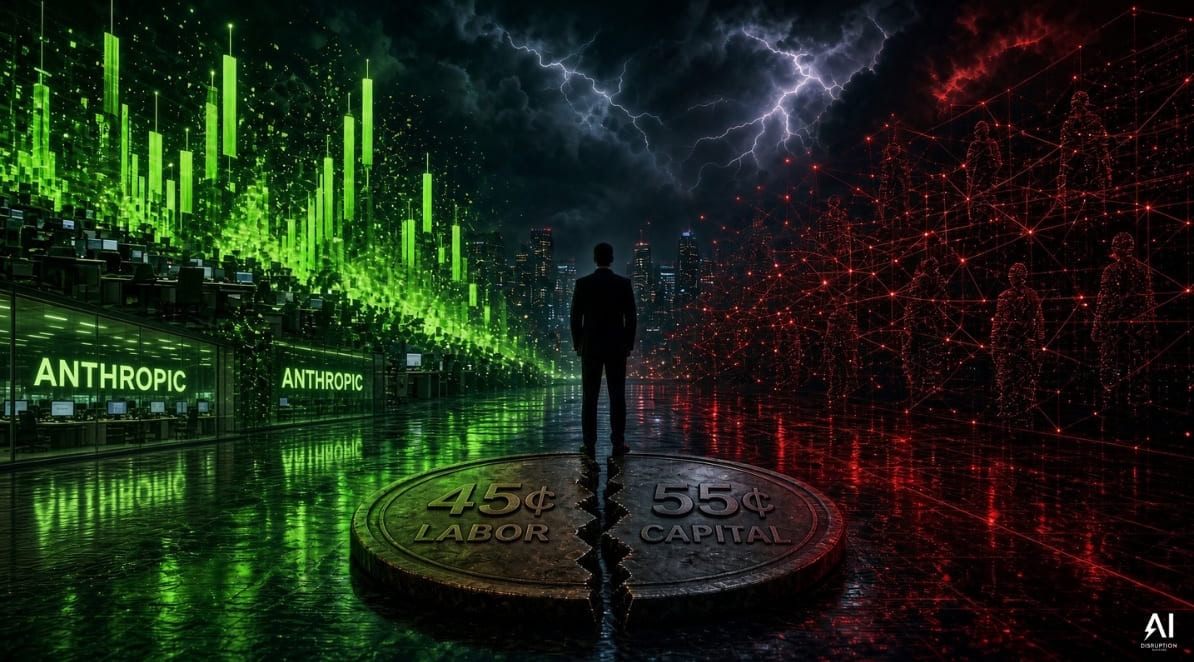
In the current economy, 60 cents of every dollar goes to those who work, while 40 cents goes to those who own. In Anthropic’s extreme scenario, the worker’s share drops to 45.2%, while the owner or investor’s share climbs to 54.8%. That is 15% of GDP moving off payrolls and onto balance sheets inside four years.
Anthropic’s own authors note that the gains are nearly three times what knowledge workers lose, so in theory everyone could be made whole. The transfer required would run to roughly 9% of GDP, about the size of Social Security and Medicare combined. They also note, drily, that transfers on that scale have no precedent and historically do not happen on their own.
While that’s a bleak prognostication for those in the world who rely on a weekly paycheck to live, it’s a pretty attractive sales pitch to potential investors looking at a company set to go public within weeks.
Invest Now
Therein lies the rub. Anthropic and its essay-writing CEO are worried about AI models that train themselves, take over, and cause irreparable damage to the world. Meanwhile they are telling investors that their AI will train itself, take over, and do irreparable damage to some people’s world. Invest now.
Read the two documents side by side and they tell one story. The extreme scenario is the one where AI builds its own successors. It is also the one where labor’s share of every dollar falls to 45 cents and capital income runs 81% above trend. Amodei says that world frightens him. His bankers say it is worth $2 trillion. Both messages left the same building in the same week, addressed to two different audiences.
Investors get to decide which version they believe sometime in October. Knowledge workers find out over the next four years, whether they were asked or not.
Author: Matt Collison
The editorial team at #DisruptionBanking has taken all precautions to ensure that no persons or organizations have been adversely affected or offered any sort of financial advice in this article. This article is most definitely not financial advice.