The Financial Times published the investigation this morning. A Swiss trading arm of Poland’s state energy group Orlen tried to buy cheap Venezuelan crude in late 2023. The money left the banking system. The oil mostly did not.
That is the story. Not another Warsaw political row. A listed European commodity desk used Tether as a correspondent bank, handed USDT over in Caracas hotels, and wrote off more than $400 million.
The contract that should never have been signed
On 29 November 2023, Orlen Trading Switzerland signed for about six million barrels of Merey 16 with Dubai intermediary Hannon International. Face value: roughly $345 million.
Within five days OTS wired $230 million to Hannon. There was no collateral, and no parent guarantee. Importantly, there was no prior relationship. A further $100 million went to another Dubai name, Horizon Global.
Reuters reported the wires in May 2024. PDVSA, Venezuela’s state oil company, said it never saw the money. The tankers still showed up.
Why the cash became Tether
US sanctions had pushed PDVSA off ordinary dollar rails. Buyers who wanted Venezuelan barrels in that window were told to pay in USDT – Tether’s stablecoin. Disruption Banking has covered that shift before, including how crypto became a working currency in Venezuela after the bolivar collapsed.
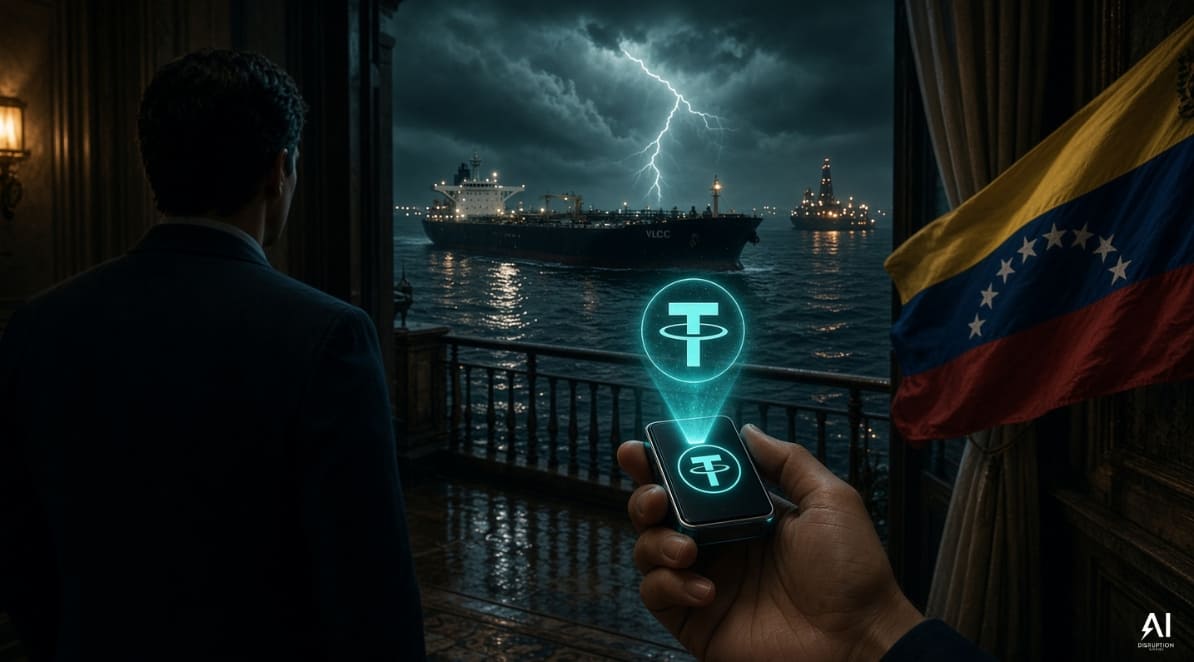
The OTS–Hannon contract, according to the FT, did not mention crypto. The cash still became USDT. Brokers then carried hardware wallets through Caracas restaurants and hotels. One handover the paper names: about $60 million in USDT at Hotel El Ávila on 5 January 2024.
Three chartered Very Large Crude Carriers (VLCCs) sat off the José terminal burning something like $600,000 a day in demurrage. Poland took a sliver of cargo, about $28.8 million. Orlen later booked a write-off of some PLN 1.6 billion.
Orlen itself put the $400 million hole on the record in April 2024.
The same token, two stories in one week
Last Thursday this site carried Tether’s other face. Tether and Fasanara Capital launched a $400 million private-credit fund to push USDT-linked lending into the real economy. Paolo Ardoino, CEO of Tether, said USD₮ was built to be money that works everywhere.
This morning’s FT piece is a different angle of the same mechanism. Sanctioned crude. Unsecured prepay. A 25-year-old Hong Kong trader operating out of Dubai. A European state champion that treated a stablecoin wallet like a letter of credit.
S&P has already given its opinion. In November it cut USDT’s stability assessment to 5 (weak), citing reserve mix and disclosure. The Orlen file is not a reserve story. It is a use-case story. When correspondent banks step back, USDT steps in. Sometimes the barrels arrive and sometimes they do not.
The Iran overlay
The same news cycle produced a second Tether-and-oil item. On 14 September the Southern District of New York sought forfeiture of $61.2 million USDT tied to alleged Iranian crude sales. Tether had already frozen the ten TRON wallets. Prosecutors want the tokens burned and replaced into an FBI wallet.
The two stories aren’t related. Venezuela 2023 was a Polish corporate-governance failure during a brief US licence window. The SDNY complaint is a sanctions-enforcement action against alleged IRGC-linked oil proceeds. The common rail is the point. USDT is now the settlement layer both for a Warsaw-listed energy group and for the trades Washington is trying to seize.
The correspondent bank that isn’t a bank
The dollars left a Swiss trading account as a bank wire. They arrived in Caracas as Tether on a hardware wallet. That is what happens when the correspondent bank is closed and the cargo still has to be paid for. It is a payments story before it is an energy story.
The question that is left
Warsaw prosecutors opened a file after the 2024 write-off. Three former Orlen managers were charged in August over the failed cargoes. Daniel Obajtek, who ran the group when OTS signed the Hannon contract, is no longer CEO. The new board disclosed the loss.
Why did a Swiss commodity subsidiary of an EU state champion send $230 million, unsecured, to names it had never used, then allow that cash to leave the banking system as Tether on a pendrive?
The FT has the details. The balance sheet has the loss. The rail is unchanged. When the correspondent bank is closed, someone still gets paid. In this case it was not PDVSA, and it was not Orlen’s shareholders.
Author: Andy Samu
The editorial team at #DisruptionBanking has taken all precautions to ensure that no persons or organisations have been adversely affected or offered any sort of financial advice in this article.
See also:
Tether and Fasanara Capital Launch $400 Million Private Credit Fund
From Market Crash to Crypto Boom: Venezuela’s Digital Currency Revolution