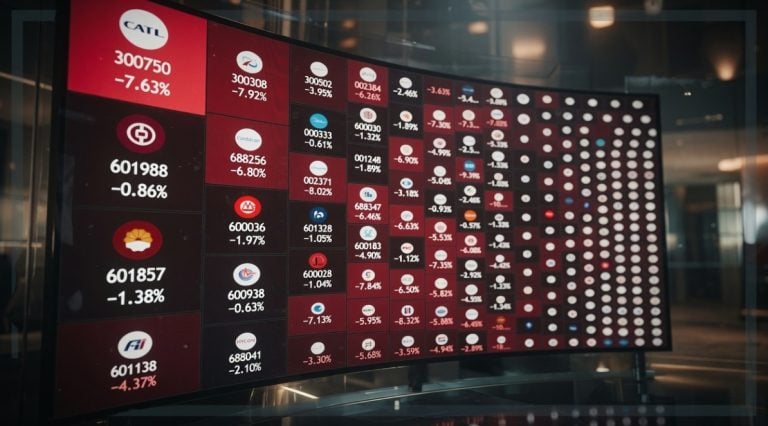


China is putting $54 billion into eight state-owned banks and insurers. The Ministry of Finance is leading the injection. The banks were always going to be in the room. The insurers were not. That is the story.
Eight institutions are taking 360 billion yuan (about $54 billion) in fresh capital. Agricultural Bank of China wants up to 160 billion yuan. ICBC wants up to 100 billion. Export-Import Bank of China, Sinosure, China Life, People’s Insurance Company of China (PICC), China Taiping and China Re make up the rest. The finance ministry is putting in 300 billion yuan through special bonds. China National Tobacco and its subsidiaries are covering the balance.
Xinhua, China’s official state news agency, said the money will “enhance their sound operating capabilities, risk resistance capabilities, and ability to serve the real economy.” That is the official line. But it is not the interesting part.
Who Gets the Money?
Beijing has already recapitalized the big state banks. Last year’s package was about 520 billion yuan. This $54 billion package is smaller, and it is no longer only a bank story. Insurers are in it. Policy lenders are in it. Analysts told the South China Morning Post the recapitalization drive that began with the banks has now been widened to insurers and other financial institutions. It is also the first time Beijing has used special treasury bonds to recapitalize insurers.
That tells you where the stress has moved.
Low rates have compressed bank net interest margins. The same rates have eaten insurer investment returns. Property is still a multi-year drag. Domestic demand is weak. Official GDP grew 4.3% in the second quarter, below the target range Beijing itself cut to 4.5%–5% in March, the lowest growth goal since 1991. Trade tension with the West has not gone away. President Xi has spent years saying financial stability is national security.
The banks get more core capital. The insurers get improved solvency. Exim and Sinosure, the policy bank and export-credit insurer that finance Chinese trade, get 30 billion yuan and 10 billion yuan. That is the export-finance balance sheet being restocked, not a commercial-bank recap.
In theory the extra capital lets them lend more and hold more risk. In practice the constraint has not been the size of the buffer. It has been the borrower.
Raymond Yeung, chief Greater China economist at ANZ, the Australian bank, told the South China Morning Post the injection is aimed at safeguarding financial stability, “particularly amid persistent concerns over banks’ non-performing loans.”
Other desks said the same thing in different words. Capital stops a solvency scare. It does not create a borrower. If households will not take credit and private firms will not invest, a stronger capital ratio is just a stronger capital ratio.
Why Are Insurers Included?
There is a second, quieter use for the insurance money. State insurers have been told to put medium- and long-term funds into the stock market. Solvency rules had started to get in the way. Recapitalize the insurer and the mandate becomes easier to obey. It is not a growth plan. It is a market-support plan dressed up in a capital-adequacy jacket.
So, the $54 billion China is putting into state banks and insurers is real, and it is also a tell. Beijing is not pretending the problem lives in one corner of the system. Banks, insurers and policy lenders are being treated as one state balance sheet that needs topping up before the next shock. Tobacco cash sitting next to finance-ministry bonds is the clearest version of that idea you will get in a filing.
What the $54 billion does not answer is the question desks will ask anyway. If the real economy does not want the loan, who is this capital for?
Author: Andy Samu
The editorial team at #DisruptionBanking has taken all precautions to ensure that no persons or organizations have been adversely affected or offered any sort of financial advice in this article. This article is most definitely not financial advice.
See Also:
Wealthy China Investors Rattled as Quant Hedge Fund Losses Top 20% | Disruption Banking
China’s export shield is starting to weaken as domestic slowdown deepens | Disruption Banking

Andrew Samu
Andrew Samu, Editor-at-Large at Disruption Banking, shapes the publication’s global coverage of banking, capital markets and digital assets. Based at London’s Level39, he combines market analysis with a strong commercial perspective, informed in part by his role as Commercial Director at Verita HR.