In November 2020 the Journal of Risk and Financial Management published a paper on obligation-clearing, the practice of setting off what firms owe each other so that only the difference is paid.
The authors of the paper took a real set of invoices from Sardinia, 138,000 transactions between 3,199 firms, worth more than €31 million, and ran them through software to see what would have happened if the debts had been set off. On that test, the gross internal debt of that network fell by about a quarter. No money moved. The authors were Tomaž Fleischman, Paolo Dini and Giuseppe Littera.
In May 2026 an article about how trade credit could deepen settlement liquidity was published in the World Federation of Exchanges focus newsletter. The authors were Tomaž Fleischman and Ethan Buchman of Cycles Protocol SA. They argued that clearing has made markets safer, but that settlement liquidity has not kept pace. They say that trade credit is still a private invoice between two firms, and that it cannot be used to settle anything else. The authors point to how exchanges, central counterparties (CCPs) and central securities depositories (CSDs) know how to make obligations standard, verified, legally final and operable at scale. They suggest that if those principles are applied to verified trade credit then a sizeable share of these obligations can become usable for settlement.
These types of trade-credit clearing arrangements already exist in Slovenia and Spain. Slovenia’s has been going since 1991. Cycles is trying to do the same thing without a national system in the middle.
That is the problem Ethan Buchman says he is trying to solve. He built a system for moving assets. He is now working on the liabilities that need to be settled.
Liabilities should be settled, not tokenized
Buchman co-founded Cosmos with Jae Kwon. His 2016 master’s thesis at the University of Guelph, Tendermint: Byzantine Fault Tolerance in the Age of Blockchains, set out the consensus method he and Kwon used to build it. Cosmos was built so assets move between chains. He now says that was only half the balance sheet.
“We were focused on assets and moving assets around,” Buchman shared with Disruption Banking in an online meeting. “There’s a whole other side of the balance sheet, which are the liabilities, and nobody’s talking about the liabilities.”
Tokenizing a debt and passing it around is, on his account, the wrong move. “What you want to do with liabilities is settle them. That’s the point of a liability. You owe me. Are you going to pay me?”
The white paper, Cycles Protocol: A Peer-to-Peer Electronic Clearing System, starts from invoices. Accounts payable, typically 30, 60 or 90 days, are interest-free until they are late.
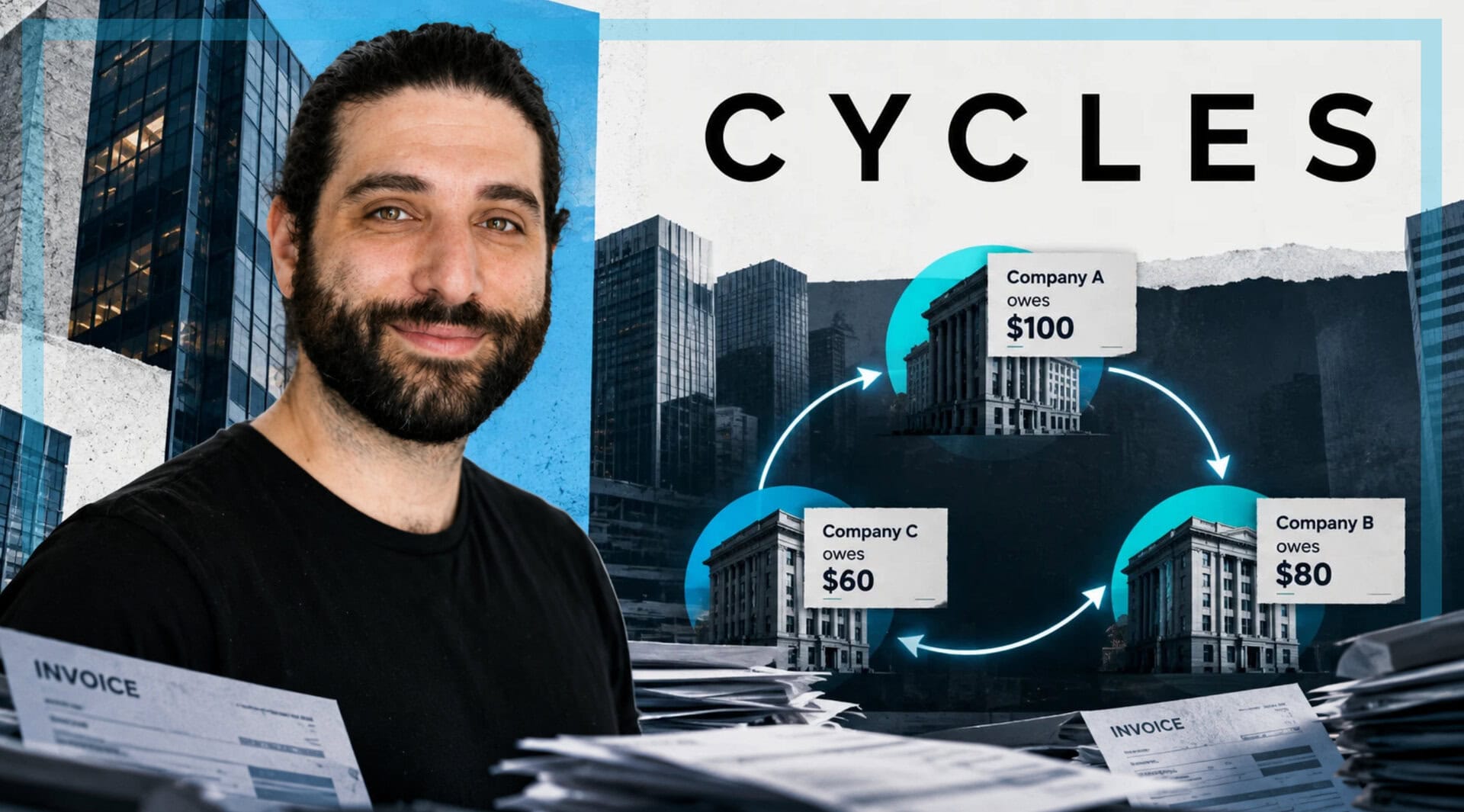
The claim is that liquidity sits in loops. If A owes B, B owes C and C owes A, part of all three debts can come off without cash moving and without a new firm stepping into the middle. Say a firm owes $100, the next firm owes a third firm $80, and that firm owes the first $60. Sixty dollars comes off each debt. The first still owes $40. The second still owes $20. The third is clear.
A clearing house, in the form DTCC and LCH (the London clearing house) run, becomes the buyer to every seller, and seller to every buyer. It underwrites the member. “The main function of a clearing house isn’t actually to net out debts,” Buchman said. “It’s to underwrite everyone’s risk.” Cycles is different. “We don’t mutate the risk, and we don’t mutualize the risk. We leave all the risk exactly how it was.” If a firm misses Friday, Cycles does not pay the other side. The saving is the amount that no longer has to move. The residual is still paid on the rails the two firms already use. Settle, in Buchman’s terminology, means the bill is finally paid. It does not mean the cash move disappears.
DTCC’s capital and liquidity page shows what this process can look like inside the club. Setting equities trades off against each other cuts the payment obligation by 98.6 percent on average. The same practice at its bond clearer, the FICC (Fixed Income Clearing Corporation), has freed $1.2 trillion of balance-sheet capacity. FICC is the DTCC subsidiary that stands between firms in the US government-bond and mortgage-bond markets, so each member settles with FICC rather than with every other firm it has traded with.
The group processes $4.7 quadrillion of securities in 2025. The netting figures above are as of the second quarter of 2026. Those savings are for members. A supplier with a 60-day invoice is not in that club, and pays the gross.
What Slovenia already clears, without a new clearing house
Fleischman and Buchman argue that multilateral set-off can extinguish closed chains of obligations across more than one clearing silo, without novation and without mutualizing the loss. Legal finality, they say, can sit on ordinary set-off law, which is why the Slovenian arrangements already exist. Buchman calls the public one a system that clears a slice of the country’s output every year. There is also a private circuit in Slovenia, and a Spanish system that takes in unpaid invoices a finance firm has already bought. Cycles wants the same set-off without a national office in the middle.
The protocol paper is more specific about the obligations. Two balance sheets, assets and liabilities on each, give four ways to settle one debt. Scale that to many firms and the debts are a graph. The software looks for loops, proves the loop without publishing who trades with whom, and writes the set-off down.
Cycles Pay is the company’s invoice product. A European firm that already handles other companies’ invoices has started integrating the API, with a rollout hoped for in the first quarter. Buchman says a few hundred firms is enough to see whether the loops are there. Cycles Prime is the other service. Crypto trading firms that deal on credit and settle once a day, with no clearing house, pay the gross. Lynq and FalconX are the named pilot partners. In May Cycles raised $6.4 million from investors, taking the total to $8.7 million.
From Cosmos to Arc
The chain behind Cycles has already changed. Cycles Pay sat in a public beta on Neutron. On June 17 the company said the clearing network, Pay and Prime were moving to Arc, the layer Circle has built for payments and foreign exchange, with fees in a stablecoin. Arc’s public mainnet went live on September 16, with USDC native and a validator set that includes DTCC, BlackRock, ICE, Mastercard and Visa. Buchman treats that as a distribution opportunity and not as a change in the clearing process. “It’s on robust infrastructure, supported by Circle and USDC issuance.”
Ethan spent a decade at Cosmos on assets. The next one, he said, is for liabilities. His letter to the Cosmos community said he would keep contributing there, and put the work to use at Cycles.
An upstanding Canadian gentleman
The mission statement of Cycles is not just the white paper. It is a refusal to propose a revolution, delivered with a straight face and a Victorian handbook.
Lombard Street is the book that many central bankers quote. Bagehot says lend freely, at a high rate, to solvent houses, against good collateral. He also says the system is unnatural, that a natural one would have every bank keep its own reserve, and that he will not sit in front of an English public and propose the end of the Bank of England.
Instead, Ethan explained what he would do: “I sit in front of you as an upstanding Canadian gentleman that’s not about to propose a revolution that will overthrow the central banks. However, I would like to provide a graceful means for them to transition.”
The Battle of Bretton Woods is the other book he used. Keynes wanted a clearing union that would balance the international payments graph. The American answer was the dollar. Buchman calls the first fundamentally correct and the second the system that followed. He is not asking a treasurer to go back to the 1940s. He is arguing that the same record, who owes whom, can now be set off between firms on the invoices they already hold, not only between countries.
Cycles is not a Basel replacement, it is a piece of technology. Buchman does not need the large banks to start it. “We can do this just with the firms themselves. The banks can come later when it makes sense for them.”
The line he used for the smaller institutions was “arm the rebels.” The large banks are not going away. A smaller firm that can free cash without them is the point.
How it gets paid for
Clearing, on Buchman’s numbers, is not where the profit lies for Cycles. An annual subscription, and a fraction of a basis point on what is cleared, is there to cover the cost of what the company is offering. A market maker’s spread, in single digit basis points, is not, Buchman highlighted, a place to take a large fee. The revenue he wants later is credit: originating working-capital loans into a graph where some of the debt has already been set off, and taking a piece of an interest rate rather than a piece of a basis point. “A clearing house is just there to settle obligations and have everyone go home peacefully. We’re putting that kind of risk infrastructure in place. The opportunity is getting into credit.”
Buchman locates the method further back than the clearing house. Netting, setting off what firms owe each other so only the difference is paid, is what the Medici and the other Italian banking houses did between branches and between cities by letter, so physical money did not have to move. A graph is the modern way of seeing the same thing: each firm a point, each invoice a line. Slovenia has run a national version since 1991. Cycles is making the argument that the same netting can be done without a national office in the middle, beside the system rather than against it. The method is old. What is new is a firm that already handles other companies’ invoices running it, rather than a city or a clearing house.
The invoice work is already under way. Lynq and FalconX are in the Prime pilot, about 20 businesses have sent invoices on Pay. Buchman may have a large audience in blockchain, but what he is doing today is of much more interest to a clearing-house audience.
See Also:
Why Did Goldman Put a $100 Billion Treasury Fund on Lynq Without a Token? | Disruption Banking