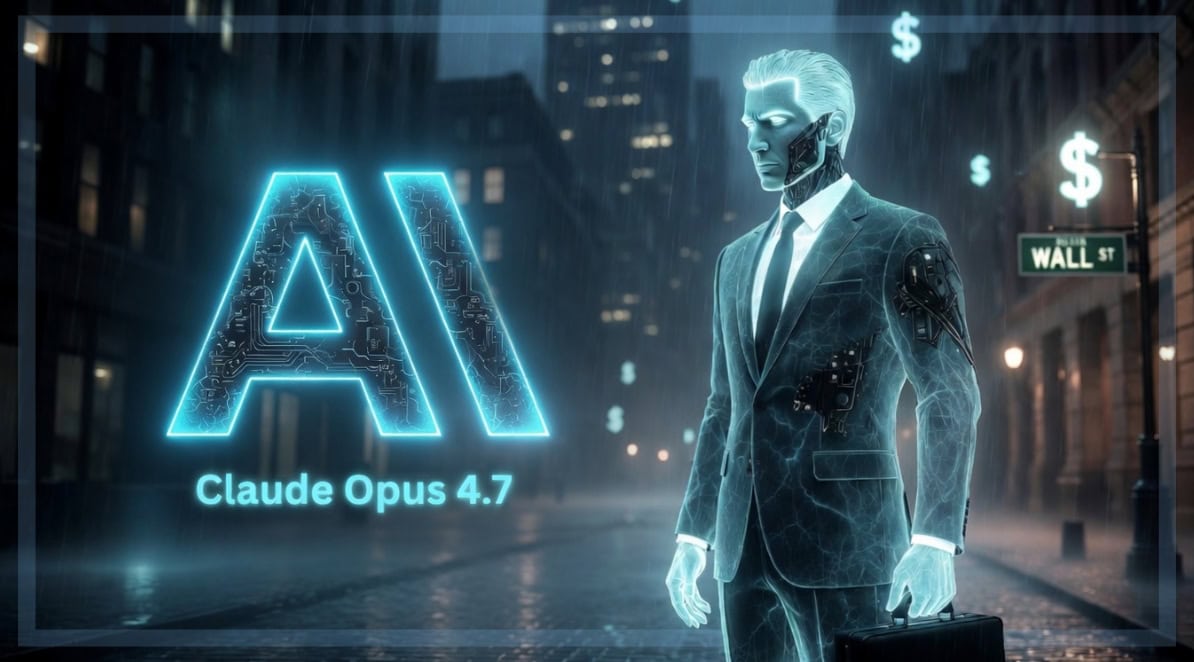
Anthropic is expanding its reach into financial services. The company is rolling out a suite of pre-built AI agents tailored for the world’s largest banks and introducing Claude Opus 4.7, its most powerful model yet for financial workloads. This latest move signals Anthropic’s serious ambition to bring its AI agents deep into Wall Street operations.
The announcement was unveiled on Tuesday at the company’s exclusive invite-only financial services briefing in New York. They make one thing clear: Anthropic isn’t simply selling artificial intelligence (AI) tools to banks. It’s constructing the infrastructure, deployment systems, and high-level relationships needed to become the foundational operating layer for Wall Street.
The company is now increasingly competing with rival OpenAI to show that its technology can handle a wide array of high-value tasks beyond coding, particularly in finance, as both startups seek to expand revenue and strengthen their businesses ahead of expected initial public offerings.
How Anthropic’s Back-Office AI Agents Could Replace Junior Roles
Anthropic has split its new AI agents into two practical categories that mirror real financial workflows: Research and Client Coverage, and Finance and Operations. These agents are not just chatbots. They are designed to handle the repetitive, time-consuming work that junior analysts, associates, and operations staff usually do.
In the Research and Client Coverage category, the Pitch Builder instantly creates target lists, runs comparable analyses, and assembles complete pitchbooks. The Meeting Preparer pulls together detailed client and counterparty briefings in minutes. The Earnings Reviewer reads earnings transcripts and regulatory filings, updates financial models, and highlights material developments. The Model Builder constructs and maintains complex financial models by pulling data from multiple sources. And the Market Researcher monitors sector trends, synthesises news flow, and flags items that need deeper credit or risk review.
On the Finance and Operations side, the Valuation Reviewer cross-checks valuations against market comparables and internal guidelines. The General Ledger Reconciler manages account reconciliations and net asset value calculations. The Month-End Closer follows close checklists, prepares journal entries, and produces required reports. The Statement Auditor reviews financial statements for accuracy and audit readiness. Finally, the KYC Screener compiles entity documentation, examines source materials, and prepares packages for compliance escalation.
Each agent comes equipped with domain-specific instructions, secure integrations with platforms such as FactSet, S&P Capital IQ, and Moody’s, plus sub-agents that break down complex, multi-step processes. Banks and insurers can customise them to fit their own policies, modeling conventions, and approval chains.
The outcome is clear: tasks that once took junior and mid-level staff hours or days can now be completed in minutes with greater consistency and fewer errors.
New for financial services: ready-to-run Claude agent templates for building pitches, conducting valuation reviews, closing the books at month-end, and more.
— Claude (@claudeai) May 5, 2026
Install them as plugins in Cowork and Claude Code, or use our cookbooks to run them in production as Managed Agents. pic.twitter.com/Nzj4Feaaz2
How Do Anthropic’s AI Agents Integrate with Existing Tools?
The agents are engineered for fast adoption inside existing technology stacks. They function as plugins inside Claude for Microsoft 365, operating directly within Excel, PowerPoint and Word. A new Claude for Excel add-in builds models from filings, audits formulas and runs sensitivity analyses with limited manual intervention. For broader deployment, the agents provide templates for Claude Managed Agents, which support long-running tasks, detailed permission settings, credential vaults and complete audit trails.
A new Moody’s integration supplies proprietary credit ratings and data on more than 600 million companies, while other connectors feed real-time fundamentals and industry research directly into Claude’s analysis. All outputs remain subject to human review and approval before distribution to clients or regulators.
Anthropic’s Chief Commercial Officer Paul Smith outlined onstage what the company calls a “staircase of autonomy,” describing a progression in which AI systems in finance will advance from basic research support to performing fully autonomous work at the level of a senior analyst, much as they have already done in software engineering.
How Leading Banks and Financial Firms Are Using AI Agents
Several institutions have already begun deploying the technology. Fidelity National Information Services (FIS), a major provider of banking and payments technology, is using Anthropic’s agents to speed up anti-money laundering reviews, with further agents planned for credit decisions and fraud detection. Private-equity firm Carlyle has also applied Claude across investment analysis, operations and portfolio oversight.
The early results suggest the agents are less about replacing analysts than enabling them to shift time from routine processing to higher-value work such as strategy and client relationships.
Financial services place a premium on governance, data security and clarity. Anthropic has leaned on its constitutional AI framework, comprehensive logging and mandatory human approval loops to meet those expectations. While regulatory and privacy challenges persist, the packaged agents offer a relatively low-friction route for institutions to test and scale AI applications.
At the same event, JPMorgan Chase CEO Jamie Dimon highlighted the bank’s deep commitment to AI, noting that the institution has a dedicated department focused on the technology.
“We have a lot of people deployed doing it, hundreds of use cases across risk, fraud, marketing, design, note-taking, document review, and it’s just starting,” Dimon said.
With competitive pressures intensifying, banks and insurers that move quickly could secure advantages in efficiency, client responsiveness and risk control. The technical foundation is now in place. The next test will be how readily financial firms weave these specialised AI agents into their daily operations.
Author: Ruben McCarthy
See Also:
Can Anthropic’s Mythos Hack Europe’s Banks? | Disruption Banking
Anthropic’s Mythos Reaches British Banks | Disruption Banking