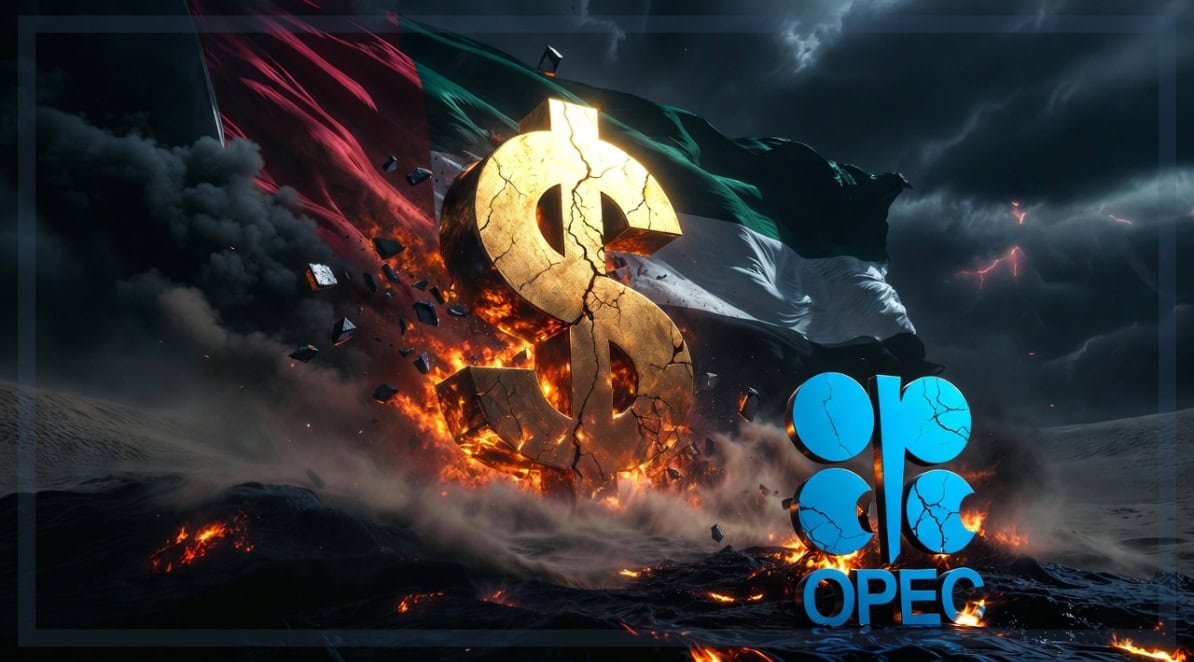
The United Arab Emirates (UAE) delivered a major shock to global energy markets on today, announcing its departure from both OPEC and OPEC+ effective May 1. As the cartel’s third-largest producer, the UAE’s exit marks the biggest defection in OPEC history and severely weakens coordinated production controls at a critical time.
The decision comes just days after UAE Central Bank Governor Khaled Mohamed Balama held high-level talks in Washington with US Treasury Secretary Scott Bessent and Federal Reserve officials. Discussions centered on securing a potential dollar swap line, reportedly around $20 billion, to provide liquidity support amid the Iran conflict and ongoing Strait of Hormuz disruptions.
OPEC Exit Accelerates Petrodollar Decline
Abu Dhabi framed the exit as a strategic move aligned with its long-term economic vision. Free from quotas, the UAE can now ramp up production toward its 4.5-5 million barrels per day capacity and accelerate domestic energy investments.
While immediate supply increases are limited by Hormuz tensions, analysts expect eventual market flooding once routes stabilize, potentially easing prices after Brent crude surged above $110 per barrel.
This timing highlights complex petrodollar dynamics. While the UAE seeks US dollar backstops through swap lines to reinforce financial stability, its OPEC exit loosens traditional cartel and implicit dollar-oil linkages. It opens greater flexibility for alternative currency settlements in energy trade.
China’s CIPS payment system continues breaking records, with a single-day volume of 1.22 trillion yuan ($178.5 billion) in March 2026, fueled by rising yuan-denominated energy deals. The dollar’s share of global reserves has fallen to around 57 percent from a 72 percent peak.
For global banks, investors, and energy financiers, the UAE’s bold independence signals accelerating fragmentation. Markets now face more flexible oil supply, continued de-dollarization momentum, and the need to prepare for a multipolar energy-finance landscape. Gulf producers are balancing longstanding US alliances with greater strategic autonomy in a volatile world.
Author: Ruben McCarthy
The editorial team at #DisruptionBanking has taken all precautions to ensure that no persons or organizations have been adversely affected or offered any sort of financial advice in this article. This article is most definitely not financial advice.