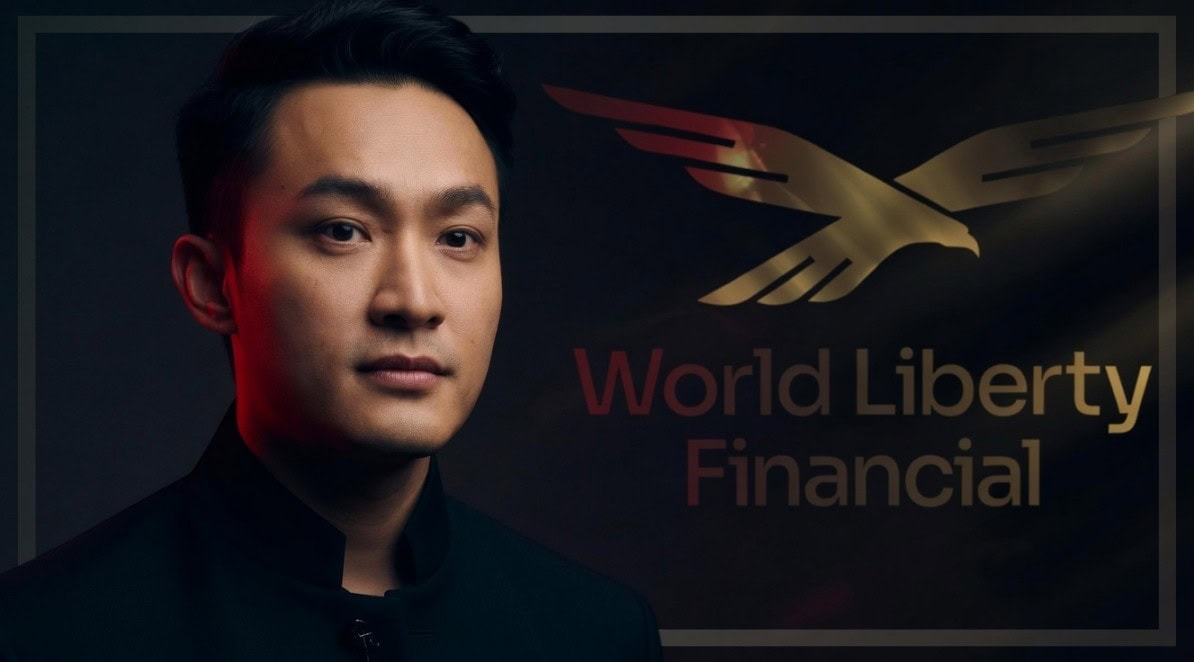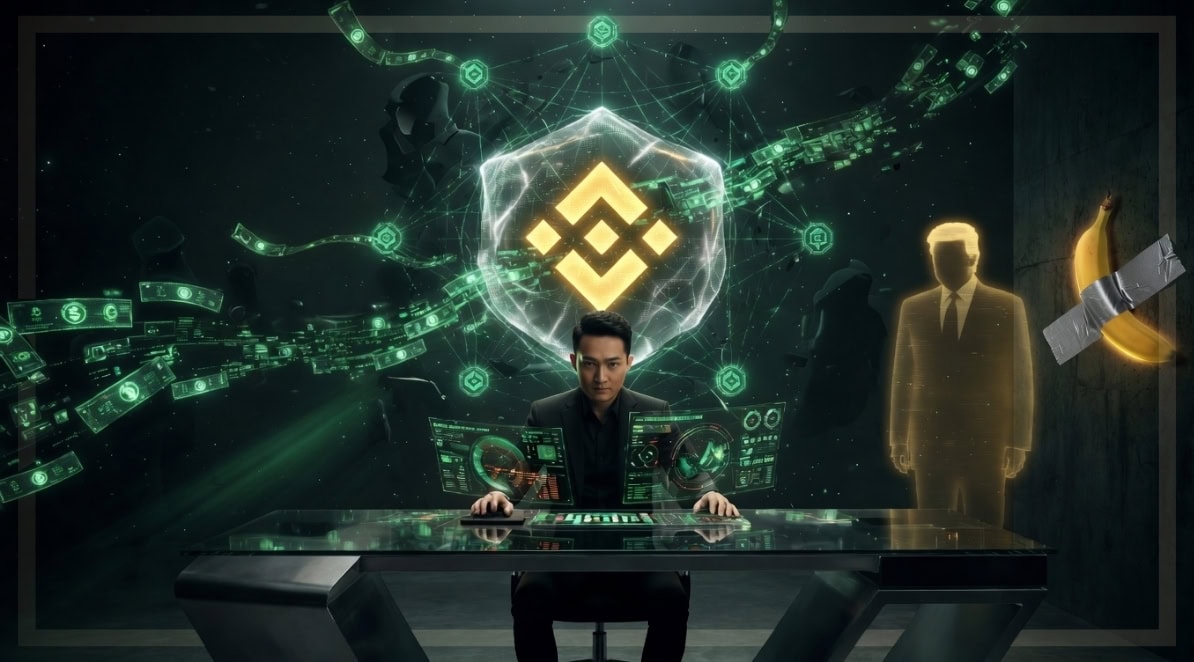
On April 22, 2026, Tron founder Justin Sun filed a federal lawsuit against World Liberty Financial (WLFI), the crypto venture co-founded by President Donald Trump and his sons. In the $1B Banana Feud, Sun alleges that the project illegally froze $1 billion worth of his tokens, threatened to burn them, and tried to shake him down for another $200 million. Sun had originally invested $45 million in WLFI and was named an adviser.
The Trump family’s response? Eric Trump posted a sarcastic dig about a banana duct-taped to a wall. WLFI co-founder Zach Witkoff accused Sun of “misconduct” but declined to specify what that meant.
It’s a spectacular falling-out. But to understand why any of it happened, you have to start at a leadership shuffle inside Binance that most people treated as routine.
Billionaire crypto entrepreneur Justin Sun has filed a lawsuit against World Liberty Financial, alleging the firm engaged in an illegal scheme to seize his WLFI tokens. pic.twitter.com/GG5vTphJ6l
— Firstpost (@firstpost) April 23, 2026
Richard Teng’s Title Change: What It Actually Signals
In December 2025, Binance announced that Yi He, co-founder of the exchange and Changpeng Zhao’s (CZ) longtime life partner, would join Richard Teng as co-CEO. The press release used words like “complementary perspectives“ and “natural progression.” What it did not say was that Teng, the former financial regulator who became the sole CEO after CZ’s 2023 guilty plea, was no longer the only person in charge.
Teng had been useful. His background, thirteen years at the Monetary Authority of Singapore, then Chief Regulatory Officer of the Singapore Exchange, and finally CEO of Abu Dhabi’s ADGM regulator, gave Binance exactly the kind of credentialed face it needed while navigating U.S. enforcement actions, $4.3 billion in DOJ penalties, and years of regulatory suspicion. He guided the firm through the removal of CZ as CEO and kept the platform operational while much of the institutional crypto world held its breath. Then CZ was pardoned, and Yi He stepped up.
The division of labor is not subtle. Teng handles the regulatory side: filings, licenses, compliance. Yi He handles product, user growth, and strategic investments.
According to the Wall Street Journal, she holds at least 10% of a Cayman Islands holding company associated with Binance and has long exercised broad influence over the firm’s marketing and investment operations, mostly out of public view. Her appointment makes official what was already true in practice, and it arrives in a very specific political moment.
Trump Pardoned CZ, and the Timing Was Not Accidental
On October 23, 2025, President Trump pardoned CZ, who had pleaded guilty to enabling money laundering, served four months, and paid $50 million in personal fines as part of the broader $4.3 billion Binance settlement. The pardon came after Binance retained a lobbyist connected to Donald Trump Jr. and spent $450,000 in a single month lobbying the White House and Treasury Department. When asked why he pardoned CZ, Trump said, “I don’t know, he was recommended by a lot of people.” He also said he had no idea who CZ was.
The backdrop here matters.
Bloomberg reported that Binance helped write the foundational code for USD1, World Liberty Financial’s stablecoin, and that this stablecoin was later used by UAE investment firm MGX to complete a $2 billion investment in Binance. That arrangement could channel millions annually in interest income directly to the Trump family. The pardon came less than six months later. Senator Elizabeth Warren called it “corruption.”
CZ is pardoned, Yi He is now co-CEO, and the exchange that was previously under a federal monitor is now seeking, with apparent confidence in the current administration, to have that monitor removed.
Justin Sun’s Fortune: The Question the Market Has Always Avoided
Kyle Doops, a YouTube trading analyst, put it bluntly during a recent live session: “How does Justin Sun have so much money?” He called it a potential conspiracy. He wasn’t the first to ask.
Sun settled a 2023 SEC lawsuit in March 2026 for $10 million. The original charges alleged that he orchestrated more than 600,000 TRX wash trades across accounts he controlled, generating $31 million from illegal, unregistered token sales and paying celebrities, including Soulja Boy, to promote his coins without disclosing they were being paid.
The bulk of Sun’s estimated net worth stems from his outsized personal holdings of TRX, the token issued by his own Tron blockchain, of which he reportedly owns roughly 63% of the supply. He also holds approximately 17,000 Bitcoin and significant ETH and USDT positions, along with a reported 90% ownership stake in HTX (formerly Huobi), which he has publicly denied while calling himself merely an “adviser.”
Analysts at Protos have previously raised concerns about whether HTX double-counts reserves tied to other Sun-affiliated entities. None of these concerns has been independently resolved.
In February 2026, a woman who identified herself as a former girlfriend publicly alleged that Sun used multiple Binance accounts registered in employees’ names to coordinate buying pressure before dumping TRX on retail investors. She stated she is willing to cooperate with U.S. authorities and has preserved evidence. Sun’s response on X: “Ignore the FUD and keep building & holding.” No elaboration.
That scrutiny now extends to the network he built. On April 23, 2026, the same week Sun filed his WLFI lawsuit, Tether confirmed that it had frozen $344 million in USDT across two Tron wallets in coordination with OFAC and U.S. law enforcement, in what appears to be the largest single enforcement action in Tether’s history.
The wallets, holding roughly $213 million and $131 million respectively, were flagged for suspected sanctions evasion and criminal activity. Tether has not named the wallet operators, and the freeze is not attributed to Sun. But the action lands squarely on the blockchain he controls, and Tron network activity dropped sharply in its wake. For a founder already fighting a federal lawsuit and a newly settled SEC fraud case, the timing is hard to ignore.
Tether froze two Tron wallets holding $344 MILLION in USDT.
— Jeremy (@Jeremybtc) April 23, 2026
> One wallet held $212.9 MILLION. The other $131.3 MILLION. Both completely locked.
> The freeze was coordinated with OFAC and US law enforcement.
> Largest single Tether enforcement action ever.
> It happened two… pic.twitter.com/X8YxYVyWqA
Sun, CZ, and a Relationship Worth Watching
Sun has publicly described CZ as “my mentor and a close friend.” That warm framing resurfaced last April when the Wall Street Journal reported that CZ had agreed to provide evidence against Sun as part of his 2023 DOJ plea deal. Both men denied the story, calling it a “baseless hit piece.”
The Block reported that Binance was simultaneously in talks to list USD1, WLFI’s stablecoin, the same stablecoin Sun had been pressured to help mint in the months before the WLFI lawsuit erupted.
Sun and CZ’s relationship goes back to China’s 2017 ICO ban, when, according to The Verge, CZ tipped Sun off, allowing Tron to complete its $70 million ICO the day before the ban was announced. Sun then fled China. Binance went on to offer favorable early listings for TRX and Tron-based tokens. The two were seen vacationing together that same year, while CZ insisted publicly that it was purely a business trip.
The allegation, now embedded in Sun’s WLFI lawsuit, that World Liberty accused Sun of making prohibited transfers to HTX and Binance adds another wrinkle. Those are precisely the platforms where Sun has historically operated with the most flexibility.
Bybit lost $1.5B. KelpDAO Lost $292M. Why Not Binance or HTX?
North Korea’s Lazarus Group has become the dominant threat in crypto security.
In February 2025, the FBI confirmed it was responsible for the $1.5 billion Bybit heist, the largest single crypto theft ever recorded. On April 18, 2026, the group’s TraderTraitor subunit was attributed with the $292 million KelpDAO exploit. Earlier this month, the Solana-based Drift Protocol lost $285 million in what was described as a six-month intelligence operation. Chainalysis found that DPRK-linked actors stole $2.02 billion in crypto in 2025 alone, a 51% year-over-year increase.
The targets: Bybit, KelpDAO, Drift Protocol, WazirX, Atomic Wallet, Ronin Bridge, DMM Bitcoin. All targeted. All hit. Not Binance or HTX.
No credible public attribution of a major Lazarus attack on either platform exists. Security researchers point to a few technical reasons: centralized exchanges with deep cold-storage reserves and compliance infrastructure present a different kind of challenge than DeFi bridges with single points of failure.
But that explanation only goes so far. WazirX was also a centralized exchange. It lost $235 million in 2024, which was widely attributed to DPRK-linked actors.
Chainalysis and blockchain forensics firms have noted that North Korea uses a network of over-the-counter brokers to launder stolen funds and has historically used exchanges with lax KYC to move the money. Exchanges that operate in regulatory grey zones or have historically turned a blind eye to illicit transaction flows have come up repeatedly in enforcement actions against money laundering tied to state-sponsored actors.
Binance’s own $4.3 billion DOJ settlement included findings that Binance had processed transactions linked to sanctioned entities and criminal enterprises. It is worth asking whether any platform that has previously demonstrated tolerance for certain transaction flows might, knowingly or not, remain a more convenient conduit than a target.
No definitive evidence ties Binance or HTX to facilitating Lazarus laundering in 2025 or 2026. But the pattern of who gets hit, and who doesn’t, is a legitimate question for the industry.
The Network Holds For Now
Sun is currently in federal court fighting the Trump family. The SEC case that was stayed in February 2025, paused shortly after reports of Sun’s $45 million investment in WLFI, was later settled for $10 million in March 2026. Sun’s TRX is still trading, HTX is still operating, and Tron’s blockchain is still processing transactions.
Meanwhile, Binance has Teng as the compliance face and Yi He, CZ’s co-founder and life partner, back at the center of strategy. CZ is pardoned. His memoir went on sale on April 8, 2026. He has said he plans to donate 99% of his wealth. His net worth, according to Forbes as of March 2026, stands at $111.8 billion.
The question of whether any of this constitutes coordinated self-interest, political favor-trading, or simply successful navigation of a poorly regulated industry is one regulators have so far declined to press, at least in this administration. Democrats in Congress have.
In January 2026, Representatives Maxine Waters, Sean Casten, and Brad Sherman wrote to SEC Chairman Paul Atkins, questioning the pattern of paused cases involving Sun, Binance, Coinbase, and Kraken, warning of a “pay-to-play” dynamic tied to political donations.
Their letter has not resulted in new action. Whether the Sun-WLFI lawsuit cracks this network open or simply becomes one more dispute quietly settled in the shadows may tell us more about where crypto regulation is actually headed than any policy announcement from Washington.
Author: Ayanfe Fakunle
See Also:
What is the relationship between Tron Founder Justin Sun and Binance’s CZ? | Disruption Banking
Justin Sun, Donald Trump, and a Banana Walk into a Bar | Disruption Banking