

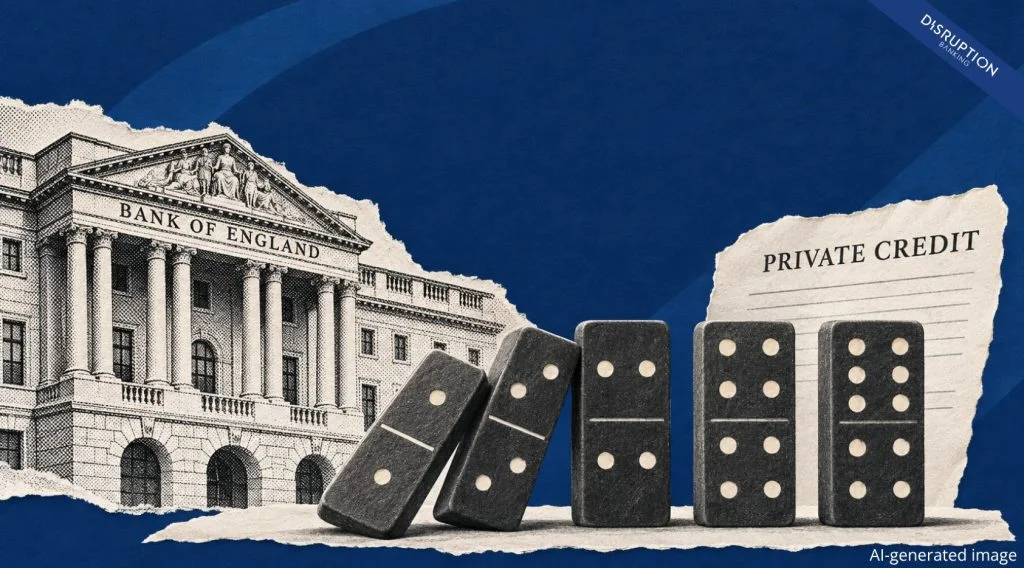
The Bank of England has launched the next phase of its system-wide exploratory scenario (SWES) on private markets.
On June 19, the BoE sent a survey to over 40 firms including major managers such as Apollo Global Management, Ares Management, Blackstone and KKR, asking how they would react to a “severe but plausible global downturn” in private credit.
The next phase of the test now aims to assess the resilience and interconnectedness of the market’s different players. It has been structured to examine how a shock to private markets would be transmitted across the wider financing landscape.
Andrew Bailey, the governor of the BoE and chair of the Financial Stability Board (FSB), said: “It may not move the system alone, but it could be one domino in a chain reaction. Shared exposures among banks, insurers and funds could amplify a shock.”
How Big is Private Credit in The UK?
Private markets have come to represent a significant portion of funding for businesses in the UK. The BoE estimated that 80% of the debt for private-equity-backed businesses in the UK comes from alternative lines of credit including private credit . These businesses make up 15% of total UK corporate debt and 10% of UK private sector employment.
According to the Financial Stability Board, over the past 5 years, private credit has grown at an annual rate of 17%. Assets under management in private markets have grown from $3 trillion to $11 trillion over the past 10 years.
Redemptions in Private Credit Causing Stress
The BoE wants to see how UK corporate lending would be affected if private markets were to take a dip. This comes as concerns grow over redemptions in private credit and investors withdraw from private markets.
The BoE highlighted increasing redemptions from private credit funds as a concern for the wider economy in its July 2026 financial stability report.
“Private markets are increasingly central in supporting corporates and providing funding for infrastructure, real assets, real estate and venture capital.” the BoE said. They have been able to provide stability by committing long-term capital but the bank warns that this can be “weakened by high leverage or redemptions.”
Concerns around underwriting standards and the industry’s exposure to software have caused many to pull out of private credit. Redemption requests in private credit funds, especially retail-oriented vehicles that offer frequent withdrawals, surged in 2025–26. These requests often exceeded the typical 5% quarterly caps (with some reaching 10–40%).
The BoE stated that increasing redemption requests underline “both liquidity mismatch and valuation uncertainty in private credit”. The BoE is concerned that the cap on withdrawals can create a ‘first-mover incentive’: where investors all look to be the first to pull their money out before they are unable to.
What Risks Have The BoE Identified in Private Credit?
The bank’s main concern is the provision of credit to UK businesses from private markets. This mainly encompasses private-equity backed businesses and the private credit funds lending to them.
The exercise will also look at alternative sources of funding for UK businesses such as leveraged loans, Collateralised Loan Obligations and high-yield bonds to assess whether they would absorb a shock to private markets or exacerbate it by spreading risk
In a speech at the IOSCO Conference, Bailey said the FSB has flagged valuation, leverage and liquidity uncertainty in private credit. He pointed to growing links between private-credit funds, banks and insurers as a cause for concern.
In his speech, Bailey said that a systemic risk “that is opaque, interconnected and poorly understood can become destabilising very quickly”.
He added that private credit is hard to assess but that “the absence of visible stress should not be mistaken for the absence of risk”. Bailey said that information gaps and growing interconnections could make private credit a stability risk sooner than size measures suggest.
The exercise has been testing whether banks and insurers that hold overlapping exposures would cut credit lines or raise margins once private-credit funds hit redemption gates. It is also looking at whether a secondary withdrawal would further tighten financing for the private-equity-backed companies that already account for 15% of UK corporate debt.
When Was The BoE’s Last “Stress Test”?
The BoE’s first SWES was published in 2024, examining the impact of an economic shock on public markets. The first of its kind globally, the test looked at how market-based financing such as overnight borrowing, public bonds and derivatives would react to an economic downturn.
This was brought on by the fire sale in gilts following the 2022 mini-budget and the ‘dash for cash’ at the onset of the pandemic when firms rapidly sold assets in order to build up their cash reserves. These exposed vulnerabilities which the BoE wanted to investigate.
The exercise led to several conclusions regarding financial stability that the bank aims to address. One of which was that “system-wide stress exercises have proved to be an effective tool for financial stability authorities to understand system-level vulnerabilities.” The BoE and the Financial Conduct Authority committed to investing more in these SWES and running further exercises.
When Will The Results Be published?
The BoE is expected to publish SWES interim findings this year and a final report in the first half of 2027.
It has committed to sharing its findings with other regulators, both in the UK and worldwide, to build a consensus on private credit and help regulators around the world understand the new role that private credit plays in the global economy.
Author: Scott Danaher
See Also:
Could the Collapse of Tricolor Trigger a Stock Market Crash? | Disruption Banking