
Today marks the fourth edition of the North American Blockchain Summit under its current name. The event began as the Texas Blockchain Summit in 2021 and 2022 before the rebrand. Every edition has taken place in the Dallas Fort Worth area. This year the gathering moved to the National Medal of Honor Museum in Arlington, Texas, where operators, investors, policymakers, and technologists met to discuss the power, capital, and policy supporting North America’s digital infrastructure.
Disruption Banking covered the 2023, 2024, and 2025 editions in person. We are back in Texas this year to report on the latest developments.
The day opened with a keynote from Major General Patrick Brady. That was followed by a session with Neil Hoyne of Google on what leading companies see ahead, and comments from Alana Garrett of Kalshi on the odds for tomorrow.
The North American Blockchain Summit is underway in Arlington, TX.
— Digital Startup (@digitalstartup5) November 18, 2026
The first panel of the day followed keynotes with Major General Patrick Brady, Neil Hoyne of Google and Alana Garrett of Kalshi.
Follow @DisruptionBank at #NABS2026 to find out more about What's Next for Digital… pic.twitter.com/vsaTgUiEnJ
Midterms and the Shape of the Incoming Congress
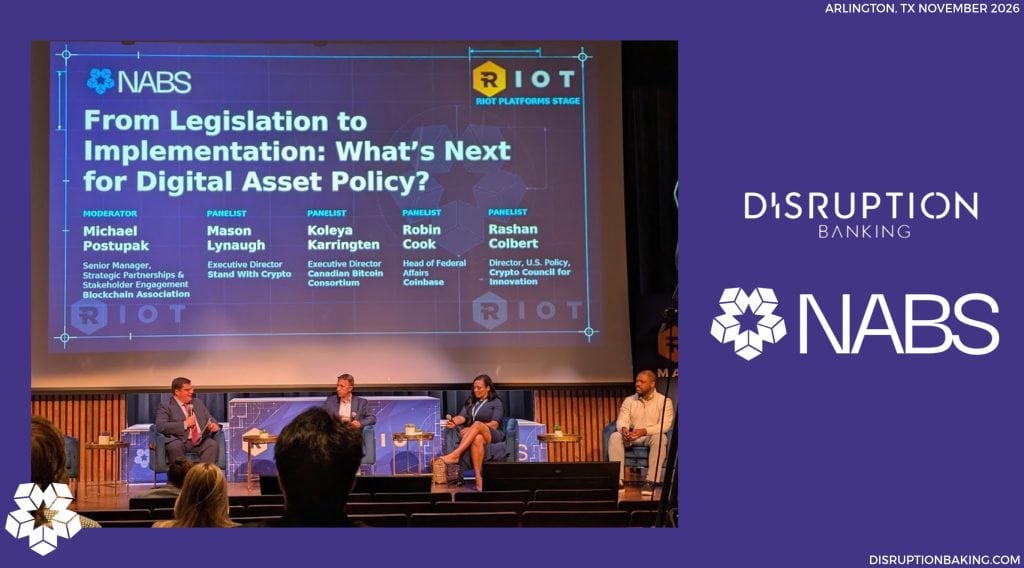
The first panel, moderated by Michael Postupak of the Blockchain Association, focused on the midterms and their effect on crypto. Robin Cook, Head of Federal Affairs at Coinbase, opened by noting that a number of Democrats are pro-crypto. He pointed to Texan Democrat James Talarico, who won a Senate seat and had voted for the Texas Strategic Bitcoin Reserve while serving in the state legislature in Austin.
Rashan Colbert, US Policy Director at the Crypto Council for Innovation, said the industry needs to update its education materials for a younger and more diverse incoming class of lawmakers. “We can’t really just use the same playbook and use the same messaging and materials,” he said. “We actually do have to make sure that we’re looking at who these people are.” He noted that earlier Democratic support for crypto bills in the House came disproportionately from younger members. Colbert added that Bitcoin is now 18 years old and that clearer use cases have emerged. “Perpetual futures, which I’ve worked with a lot, really found their traction within crypto,” he said. The same pattern held for prediction markets.
Everyday Use Cases and the Case for Implementation
Cook said voter frustration with existing systems creates an opening. “The voters sent a very loud and clear message that they want costs to go down, and that the existing system, is not working for them,” he said. He argued that products such as stablecoins and faster payments address those concerns directly. “Stablecoins actually really matter to everyday lives. It’s not just an abstract use case.”
He described Coinbase’s longer-term goal as blockchain technology that works in the background the way email protocols do today. “You’re interacting with blockchain technology multiple times every day, and aren’t even aware that you’re doing something with blockchain. You’re just doing something that works.”
Colbert described the same shift from the policy side. Working products are now intersecting with artificial intelligence and agentic finance. Educating new members of Congress means showing how these pieces fit together and how they affect constituents, rather than recycling the same materials used in prior sessions.
Canada, Energy, and the Pace of Regulation
Koleya Karringten, Executive Director of the Canadian Bitcoin Consortium, described how blockchain has moved from a standalone industry to something people use without understanding the underlying technology. She highlighted the gap between the pace of innovation and the pace of regulation. In Alberta, she said, the idea of converting stranded energy into electrons sold over the internet was difficult for officials to grasp six years ago. “You can convert all of these molecules in the ground that you can’t get a pipeline for… You can convert them to electrons, and we could start selling our energy through the internet.” Large-scale data centers are now under construction in the province, supporting both Bitcoin mining and broader digital infrastructure.
Karringten noted that governments tend to be risk averse. Progress moves faster, she said, when constituents understand the benefits for energy security, data sovereignty, and local economic activity. The same logic applies in the United States: connecting technical advances to practical outcomes for voters is what changes the policy conversation.
Looking Toward 2027
The panel closed with a constructive outlook for 2027. Speakers said continued movement is likely if the industry keeps educating new policymakers and ties technical progress to practical benefits. Regulators are already implementing elements of the Clarity Act under existing authority. The open question is whether that implementation, combined with a younger Congress that has grown up with the technology, produces clearer rules before the next election cycle.
Author: Andy Samu
See Also:
Crypto Dad Slams DeFi Rules, Champions Innovation at NABS25 | Disruption Banking

Andrew Samu
Andrew Samu, Editor-at-Large at Disruption Banking, shapes the publication’s global coverage of banking, capital markets and digital assets. Based at London’s Level39, he combines market analysis with a strong commercial perspective, informed in part by his role as Commercial Director at Verita HR.