
November has been a tumultuous month in Paraguay. On November 3rd, nearly three million Paraguayans couldn’t access their money.
The country’s most ubiquitous bank, Ueno Bank, had been placed into resolution by the Central Bank of Paraguay after its solvency ratio fell below half the legal minimum. The bank has since moved to liquidation.
Since then, President Santiago Peña was impeached and removed from office, then arrested on charges of corruption and financial misconduct. Carlos Carvallo, the central bank president Peña himself had appointed, left the post around the same time, turned himself in to police and was charged and held pending trial. Ueno Bank, part of a conglomerate called Grupo Vázquez S.A.E., had erupted in usage in the past few years, reaching close to 60% of the country’s adult population.
In the wake of the banking crisis, a parallel story has emerged alongside the financial and political disarray of the country. Ueno Bank’s failure revealed a vast apparatus of biometric capture, facilitated by Israeli and American companies.
Cashback for Biometrics
Ueno Bank’s rapid scaling in the past few years is in part due to the Paraguayan state depositing troves of its money there. Roughly $800 million in public funds sat in the bank, around 20% of all state savings according to calculations.
This includes some $355 million belonging to the social security institute, the Instituto de Previsión Social (IPS). The injection of capital allowed the bank to take on more new accounts, offer rebates of up to 40% on card purchases and become the main sponsor of the national soccer team. It also bought scale outright, absorbing Visión Banco and its roughly one million customers in 2024.
But to hear the new Central Bank President, Jorge Schreiner, tell it, Ueno wasn’t in the banking business: “They weren’t bankers; they were database managers,” Schreiner told the Paraguayan Senate on November 9th, the day it confirmed him.
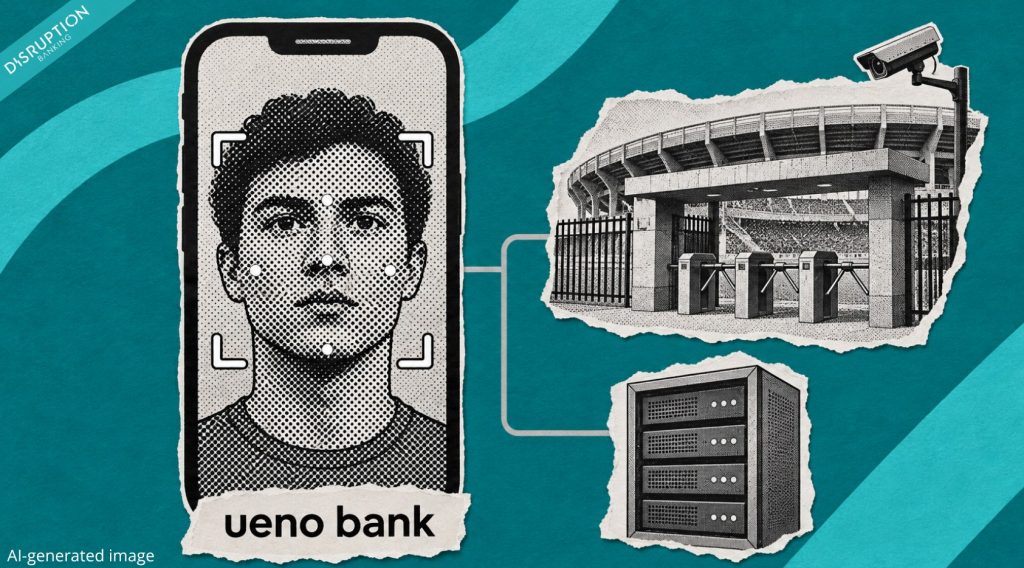
Indeed, opening a Ueno account meant handing over your face. Customers recorded a video selfie and photographed both sides of their national ID card. The bank’s single contract took their express consent to the use, storage, processing and commercial exploitation of their personal data, biometrics included, along with its transfer to third parties.
Those identities were later unified under a single sign-on service called UNID, operated by ITTI USA, LLC, a Texas-registered arm of ITTI S.A.E.C.A., the technology company inside Grupo Vázquez.
The Law That Isn’t Law Yet
In 2025, Paraguay passed its first comprehensive personal data protection law (Law No. 7593). It was promulgated on November 27th of that year with a two-year grace period, which means it does not take full effect until November 2027. Until then the country had no general data protection regime. That is how the personal data of millions of Paraguayans came to sit on cloud infrastructure in the United States.
The data is also not limited to banking customers. ITTI signed biometric deals with stadiums and sports clubs. To get into a soccer game, a fan registers through the same identity system whose operator has reported holding biometric and sensitive data on servers abroad.
Moreover, ITTI holds several contracts with Paraguay’s national government, supplying biometric verification for social security proof-of-life and for housing credit. The Agencia Financiera de Desarrollo awarded the company a direct contract to connect and store the data of Che Róga Porã, the housing ministry’s lending program.
IPS pensioners now prove they are alive by showing their face to an app. ITTI’s contracts with the state tripled after Peña took office in August 2023, climbing from small awards of around 100 million guaraníes to some 17.5 billion.
In that time, digital rights advocates expressed concerns over a private company capturing and monetizing the biometrics of millions of citizens. TEDIC, a digital rights group in Asunción, counted at least 2,300 facial recognition cameras bought by 13 public institutions since 2018, with no privacy statute in force and no public debate.
The data protection lawyer Tania Guerrero argues the consent was worthless, because surrendering biometrics was the price of opening an account or getting a credit card. It was not until the collapse of Ueno Bank that these concerns were elevated.
From Gaza’s Checkpoints to Asunción’s Turnstiles
In September 2024, Corsight AI, an Israeli facial recognition company, licensed a package of its software to Grupo Vázquez, with ITTI leading the integration and reselling it to public and private clients. Known customers of Corsight include the São Paulo Military Police, Essex Police and the Mall of America.
Most of Corsight’s press has come from somewhere else. It was revealed in March 2024 that Israeli military intelligence, including the cyber-intelligence division Unit 8200, was running a facial recognition operation in Gaza built on Corsight technology alongside Google Photos. It was cataloguing Palestinians without their consent at checkpoints and in aerial footage.
Human rights advocates have cited instances where the system led to wrongful detentions and false positives, among them the poet Mosab Abu Toha, pulled aside at a checkpoint and interrogated with no link to Hamas.
The criticism has cost Corsight very little. Campaigners spent 2025 pressing British forces to drop the company. In January 2026 the UK Home Secretary announced a major expansion of live facial recognition with Corsight subcontracted through the British firm Digital Barriers.
Cameras First, Privacy Laws Later
In Paraguay, ITTI has integrated Corsight AI’s facial recognition system across Grupo Vázquez’s broad portfolio, including finance, insurance, retail, e-commerce, agribusiness and entertainment. That includes the world of football.
In January 2024, the Paraguayan Football Association (APF), the Ministry of the Interior and the National Police signed an agreement to put facial recognition in stadiums, with ITTI as the provider. The cameras went up before the privacy law was written.
By UNID’s own account, it is the login for the apps of Ueno, the APF, Club Olimpia and Club Cerro Porteño. That means fans use the same account to gain entry to a football game as they do to access their bank account. The national ground now carries the bank’s name: Estadio Ueno Defensores del Chaco.
While the stated purpose of this single sign-on system is convenience, it has granted Grupo Vázquez unparalleled access to the personal data of millions. Given Peña’s close association with the group and the bank, where he held a stake of about 1.58% in Ueno Holding S.A.E.C.A.. The worry is that the government also had indirect access.
Nobody Can Say Where the Faces Went
The Central Bank paid out advances from the Fondo de Garantía de Depósitos between November 5th and November 11th, covering up to 40 minimum monthly salaries for each depositor, with claims open until December 2nd. Given how dire the situation is for individuals and businesses, the average citizen will likely be focused on being made whole financially.
Meanwhile, the Public Prosecutor’s Office and the National Police’s cybercrime department, working with prosecutors from the economic crimes unit, have executed sweeping raids on at least 13 companies tied to the conglomerate at the Torres del Paseo complex in Asunción, under case number 89/2026.
Hard drives, mobile phones, servers and corporate documents have been seized for analysis. Investigators also found ITTI’s offices stripped, and established that computer equipment had been carried out before they arrived.
Special attention is being paid to biometric and data collection concerns. Schreiner raised them in the Senate. Deputy Rocío Vallejo filed a complaint naming the biometric data held by ITTI, including records belonging to minors. On November 15th, Cardinal Adalberto Martínez called for a thorough investigation into whether the bank trafficked in its customers’ fingerprints, faces and iris scans.
But what happens to the data ITTI has already harvested is unclear. Security specialists point out that nobody has said publicly whether the servers sit in Paraguay or in the cloud, or who holds the keys now, whether that is the prosecutors, the police or former staff.
The trail does not stop in Texas. On November 17th, prosecutors searched the homes of Peña’s brothers, Francisco and Manuel Peña Palacios, looking for documents on U Holdings S.à r.l., a Luxembourg company that sat atop the structure controlling Ueno. The same day, Attorney General Emiliano Rolón resigned ahead of an impeachment vote over his handling of the case.
The Faces Outlive the Bank
Here is the shape of the thing. A bank grew on public money, and in growing it built something worth more than its loan book. It collected the faces of nearly three million people in a country of under seven million.
It did so lawfully, because the statute that would have governed the collection was still two years from taking effect. The turnstile at the stadium, the pension office’s proof-of-life check, the housing loan application and the banking app all fed one identifier, held by one company, hosted offshore.
The bank is gone. The database is not. Paraguay’s prosecutors can seize hard drives in Asunción, but a server in Texas and a holding company in Luxembourg are a different matter, and Law No. 7593 hands them nothing to work with until November 2027.
Peña is in custody and Carvallo has been charged, which answers the political question. It leaves the other one wide open. Three million people gave up something they can never change, to a company that no longer exists in the form that took it, and no official in the country can yet say where it is or who can read it.
That is the lesson for every country still drafting its privacy law. The cameras arrive first. The statute arrives later, if it arrives at all, and by then the faces have already been filed somewhere else.
Author: Tim Tolka, Senior Reporter
The editorial team at #DisruptionBanking has taken all precautions to ensure that no persons or organizations have been adversely affected or offered any sort of financial advice in this article. This article is most definitely not financial advice.
See Also:
Paraguay’s Central Bank President Resigns Following Collapse of Ueno Bank | Disruption Banking
Revolut Handed Passports and Account Histories to a Fake Government Request | Disruption Banking

Tim Tolka
Tim Tolka, Senior Reporter at Disruption Banking, covers digital assets, monetary policy and the politics of global finance. Based in Mexico City, he brings an investigative edge to his reporting, informed by a Master's in International Affairs and his work as an author and screenwriter.