
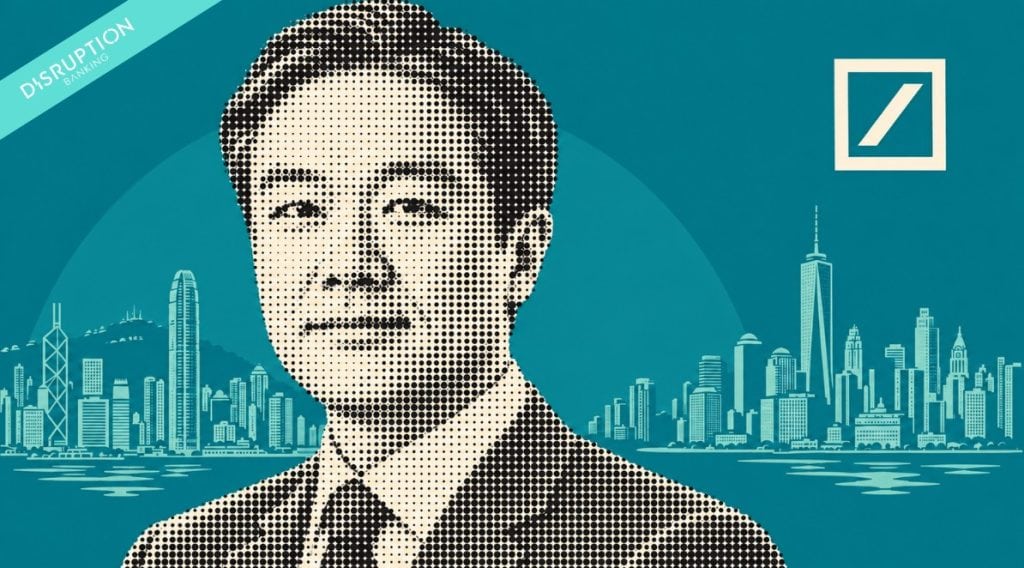
This is the next piece in a series on the bankers who run the largest M&A franchises. Previous pieces covered Tom Miles at Morgan Stanley, Stephan Feldgoise at Goldman Sachs, Anu Aiyengar at JPMorgan, Andrew Woeber at Barclays, Robert Leitão at Rothschild & Co, Vis Raghavan at Citi, Ivan Farman at Bank of America, and Rich Handler at Jefferies. Today’s story looks at Samuel (Sam) Kim, global head of M&A at Deutsche Bank.
Deutsche Bank’s third-quarter results on October 28, 2026, showed double-digit growth in Advisory and a rise in its share of the EMEA investment banking fee pool to 4.8% from 3.2% a year earlier (Dealogic). It is the first set of results covering a full year of Kim running global M&A after he took the role on June 1, 2025.
How Kim made his name in the market
A native New Yorker and Stanford graduate, Kim began at Salomon Brothers in New York. He then spent 24 years at Morgan Stanley, where he was head of M&A and vice chairman of investment banking in Asia and, finally, chairman of M&A for Asia-Pacific. He is the second Morgan Stanley alumnus in this series, after the bank’s own co-head Tom Miles.
Kim joined Deutsche Bank in 2023 as chairman of Asia-Pacific M&A, based in Hong Kong, and later added the role of chief country officer for South Korea. His reputation rested on relationships with Korean conglomerates and the region’s leading financial sponsors. In 2025 he relocated to New York to become global head of M&A, succeeding Alison Harding-Jones, who was promoted to co-head of the investment bank. He reports to her.
The route is unusual: a German bank chose a banker whose career was built in Asia to run its M&A business from New York, where most of the global fee pool sits.
What has happened on his watch
Hiring has continued. In January 2026 Deutsche Bank hired Ed King as vice chair of global M&A, based in San Francisco and reporting to Kim, as part of an ongoing effort to strengthen the advisory franchise.
In Asia, the business Kim previously led has kept winning recognition. Importantly, in 2024 FinanceAsia named Deutsche Bank Asia-Pacific’s M&A House of the Year. In 2026 it took FinanceAsia’s Best M&A House awards in China and Korea, and Euromoney’s Best Investment Bank for M&A in China, Indonesia, Malaysia and Singapore.
The bank has also pointed to a string of franchise mandates from the period before and overlapping with Kim’s global role. These include Air Liquide’s roughly €2.8–3.3 billion acquisition of DIG Airgas, work around PearlAbyss’s sale of CCP, Ximalaya’s sale to Tencent Music, Blackstone’s A$24 billion acquisition of AirTrunk, and Blackstone’s sale of Geoyoung to MBK Partners. These results reflect the Asia franchise Kim helped build; they should not be attributed to him personally.
The third-quarter numbers provide the clearest recent marker: Advisory growth and the EMEA market-share gain. Investment Banking & Capital Markets revenues overall were essentially flat at €507 million, because Debt Origination fell.
What others say about him
Harding-Jones, announcing the promotion, said Kim had “a proven track record of growing and building businesses, and a wealth of advisory experience, having worked on M&A transactions globally for over thirty years.” She added that since joining he had “had a broad impact on our franchise, playing a key role in our strong positive momentum.”
When he was appointed chief country officer for South Korea, Chandra Mallika, then chief executive for developed Asia-Pacific, said the bank looked forward to “leveraging Sam’s deep C-suite relationships across the region and his experience with leading local financial sponsors and large conglomerates to take our platform to the next level.”
The critical angle
Visibility remains limited. Kim has almost no public record as global head of M&A at a top-ten European bank, in contrast to the most visible M&A leaders in this series.
Scale is still modest. A 4.8% EMEA share shows some progress, but is not a challenge to Goldman Sachs or JPMorgan.
Attribution is imperfect. Advisory fees are recognised when deals complete, so a quarter can swing on deal timing. Growth this year also reflects hiring and pipeline decisions taken before Kim arrived. The results should not be credited to him alone, and specific deals should not be attributed to him.
Forward look
Two questions remain open. Can Kim convert Deutsche Bank’s Asian M&A strength into greater share in the United States, where he now sits? And will the EMEA gains hold into 2027 as the hiring spree beds in?
Author: Tejas Bansal
See Also:
Why Did a Deutsche Bank Private Banking Chief Siphon Client Funds? | Disruption Banking
Can Deutsche Bank Restore Investor Confidence? | Disruption Banking