
Crypto enters the final weeks of 2026 weaker than many January forecasts expected. In early November, Bitcoin defended $76,000, a level that marks the average cost basis of short-term holders. Fidelity has noted that some investors are watching for a bear market bottom around November 2026 based on Bitcoin’s four-year cycle, while cautioning that there is no guarantee the bear market is over.
In Washington, the Senate voted 49–50 on September 15 against advancing the CLARITY Act, leaving comprehensive US market structure rules unresolved. This came after months of negotiation that included the stablecoin yield compromise.
Against that backdrop, two parts of the market have kept growing on measurable data: stablecoin settlement and the tokenization of real-world assets. Total stablecoin supply stood at $294.8 billion on November 9, and the tokens on this list are the ones most directly tied to those two trends.
How This List Defines a Utility Token
The SEC and CFTC’s joint interpretive release of March 17, 2026 sorts crypto assets into five categories: digital commodities, digital collectibles, digital tools, stablecoins, and digital securities. Under that framework, the digital tools category covers access and membership tokens such as ENS domains, while network tokens such as ETH, XLM, and LINK fall under digital commodities.
This list uses the broader market meaning of a utility token, which is a native token that pays for or secures a working network. It excludes Bitcoin, stablecoins, memecoins, and tokenized securities, and the ranking reflects the strength of verifiable fundamentals such as usage, revenue, institutional adoption, and dated 2027 catalysts rather than a price forecast.
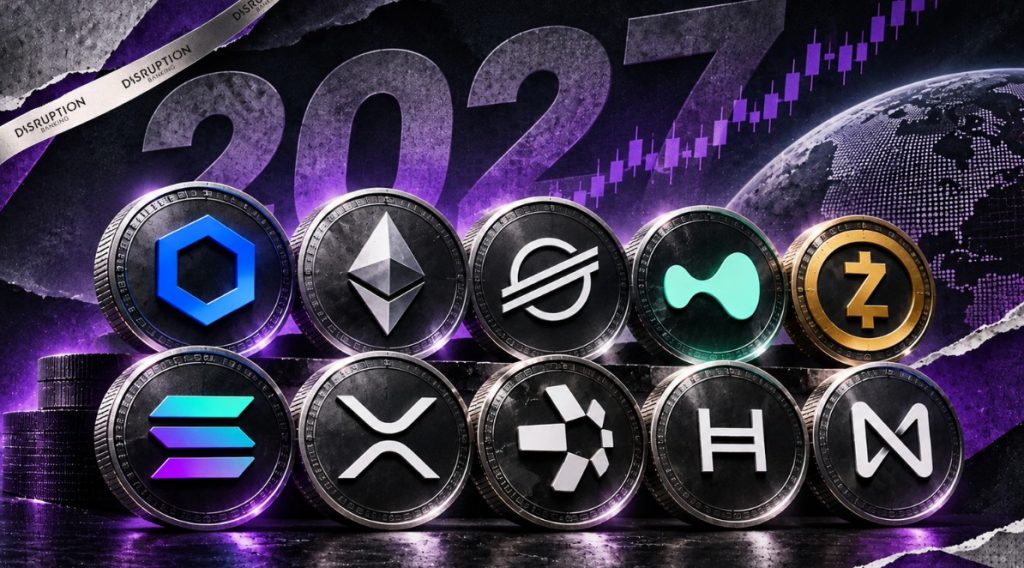
1. Chainlink (LINK): Hanwha and Swift Deals Land as LINK Falls 33% in a Year
On October 29, South Korea’s Hanwha Investment & Securities said it would adopt the Chainlink data standard and its Cross-Chain Interoperability Protocol (CCIP) as the official infrastructure for its global real-world asset tokenization platform.
A month earlier, at Swift’s Sibos 2026 conference, Chainlink announced the launch of CCIP 2.0 and an integration connecting banks to Swift’s ledger. The token has not followed the adoption news, as LINK fell 7.6% to around $10.69 on November 5 and was down 33.5% over the past year at the start of the month. Chainlink ranks first because its institutional pipeline is the most documented on this list, although whether that adoption creates sustained demand for LINK remains the open question.
2. Ethereum (ETH): $135 Billion in Stablecoins While Glamsterdam Waits
Ethereum held $135.12 billion in stablecoins on November 9, or 46.3% of total supply, ahead of Tron at $94.18 billion, according to DefiLlama. That makes it the largest settlement layer for tokenized dollars by a wide margin. Its next technical catalyst has slipped, however.
The Glamsterdam upgrade went live on the Sepolia testnet on October 6. But on November 6, the Ethereum Foundation said core developers would not activate the upgrade on the Hoodi testnet until compatibility issues with existing smart contracts are resolved. That leaves Glamsterdam without a mainnet date heading into 2027.
3. Stellar (XLM): DTCC Targets the First Half of 2027
Stellar has the clearest dated 2027 catalyst among the ten tokens on this list. In May, the Depository Trust & Clearing Corporation and the Stellar Development Foundation announced plans to make DTC-custodied assets available as tokens on Stellar, with availability expected in the first half of 2027.
The two organizations are evaluating Russell 1000 constituents, ETFs tracking major indices and US Treasuries as candidate assets. Stellar’s tokenized real-world asset market has also grown roughly fourfold this year to nearly $4 billion, and payments firm BVNK added the network to its stablecoin platform across more than 130 markets. The same report notes that transaction activity on Stellar does not automatically produce lasting demand for XLM.
4. Hyperliquid (HYPE): $141 Million in Quarterly Buybacks From Trading Fees
Hyperliquid is the only token on this list with a direct, disclosed link between protocol revenue and token demand. The decentralized derivatives exchange reported $169 million in second-quarter revenue and directed $141 million of it to HYPE buybacks, and reports if Allium Labs data show Hyperliquid and Pump.fun accounted for nearly 90% of the record $638 million that crypto projects spent on buybacks in 2026 through late August.
Because Hyperliquid routes 99% of eligible trading fees into HYPE purchases, the buybacks shrink when trading volume falls. The SEC’s March release also states that a token’s classification turns on its economic reality and may shift over time, which matters for a token whose value is tied to exchange revenue.
5. Zcash (ZEC): Up 128% in 2026 With 29% of Supply Shielded
Zcash is the exception to this list’s definition, since ZEC functions mainly as private money rather than as a network utility. It has nonetheless been one of 2026’s strongest performers, up 128% year to date as of early November. Use of its privacy features is also rising, with 29.2% of circulating supply held in shielded pools on November 6, up from 8% in early 2024.
The NU7 upgrade activated on November 5, cutting the target block interval from 75 seconds to 25 seconds and sending 60% of each block’s transaction fees to a public reserve. The rally has also reversed sharply, as ZEC peaked at $1,695 on September 26 and fell roughly 41% to lows near $1,000 on November 10–11.
6. Solana (SOL): Alpenglow Goes Live With $14.8 Billion in Stablecoins
Solana completed the largest protocol change in its history on October 21, when the Alpenglow consensus system activated on mainnet with a target finality of about 150 milliseconds, down from 12.8 seconds. It has been reported that the network dashboard showed 6.6-second finality at the time of its report, so the target has yet to be confirmed under live conditions. Solana held $14.8 billion in stablecoins on November 9, the third-largest balance of any chain.
7. XRP: $1.7 Billion in ETF Inflows as Momentum Flattens
XRP’s case rests on payments activity. Stablecoin supply on the XRP Ledger rose 25.2% in October to $1.03 billion, and global XRP exchange-traded products took in $355.3 million over the month, according to Blockworks data. Momentum in US spot ETFs has since stalled, with cumulative net inflows at $1.7 billion but daily flows flat on November 3 and 4.
8. Quant (QNT): The Clearing House Deal Leaves the Token’s Role Undefined
On September 24, The Clearing House, the bank-owned operator of core US payment systems, selected Quant to power its On-Chain Money Initiative, a network for clearing and settling tokenized deposits that it expects to make available to participating institutions in the first half of 2027.
Quant will provide the interoperability, orchestration, and transaction management layer and coordinate clearing and settlement on the network. The announcements describe Quant’s technology role but do not say participating banks must hold or pay fees in QNT, which leaves the link between this adoption and token demand unconfirmed.
9. Hedera (HBAR): ETF Inflows Return as the Price Sits Near $0.07
Canary’s US spot HBAR ETF took in $2.73 million on November 4, its strongest day of inflows since mid-January, while several other altcoin funds saw withdrawals. The fund has drawn steady attention since its October 2025 launch, which Disruption Banking examined at the time. The price has not responded, with HBAR trading around $0.07 in early November, about 45% below its September 28 high. Hedera also cancelled a testnet upgrade to version 0.79 that had been scheduled for November 4.
10. NEAR Protocol (NEAR): Holders Vote to Cut Issuance to 1.6%
On November 2, NEAR’s House of Stake governance body approved proposal HSP-029 with about 99.96% support, which would lower the network’s maximum annual token issuance from 2.5% to 1.6% over 24 months. The change is not yet binding, because it still requires Security Council review, a 90-day grace period, and a protocol upgrade adopted by validators. NEAR traded at about $3.63 on November 11.
Institutional Timelines Point to the First Half of 2027
The strongest 2027 timelines on this list belong to institutional infrastructure rather than retail trading. DTCC’s Stellar connection and The Clearing House network are both scheduled for the first half of 2027, and the UK plans its first digital gilt issuance under the DIGIT pilot by the first quarter of 2027. For most of the ten tokens, the question heading into next year is whether institutional use of a network turns into demand for its native token.
Author: Ayanfe Fakunle
See Also:
CLARITY Act Falls Short in the Senate, Stalling U.S. Crypto Rules for 2026 | Disruption Banking
Can Canary Capital’s HBR ETF Ignite a HBAR Price Surge? | Disruption Banking
Strategy Faces MSCI Exclusion Risk as Bitcoin Premium Disappears | Disruption Banking