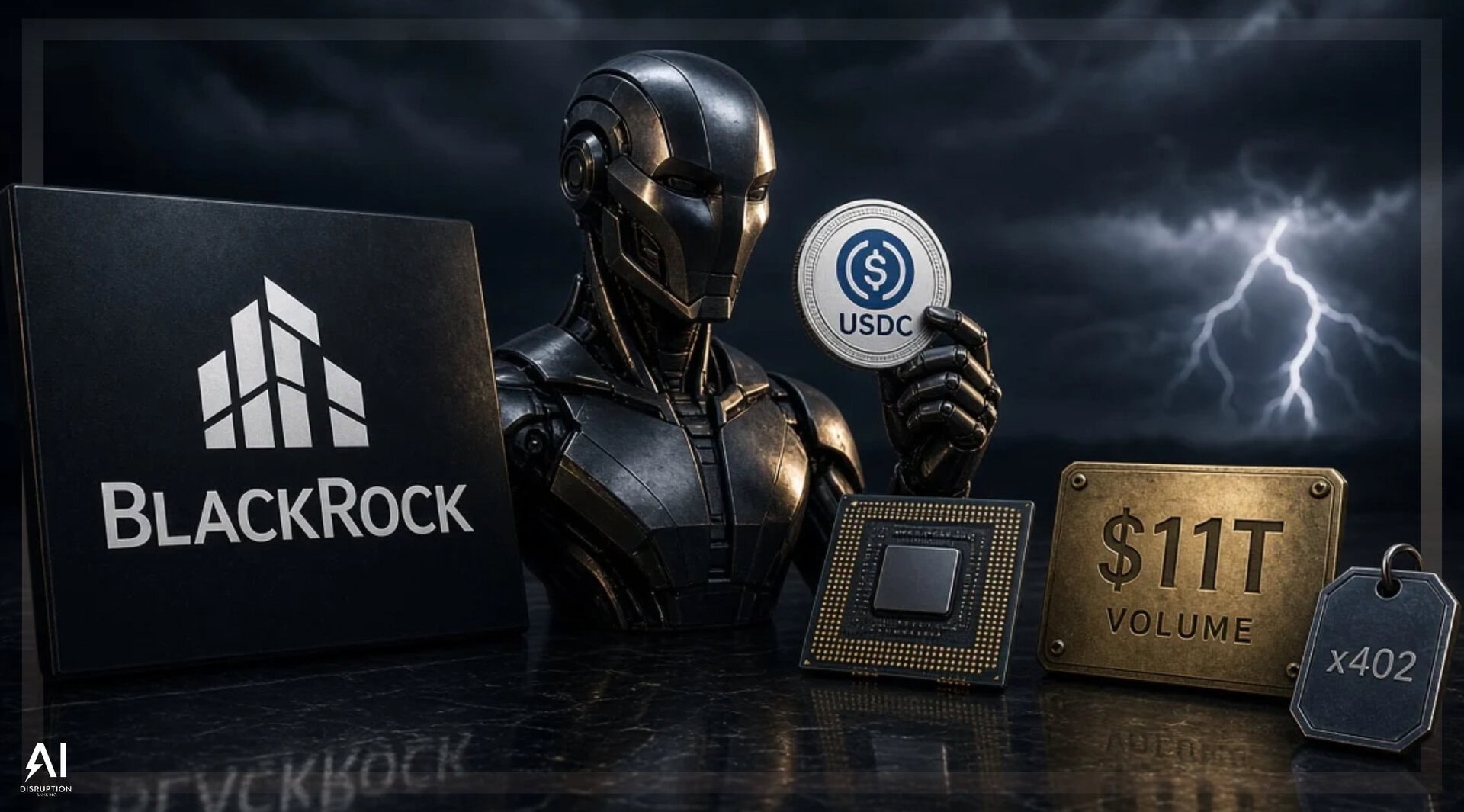
BlackRock published a research paper on September 22 arguing that the spread of AI agents could become an overlooked source of demand for digital assets.
The paper, The Machine-Native Economy: How digital assets connect intelligence, commerce, and compute, was written by Will Su, Robert Mitchnick, Jay Jacobs and William Helm. It describes AI as machine-native intelligence and digital assets as machine-native money. It identifies three areas where they overlap: tokenization, agent-driven payments, and a future market for computing power.
$11 Trillion in Stablecoin Volume, With a Footnote
The payments case rests mostly on stablecoins. BlackRock estimates the circulating stablecoin market capitalization at over $300 billion as of September 2026. It puts adjusted stablecoin transaction volume above $11 trillion in 2025, which it says is in the same general range as Visa’s and Mastercard’s annual payment volumes. BlackRock’s own table puts Visa at $16.7 trillion, Mastercard at $10.6 trillion and adjusted stablecoin volume at $11.2 trillion. The paper says those measures are not directly comparable.
ACH Moved $93 Trillion but Grew at 7.9%
The gap is wider against the U.S. ACH Network. According to Nacha, ACH processed 35.2 billion payments worth $93 trillion in 2025, a 7.9% increase from 2024. BlackRock’s case rests on growth rates instead. It calculates an 80% compound annual growth rate for adjusted stablecoin volume from 2020 to 2025, compared with about 8.5% for ACH.
The paper argues that existing payment rails fit autonomous software poorly for four reasons:
- Account setup often requires a human.
- Merchant fees make very small payments uneconomic.
- Settlement and dispute finality can take days.
- The rails may not scale if machines start sending the volume.
Regulators are working on the same problem. At the Point Zero Forum in June, Tom Mutton of the Bank of England and Shayan Hazir of HSBC discussed what agentic payments infrastructure would have to look like. The Payments Association listed agentic commerce as one of five main stablecoin use cases.
x402’s $50 Million Track Record
For machine-to-machine payments, BlackRock focuses on x402, an open protocol developed by Coinbase. It uses the HTTP 402 “Payment Required” status code so software can pay for API calls, data, and compute in stablecoins such as USDC.
When Coinbase launched Agentic.Market in April, x402 had handled more than 165 million transactions worth about $50 million. Chainalysis found that x402 transactions on Base passed 100 million in about three quarters, with meme coin farming driving much of that growth. The same analysis found that payments above $1 rose from 49% of value transferred in early 2025 to 95% by early 2026.
BlackRock acknowledges the distance between its thesis and current usage. It describes agentic payment activity as nascent and compute-market liquidity as limited.
What the AI Preference Study Measured
The paper also cites research from the Bitcoin Policy Institute. The study tested 36 frontier models across 9,072 open-ended monetary scenarios. Bitcoin took 79.1% of responses in long-term store-of-value scenarios. Stablecoins led in payment scenarios. BlackRock notes that these results are based on simulated model responses, not on observed agent behavior.
A $1.1 Trillion Compute Market Without a Futures Contract
The third part of the thesis treats computing power as a potential asset class. BlackRock cites consensus estimates for three cloud businesses: AWS, Microsoft’s Intelligent Cloud segment, and Google Cloud. Those estimates imply a combined revenue of about $1.1 trillion by 2030, a 29% compound annual growth rate from 2025. The paper also cites Goldman Sachs estimates of more than $5 trillion in cumulative AI capital spending between 2025 and 2030.
BlackRock expects standardized products, including exchange-traded compute futures, to emerge. Claims on compute capacity could then be tokenized, pledged as collateral, and settled on-chain. The paper lists problems that are still unsolved:
- Productivity differences between chip generations
- Regional differences in energy costs
- How contracts would settle, whether in cash or by delivering capacity
As an early market signal, the paper points to Stripe’s agreement to acquire OpenRouter. OpenRouter routes AI requests across more than 400 models from over 80 providers. CNBC reported the price at about $7.5 billion.
Author: Ayanfe Fakunle
The editorial team at #DisruptionBanking has taken all precautions to ensure that no persons or organizations have been adversely affected or offered any sort of financial advice in this article. This article is most definitely not financial advice.
See Also:
The Payments Association Calls for Revised Stablecoin Regulation | Disruption Banking
Our latest research paper explores the growing connection between AI and digital assets and explains why broad AI adoption may drive new demand, utility and applications across the digital asset economy. https://t.co/z5T88Orble pic.twitter.com/GMxQqTVmUN
— BlackRock (@BlackRock) September 22, 2026