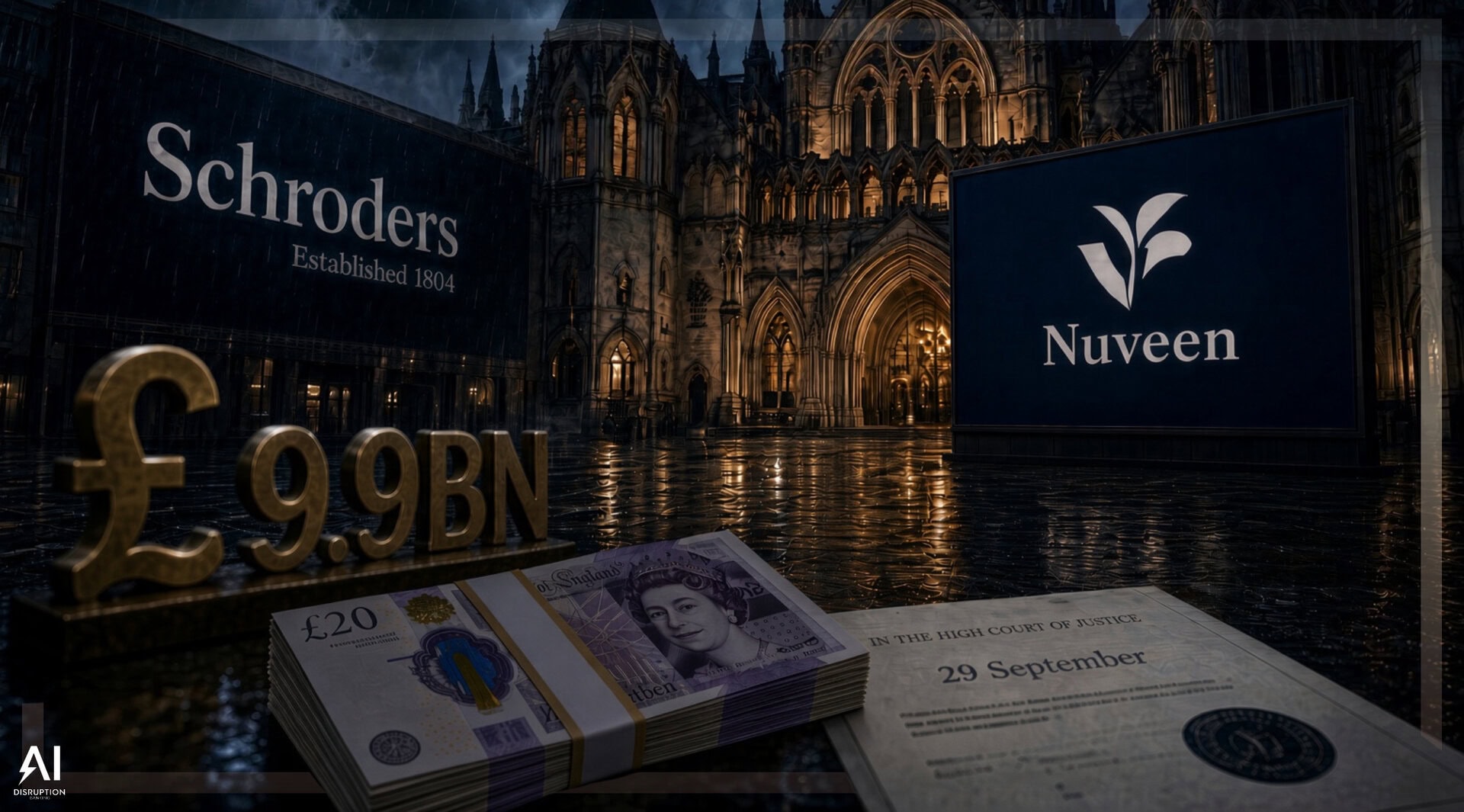
Schroders shareholders voted in April to sell the 222-year-old asset manager to Nuveen for £9.9 billion. Five months later the shares are still listed.
The delay is not a rival bid. It is the ordinary work of moving an asset manager that operates in more than 40 markets: antitrust and regulatory clearance, then a change of control that treats investment-management contracts as terminated, fund by fund.
The vote was not the finish. For an asset manager of this size, it was about halfway.
What Nuveen is paying
The recommended cash offer was announced on February 12. Each Schroders share gets 590p in cash, or £9.5 billion, plus permitted dividends of up to 22p. That values the company at £9.9 billion, or 612p a share, a 34% premium. The stock rose about 30% on the day.
The buyer is Chicago-based Nuveen, wholly owned by TIAA. The combined group would have close to $2.5 trillion of assets across more than 40 markets, set out on Schroders’ offer page. That would make it the largest asset manager in the UK, ahead of Legal & General, and second in Europe behind Amundi. It would still sit well behind BlackRock, State Street and Vanguard.
The Schroders name stays. London is to be the combined group’s non-US headquarters, with about 3,100 staff. Richard Oldfield would remain chief executive, reporting to Nuveen chief executive William Huffman, and he would join Nuveen’s executive team. Nuveen has said Schroders will be run as a separate business for at least a year. Schroders would delist in London.
What still has to happen
At the Court and General Meetings in April, 99.9% of votes cast backed the scheme, against a 75% threshold. The family’s private trust companies had already given irrevocable undertakings.
Completion still needed antitrust and regulatory approvals. An asset manager in 40-plus markets has to obtain change-of-control consent in most of them. The companies had pointed to the fourth quarter.
On September 22 those approval conditions were satisfied or waived. The High Court sanction hearing is listed for September 29. Subject to the court order being delivered to Companies House, the scheme is expected to become effective on October 1. The last trading day on the London Stock Exchange is expected to be September 30. Trading is due to be suspended at 7.30am on October 1. The listing is due to be cancelled by 8.00am on October 2.
Matthew Westerman, a former Goldman Sachs and HSBC banker already on the board, will become chair. Dame Elizabeth Corley and four other non-executives, including family director Claire Fitzalan Howard, leave. Leonie Schroder stays. Huffman, Saira Malik and Kevin McCarthy join from Nuveen. Oldfield, finance chief Meagen Burnett and CIO Johanna Kyrklund remain.
Schroders keeps an offer page with the scheme document, the voting result and the timetable.
Why the funds have their own calendar
Under US fund law a change of control is treated as an assignment. Advisory and sub-advisory agreements terminate. Each fund then has to approve a new contract.
Filings for the Hartford Schroders Private Opportunities Fund show the sequence. The board approved interim agreements in August. A shareholder meeting was set for on or about September 21, with the new arrangements due to take effect around November 16.
Why the family sold a profitable firm
Oldfield became chief executive in November 2024. The share price had been weak for years, and cheap US index products had taken a share of the market that used to belong to houses of this size. He ran a £150 million cost programme, ended the Lloyds advice joint venture and pulled out of Brazil and Indonesia. As recently as mid-2025 he had played down a family sale.
The 2025 numbers were not a rescue case. Adjusted operating profit rose 25% to £756.6 million. Pre-tax profit rose 21% to £674 million. On the day of the April vote the firm also reported £2.2 billion of net withdrawals in the first quarter and assets of £814.4 billion, down from £823.7 billion. In July it reported first-half net outflows of £4.2 billion and a 46% rise in adjusted operating profit, with assets at a record £867.8 billion.
The 42% that decided the vote
Johann Heinrich Schröder, a Hamburg financier, founded the London merchant bank in 1804. It floated in 1959 and left investment banking in 2000. The family holding is about 42%. At 612p that stake is worth roughly £4.4 billion.
JO Hambro, a top-25 holder with about 0.5%, put the offer 10 to 15% below fair value. Tikehau Capital, once a 5.4% holder, sold before the vote. With the family’s undertakings in place, 99.9% was the expected result.
What leaves the London list
Schroders will be another large name off the Exchange. The same pattern has already shown up in the easyJet bid and in London’s thinner IPO book. The UK keeps the brand, the non-US headquarters and the staff count written into the deal.
Author: Tejas Bansal
The editorial team at #DisruptionBanking has taken all precautions to ensure that no persons or organisations have been adversely affected or offered any sort of financial advice in this article. This article is most definitely not financial advice.
See Also:
The easyJet Takeover: Can Apollo Actually Own a European Airline? | Disruption Banking
Viva la Bolsa! How Mexico Just Stole London’s Financial Crown | Disruption Banking
Can Abrdn Win Back Investor Confidence? | Disruption Banking
Jana Fiserv Breakup: Can Asset Sales Fix the Credibility Crisis? | Disruption Banking