
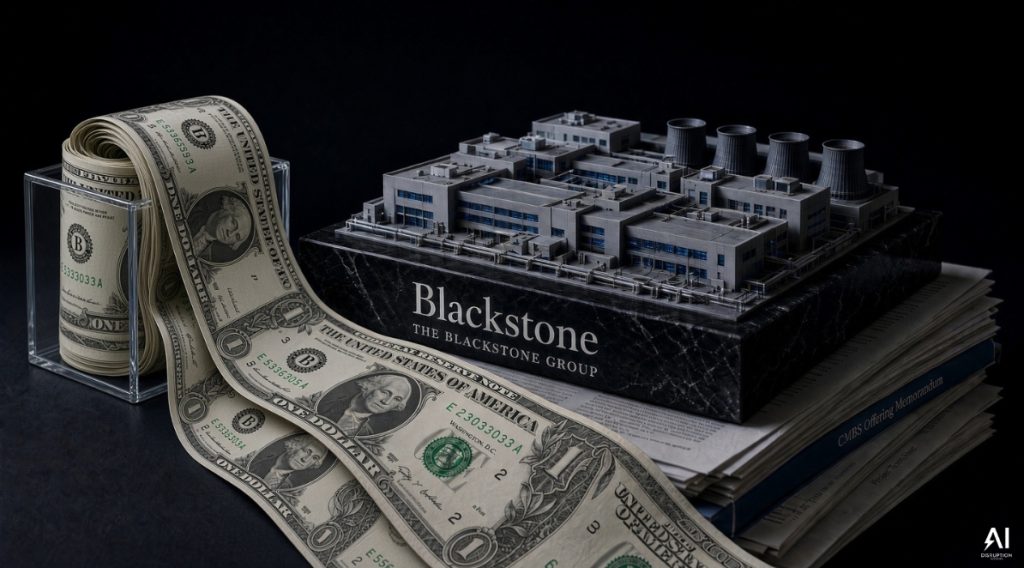
Blackstone now values its data center portfolio at $185bn. The question is not whether the buildings are leased. It is whether the banks actually got the risk off their books.
Blackstone’s data-center story starts with QTS.
Since buying QTS, Blackstone has built a data center platform it now values at $185bn, including developments still in the ground. It says that book is the largest in the world. The question is who buys the bits that are already built?
If the risk had cleanly left the banks, Blackstone would not still need buyers for the completed buildings, and the same banks would not still be writing the loans.
BXDC and Digital Realty are the exits that exist
In May 2026 Blackstone listed Blackstone Digital Infrastructure Trust on the New York Stock Exchange under the ticker BXDC. The raise was $1.75bn at pricing, and just over $2bn once the underwriters took up extra shares. BXDC is a REIT, a property company that pays rental income out to shareholders. It listed with no buildings yet, a blind pool, and Blackstone called it the largest listing of that kind on record.
Congratulations to the Blackstone Digital Infrastructure Trust team on listing on the @NYSE. As AI, cloud computing, and digitalization accelerate, demand for compute and the data centers that support it continues to grow. $BXDC gives investors access to this long‑term… pic.twitter.com/94OlYlRVF1
— Blackstone (@blackstone) May 18, 2026
BXDC is built to buy one thing: new data centres in big US markets, already rented to large, highly rated tech companies. Once it owns the building, the construction risk is supposed to be over. For the first two years it gets first look at those finished assets from Blackstone’s own portfolio. That is the point of the listing. It is a public buyer for stock the private market was not taking.
In June a second door opened. Digital Realty paid $3.5bn in cash and stock for Blackstone’s majority stake in three Northern Virginia data centres. The assets were valued at $7.8bn including debt and remaining capex. Blackstone took $1.2bn of cash and $2.3bn of Digital Realty shares.
Those three sites sat inside the $7bn development joint venture the two firms formed in 2023 across Virginia, Frankfurt and Paris. Digital Realty already knew the tenants, the remaining spend and the market. That is why they could settle it between them, in cash and stock, instead of running an auction.
Sean Klimczak, Blackstone’s global head of infrastructure, had already set out the logic before BXDC listed or the Digital Realty sale closed. If you cannot list the whole company, you sell individual data centres. He was describing a bid list.
Who else can buy Blackstone’s data centers?
Who else could take the completed buildings?
Not, in practice, another private equity firm. KKR, BlackRock, Blue Owl and the rest have been writing their own data-center cheques. They want the return from building new sites, not the lower income on a building that is already rented. That is why so much of the finished stock was refinanced in the bond market instead of sold to another sponsor.
A hyperscaler could buy the building rather than rent it. That option exists every time a 15- or 20-year lease is signed. It is not the exit Blackstone has used.
A state-backed buyer is a newer route. The $3bn partnership with Humain, Saudi Arabia’s AI company, with AirTrunk as operator, is the start of that new avenue. However, it is not yet a bid for the US assets.
That leaves the two doors already open: BXDC in the public market, and a partner already on the site, as with Digital Realty. There are not many others large enough to take what Blackstone has built.
Nadeem Meghji, Blackstone’s global co-head of real estate, is still talking about accumulation. “It’s a really global business for us in strategy, and we think we’re still in the early innings of that build-out and couldn’t be more excited about the opportunity ahead there.”
When $BX acquired @AirTrunk, we became the largest data center provider in the world — but, as Global Head of #Infrastructure Sean Klimczak and Global Co-Head of #RealEstate Nadeem Meghji explain, it’s still early days for #AI infrastructure investing. ✨ https://t.co/TBy1Kxn52U pic.twitter.com/2QQBF9d46e
— Blackstone (@blackstone) January 16, 2025
Early innings is an easy phrase when you are still buying. It is a harder one when the completed buildings need a buyer, and when BREIT (Blackstone’s big private real-estate fund) already has more than a quarter of its property value in one operating company.
Why QTS is too big for BREIT to hold
QTS, the data-center operator, is no longer a sideline inside BREIT. It is the portfolio.
Blackstone took the listed REIT private in 2021 for about $10bn, then the largest data center transaction on record. Leased capacity has grown close to sixteen times in BREIT’s own 2026 materials. The BXDC filing called QTS the firm’s most profitable investment to date. Sector rents over that stretch were up 84%.
As of 31 December 2025, QTS accounted for 20.4% of BREIT’s real estate asset value. BREIT put $5.8bn into pre-leased data center developments that year and said 2026 would run faster. By 30 June 2026 the QTS line was 26.1%. Another $5.7bn went in during the first half.
Blackstone talks about this as one global platform. It is not. QTS is the US operator sitting inside BREIT. AirTrunk, bought in 2024 with Canada’s CPP Investments at an A$24bn valuation, is the Asia-Pacific business.
$BX continues to make significant investments in the infrastructure powering the AI revolution, including in India through our portfolio company @airtrunk. https://t.co/p8ysSeZvd2
— Blackstone (@blackstone) June 5, 2026
Humain is a Saudi development partnership. The Digital Realty deal was a slice of a joint venture, not a sale of the whole book. Those are different owners, different funds and different exits. Add them up and it sounds like one book. It is not.
BREIT cannot let one operating company keep taking a larger share of the book. A closed-end fund cannot sit on a finished campus forever either. That is why BXDC exists, and why Digital Realty was offered three buildings in the most important data center market in the United States. Somebody has to own the finished product so Blackstone can keep building the next one.
The banks sat on both sides of that sale
This is where the headline stops being rhetorical.
Morgan Stanley was one of the banks that took BXDC public, alongside Goldman Sachs, Citigroup, Barclays, Bank of America, Deutsche Bank, JPMorgan, RBC and Wells Fargo.
Additionally, in 2025 QTS took a $1.5bn seven-year floating rate loan on two fully leased single-tenant sites in Atlanta and Sandston, Virginia, 138MW across 987,000 square feet. Morgan Stanley originated it with Bank of America, JPMorgan, Societe Generale, Goldman Sachs, BNP Paribas and RBC. The plan was to sell the loan on as CMBS: bonds backed by the mortgages on the buildings.
A $2.1bn CMBS then refinanced three campuses in Northern Virginia, Chicago and Atlanta at 6.1%. A $3.5bn CMBS refinanced ten data centers across six markets at 6.25%, then the largest deal of its kind. Morgan Stanley was again among the originators.
AirTrunk’s A$4.3bn construction loan for SYD3 in Australia, about $3bn, brought Morgan Stanley in with Credit Agricole, DBS, Deutsche Bank, HSBC, ING, MUFG and UOB. A further loan of about $2.3bn was being completed for Johor. When Bloomberg reported the Australian loan, it noted growing concern about how much debt now sits under AI infrastructure.
The later loans are larger still. QTS issued a $4.6bn bond, tied to a Microsoft lease at its Fayetteville, Georgia site. Investors offered to buy far more than was for sale. Moody’s rated the deal Baa2. In July 2026 QTS went out for a $1bn term loan, a floating-rate loan sold on to institutional lenders. Demand was strong enough that the deal closed at $3.25bn.
There is no hidden scheme here. There is a chain of fees. Advise the owner, fund the building, sell the debt, run the listing, then advise the sale. The Financial Times has written that Morgan Stanley has emerged as Wall Street’s chief architect of the financing behind the AI data-centre build-out.
That last point is the one that matters. The banks that sold the data-centre loans are the same banks now being asked who will buy the buildings. They moved the debt. The banks did not leave.
Private credit did not take the risk away. It sat on bank lines.
The popularly used story says private credit replaced the banks. The real story is that private credit borrowed from them.
Blackstone owns the data-center businesses. It is also one of the largest private credit managers in the market. BCRED, its flagship private credit fund, has a portfolio of about $77bn. S&P affirmed the fund at BBB- on 2 June 2026 and kept a positive outlook.
In the third quarter of 2026 it took repurchase requests of about $4.3bn, roughly 10 percent of outstanding shares. The fund will redeem only 5 percent of its net asset value each quarter. Demand has been running higher than that. Some investors who were turned down last quarter applied again.
That is why the spare borrowing from banks matters. BCRED will only let investors take out a set slice of their money each quarter. When more people want out than that slice allows, the fund can draw on loans the banks have already stood ready to provide. By mid-2026 that unused capacity was still measured in the tens of billions.
Who owns the building, and who owns the loan
That does not mean BCRED holds the QTS bonds. Those bonds sit with whoever bought the CMBS. QTS, which Blackstone owns, still owns the buildings and still owes the debt. BCRED is a different Blackstone fund. It lends to other companies, and its investors can ask to cash out every quarter.
A buyer of a Blackstone data center is not underwriting only a Microsoft-class lease. They are buying from a group that also runs a large private credit fund, with a quarterly exit and billions of unused borrowing already agreed with banks. Nobody needs a default for that to matter. It is a question any serious buyer will ask: who owns the building, who owns the loan, and what else is on the same name.
Regulators are watching AI data center debt
Regulators have already noticed the wider pattern. The Bank of England’s Financial Policy Committee wrote in July 2026 that AI names are now raising debt in public markets, private credit, leveraged finance and structured finance, and that the danger sits in three assumptions: future compute demand, power arriving on time, and how fast the chips and the buildings depreciate.
The Federal Reserve has been watching bank lines into private credit funds, and the Financial Stability Board has already warned that private credit sits in data-center financing if the underwriting is wrong. If demand for computing slows, if the power is late, or if the buildings and chips lose value faster than the loans assume, the loss would not sit in one place. It would be split across banks, bondholders and private funds.
They are not saying losses have started. They are saying it is hard to see who is left holding the debt after the bonds are sold, and that a lot of those loans rest on the same three bets: demand, power and depreciation. That is why they are treating AI infrastructure debt as a monitoring item rather than a closed chapter.
Power and permits are what a buyer actually prices
Power is one thing buyers are looking for. Blackstone is already moving on this topic, including a Pennsylvania commitment with PPL and QTS sites attached. However, a completed campus is only as good as the megawatts behind it.
Permitting is the other. In July 2026 QTS walked away from Digital Gateway in Prince William County, Virginia, after years of lawsuits and local opposition. A buyer of a finished site is also buying the political weather around the next one.
The buildings can still be sold
The buildings are largely pre-leased to investment-grade tenants before construction. BREIT describes QTS’s $30bn development pipeline that way, on 15-to-20-year terms.
Those tenants are the hyperscalers. S&P rates Microsoft AAA. It rates Alphabet AA+, Amazon AA and Meta AA-. Apple sits at AA+ with S&P and Aaa with Moody’s. Apple is a useful benchmark, as it doesn’t usually appear on these leases. The ratings of the hyperscalers are one of the big reasons why the leases hold, and why the bonds still sell.
It is also why a buyer who stops at analyzing the tenant has not finished the research needed. The debt wrapped around those leases is not AAA. Moody’s rated the Microsoft-linked QTS bond Baa2. QTS lease-backed bonds have come at A- and BBB- from S&P. The building, the bond and the credit fund are three different credits. Read only the tenant and you have read one of them.
The operating record is real. QTS is Blackstone’s most profitable investment. Demand has outrun supply. Bank syndicates are still forming. The Microsoft-tied bond was not a struggle. Digital Realty did not buy three Northern Virginia sites as a favor. BXDC raised real public money.
BXDC and one operator in Northern Virginia can take some of the finished buildings. They cannot take a platform Blackstone now values at $185bn, including sites still being built, and which the firm says could double if the pipeline is delivered.
Did Blackstone move the risk off the banks?
A lot of the risk has moved. Once the loans were packaged as bonds and sold, a lot of the risk did move. The IPO happened. The Digital Realty sale happened.
Off the banking system, no. Not entirely. The same syndicate that sold the loans is still arranging the next ones. The same banks lend to the funds that buy what the banks say they distributed. The sponsor that owns the buildings also runs a large private credit vehicle with a quarterly gate. Regulators are already treating AI infrastructure debt as a monitoring item, not because a default has occurred, but because the final holders are not in one register.
The bottom line is that Blackstone needs buyers for completed data centers. The bid list is short. The paper those buyers inherit was written by the same firms that will run the sale. Anyone who is considering taking on that mandate should know the risk did not vanish when the fine details were written. It just changed place.
The next buyer may be another listed fund like BXDC. Or an operator that already knows the site, as Digital Realty did. A hyperscaler could stop renting and buy the building. However, if the finished stock cannot be sold as fast as Blackstone is adding it, the firm will keep borrowing against those sites instead of selling them.
Author: Tejas Bansal
See also:
Why Big Tech Is Borrowing for Data Centers Instead of Spending Its Own Money | Disruption Banking
Why Did Jane Street Sign a $13 Billion Cloud Contract If the Hall Can Wait? | Disruption Banking
How Data Centers Came Between Trump and Texas
Who Are the Firms Dominating Private Credit Markets? | Disruption Banking