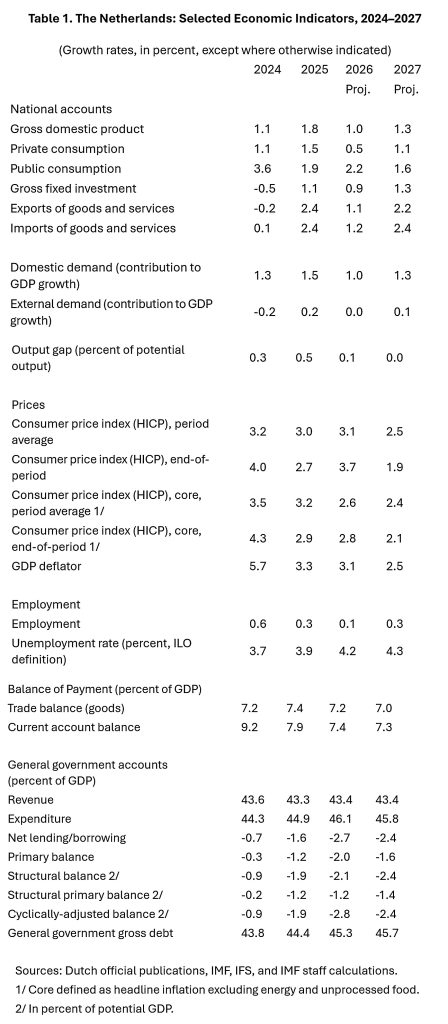
- Entering 2026 from a position of relative strength, the energy price shock from the war in the Middle East is projected to slow growth to about 1 percent and lift inflation to around 3 percent, amid unusually high uncertainty.
- The restrained and well‑targeted policy response to higher energy prices—with readiness to scale if more severe risks materialize—is appropriate. Fiscal policy should stay cautious in the near term and continue to shift toward investment‑oriented spending.
- Weak investment and binding capacity constraints—including in energy, nitrogen, labor, and housing—continue to weigh on the outlook. Addressing these challenges will require structural reforms to ease growth constraints, scale up R&D, and strengthen innovation ecosystems, alongside targeted measures to crowd in private investment, enhance high‑tech resilience, and advance deeper EU‑level coordination.
Washington, DC – July 27, 2026: The Executive Board of the International Monetary Fund (IMF) completed the Article IV Consultation for Kingdom of The Netherlands–The Netherlands on July 20, 2026[1] and endorsed the staff appraisal on a lapse-of-time basis without a meeting.
The Dutch economy is entering a more challenging phase as the energy shock from the war in the Middle East impacts an economy that entered 2026 from a position of relative strength. Growth has been resilient and buffers remain ample, even as longstanding structural bottlenecks—high private savings, weak investment, and capacity constraints—continue to weigh on productivity and medium‑term growth. The new government has articulated an ambitious agenda to ease constraints and support innovation‑led growth, but minority‑government dynamics raise implementation risks. Elevated external imbalances persist.
Notwithstanding recent momentum and solid domestic consumption, growth is expected to slow as the tensions in the Middle East weigh on activity, particularly through weaker business investment and external demand. Risks to the outlook are tilted to the downside for growth and to the upside for inflation, especially in the event of an escalation of geopolitical tensions and stronger energy price pressures.
Executive Board Assessment[2]
Despite strong starting conditions, the war in the Middle East has again tested economic resilience. Near-term prospects are unusually uncertain: energy prices have increased, inflationary pressures are re-emerging, growth is moderating, and supply-chain tensions are building. Structural bottlenecks, high savings, and low investment continue to limit the economy’s capacity to adapt.
Given the unusually uncertain outlook, the government’s response to the energy price shock is appropriate. Planned support is well targeted, restrained, and preserves price signals by focusing on vulnerable households, energy-intensive SMEs, and housing-related energy investment. Broader measures, such as price caps or VAT and fuel-tax cuts, would be costly, weaken incentives for conservation and transition, and difficult to unwind, as shown by the fuel-excise reduction introduced during the 2022 energy crisis, which remains largely in place. The government’s contingency framework appropriately calls for support to be scaled with shock severity.
Fiscal plans are well calibrated to slowing growth, provided energy-related risks are managed prudently. The broadly neutral stance over 2026–31 is appropriate. Automatic stabilizers should remain the main macroeconomic buffer, including in a severe scenario, where use of fiscal space could be directed toward energy security and the energy transition. The budget-neutral design of energy support will help contain fiscal and demand pressures in a tight labor market and remaining excess demand.
The coalition agreement rightly prioritizes investment and structural reforms but success hinges on parliamentary support and implementation capacity. Proposed measures to invest in defense readiness, ease structural bottlenecks, and support innovation-led growth are incorporated in the fiscal framework and backed by adjustment and revenue measures. Uncertain parliamentary majorities raise risk of delays and uneven implementation. Any compromise should protect growth-enhancing investment, especially in infrastructure and education.
As medium‑ and long-term spending pressures intensify, fiscal sustainability will depend on progress with fiscal structural reforms. Fiscal space is substantial, but over time, spending pressures from defense, health care, aging, and climate will intensify. While planned healthcare reforms are expected to generate sizeable savings of 1 percent of GDP from the early 2030s, realizing these will require strong implementation and prioritization. Even then, curbing aging-related spending pressures will also require parametric reforms in the tax-funded old-age pension system.
Easing structural bottlenecks is critical to raise investment, lift medium‑term growth, and reduce elevated external imbalances. The external position in 2025 was stronger than implied by medium term fundamentals and desirable policies based on preliminary assessment. Despite high corporate savings, private investment remains subdued, limiting supply expansion and slowing external rebalancing. Priorities include accelerating grid expansion and permitting, resolving nitrogen‑related constraints, strengthening skills, and facilitating labor mobility, as structural shifts—including from AI and digitalization—reshape labor demand. Addressing domestic barriers to firm scaling, including by better identifying financing gaps for growth‑stage firms and crowding in private investment, is essential to sustain innovation‑led growth and gradually reduce external imbalances. As industrial policy is increasingly steering investment, initiatives need to be managed effectively and be targeted to where externalities or market failures prevent effective market solutions, while minimizing trade and investment distortions.
Supporting innovation-led growth requires strengthening high-tech resilience through diversification and EU-level coordination amid rising geopolitical tensions. The Netherlands operates at the technological frontier, with strong clusters including in semiconductors, photonics, fintech, and agrifood. Expansion plans underscore growth potential, but also expose bottlenecks in infrastructure, skills, and permitting. Heavy reliance on foreign inputs and demand heightens vulnerability to fragmentation and supply chain disruptions. Enhancing resilience calls for supplier diversification, management of critical dependencies, and leveraging strategic interdependencies, supported by EU level initiatives such as the Chips Act, and, notably, deeper single and capital market integration.
Overall systemic stability risks in the financial sector remain significant; current capital buffer requirements should be maintained and monitoring of liquidity mismatches in real estate and corporate bond funds intensified. Tighter borrower-based macroprudential policy is needed to contain risks from housing and support affordability. Improving affordability will also require ambitious supply-side reforms to address housing shortages. Progress in strengthening system-wide stress testing, supervision, and climate risk oversight and analysis is welcome. Continued close monitoring and proactive management of risks related to the second-pillar capital-funded occupational pension system transition are essential to safeguard financial stability. Ensuring resolution and crisis-management preparedness remains a priority.
[1] Under Article IV of the IMF’s Articles of Agreement, the IMF holds bilateral discussions with members, usually every year. A staff team visits the country, collects economic and financial information, and discusses with officials the country’s economic developments and policies. On return to headquarters, the staff prepares a report, which forms the basis for discussion by the Executive Board.
[2] The Executive Board takes decisions under its lapse-of-time procedure when the Board agrees that a proposal can be considered without convening formal discussions.
See also:
IMF Executive Board Concludes 2026 Article IV Consultation with Italy | Disruption Banking
IMF Executive Board Concludes 2026 Article IV Consultation with Brazil | Disruption Banking
IMF Executive Board Concludes 2026 Article IV Consultation with France | Disruption Banking