

Prediction markets were supposed to be the future of information pricing. Polymarket, valued at over $10 billion, has spent the past year signing deals with Major League Baseball (MLB), Major League Soccer (MLS), and the National Hockey League (NHL), opening themed bars in Washington D.C., and positioning itself as a legitimate financial platform. Now, a U.S. Army soldier faces up to 50 years in federal prison for allegedly using classified military intelligence to win $409,000+ on the platform, and US Congress has seen enough.
How a Soldier Bet on Classified Intel
Gannon Ken Van Dyke, a U.S. Special Forces master sergeant, was indicted in late April 2026 by the Department of Justice (DOJ). Prosecutors allege he used classified information about “Operation Absolute Resolve,” the January 2026 mission to capture Venezuelan President Nicolás Maduro, to place over $33,000 in bets on Polymarket. Those wagers returned more than $409,000 in profit, as seen in the image below.
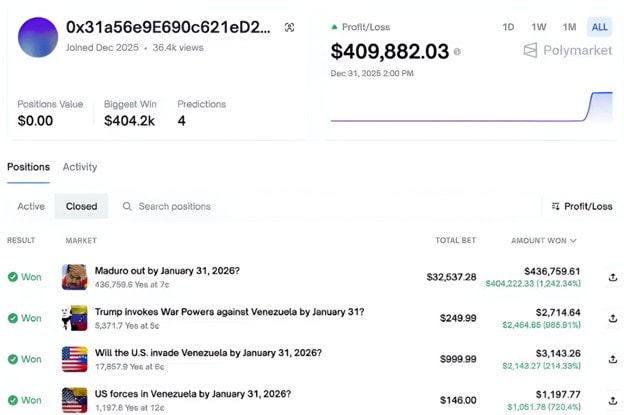
Source: X
The DOJ charged Van Dyke with unlawful use of confidential government information, theft of nonpublic government information, commodities fraud, wire fraud, and making an unlawful monetary transaction. The CFTC filed a parallel civil complaint seeking disgorgement, civil penalties, and a permanent trading ban. These are the first charges of their kind in the U.S. Van Dyke faces a maximum of 20 years on the wire fraud count alone.
CFTC Chairman Michael Selig was direct: “I have been crystal clear that anyone who engages in fraud, manipulation, or insider trading in any of our markets will face the full force of the law.”
It is also worth noting that Van Dyke used a VPN to access Polymarket’s international platform, which formally bars U.S. users, and that Polymarket does not require government-issued ID from users.
Are Prediction Markets Derivatives or Just Fancy Gambling?
The regulatory fight centers on one question: Are sports contracts derivatives or bets? The CFTC currently oversees Polymarket and Kalshi as “event contracts” under the Commodity Exchange Act. But Senators John Curtis (R-Utah) and Adam Schiff (D-Calif.) say sports contracts “are sports bets — just with a different name”. Their bipartisan Prediction Markets Are Gambling Act, introduced in March 2026, if passed, would ban any CFTC-registered entity, including Polymarket and Kalshi, from listing contracts tied to sporting events or casino-style games.
They’re not alone. Senators Jeff Merkley (D-OR) and Elizabeth Warren (D-MA), along with Representative Jamie Raskin (D-MD), have filed the STOP Corrupt Bets Act to ban contracts involving elections, sports, war, and government activities. Senator Chris Murphy (D-Conn.) and Rep. Greg Casar (D-Texas-35) rolled out the BETS OFF Act on March 17, 2026, to ban wagers on military operations, terrorism, and events where traders control the outcome.
Additionally, Senators Elissa Slotkin (D-Mich.) and Todd Young (R-Ind.), co-sponsored by Schiff and Curtis, lead the Public Integrity in Financial Prediction Markets Act of 2026 to stop federal officials from trading on insider info. None of these bills has committee hearings scheduled. But four bipartisan bills targeting the same industry in under five weeks sure deserves attention.
The catalyst: anonymous Polymarket users profited heavily by betting on U.S. strikes in Iran and the extraction of Nicolás Maduro hours before they happened. “When public officials use non-public information to win a bet, you have the perfect recipe to undermine public trust,” said Sen. Merkley.
States Strike First, Polymarket and Kalshi Retaliate, Feds Follow
While Congress debates, states moved fast. Arizona filed criminal charges against Kalshi in March 2026 for operating as an unlicensed bookmaker. Massachusetts and Michigan sued Kalshi for allegedly offering illegal sports betting. Minnesota’s SF 4511, headed to the Senate floor, would ban prediction contracts on sports, elections, weather, and pop culture starting August 1, 2026. New York’s ORACLE Act and New Jersey’s A 4689 are pushing similar state bans. Brazil already banned sports and political derivatives, with blocks starting May 4, 2026.
In retaliation, Polymarket filed a countersuit against Michigan in early March to block state enforcement. Kalshi has also sued Arizona, Iowa, and Utah.
The CFTC itself flipped. After years of treating sports contracts as “gaming” and barring them, Chair Michael Selig is now intervening in litigation and relaxing enforcement. MLB cited that shift when it partnered with Polymarket: “The CFTC is greenlighting these markets,” Sen. Schiff argued.
The industry’s legal bet now is on federal preemption. That argument becomes much harder if Congress moves first.
Trump Calls It a Casino While His Family Invests in the Game
When asked about the Van Dyke probe, and suspicions of insider trading, betting on the Iran conflict, President Trump invoked Pete Rose and then said: “Well, you know, the whole world, unfortunately, has become somewhat of a casino… I was never much in favor of it. I don’t like it, conceptually. But it is what it is. No, I think that I’m not happy with any of that stuff… It’s a crazy world.” That is a striking statement from a former casino owner whose son, Donald Trump Jr., is both a Polymarket investor and a board member of Kalshi, Polymarket’s main competitor.
The Trump administration has also made enabling Polymarket’s U.S. operations a stated second-term priority. Four years after Polymarket paid $1.4 million to settle with Biden-era regulators and banned American users, it has been actively lobbying for full U.S. market access under the new administration. That political entanglement limits how forcefully Trump can push back, even as the DOJ files charges and a bipartisan Senate coalition moves to restrict the entire sector.
$63 Billion in Volume: Why Sports Leagues Are All In on Prediction Markets
Prediction market trading volume hit over $63 billion in 2025, with 80%+ from sports. That’s why the sports betting industry is lobbying hard. Senator Cortez Masto (D-NV) says these contracts “fall entirely within the jurisdiction of tribes and states”. Sen. Curtis warns they’re offered “in all fifty states in clear violation of state and federal law”.
Meanwhile, March Madness contracts on prediction markets topped $100 million in volume and Super Bowl volume passed $1 billion in 2026. If MLB is getting $300M/year, the NFL’s price could be “much more,” per NBC Sports.
What Happens Next for Prediction Market Regulation: Ban, Regulate, or Federalize?
Polymarket CEO Shayne Coplan tried to reframe the Van Dyke arrest as a compliance win, writing on X (formerly Twitter): “Every trade is public, permanent, and auditable. Bad actors leave a trail.” That argument has limited merit. Transparency is not the same as market integrity. The fact that Van Dyke was eventually identified does not make war-related betting markets defensible.
The OpenAI employee fired for Polymarket insider trading, the Israeli Air Force insider trading investigation, and French police examining whether temperature measurement infrastructure was manipulated for a weather bet all point to the same structural problem: the platform’s global footprint has outpaced its risk controls. This is not a one-country compliance gap.
Both Kalshi and Polymarket announced new insider trading guardrails in March after the Senate bill was introduced. Neither addressed the structural question of whether markets tied to covert military operations should exist at all on a federally regulated exchange.
The prediction market industry now faces a hard choice: reshape itself before Congress legislates the specifics, or wait and lose the framing entirely. At the current trajectory, the latter looks increasingly likely.
Author: Richardson Chinonyerem
The editorial team at #DisruptionBanking has taken all precautions to ensure that no persons or organisations have been adversely affected or offered any sort of financial advice in this article. This article is most definitely not financial advice.
See Also:
UAE Exits OPEC | Disruption Banking
Is Jane Street About to Walk Free from the Terra Collapse Scandal? | Disruption Banking
The $1B Banana Feud: Justin Sun Sues the Trumps | Disruption Banking

Richardson Chinonyerem
Contributing author at Disruption Banking, covering capital markets.