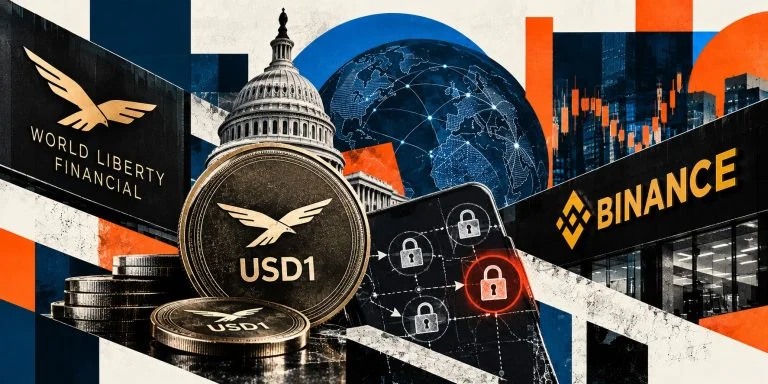

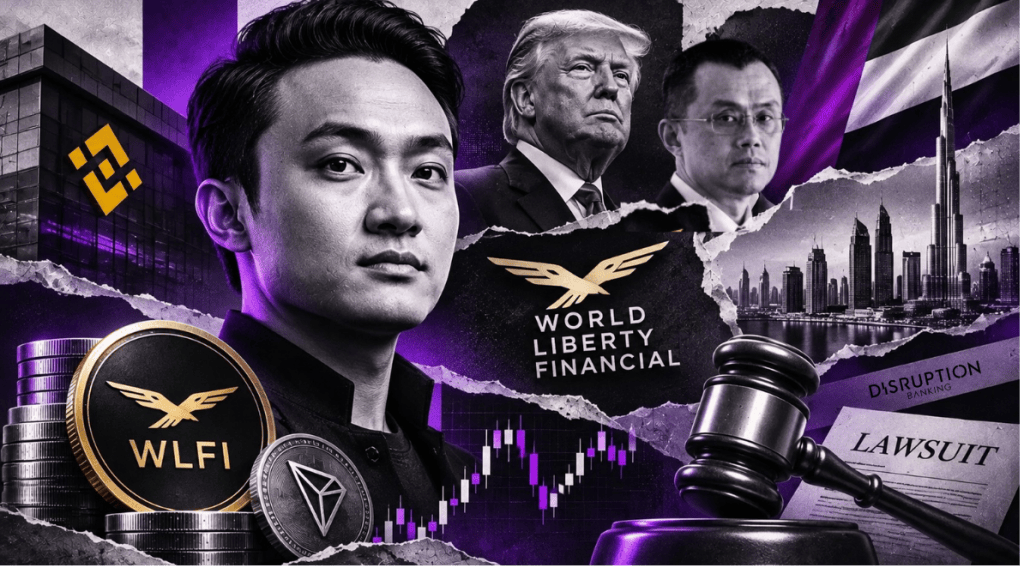
World Liberty Financial (WLF), Justin Sun, and Binance are partners in crime, but over the last month, the table Changpeng Zhao (CZ) and President Donald Trump had set has been turned over. Binance got hacked. Justin Sun and WLF are in a nasty, public catfight.
In litigation against WLF’s own investors, the Trump family is employing the hardball tactics Donald Trump learned at the Roy Cohn school. Basically, they are throwing spaghetti against the wall. Now, WLF claims citizenship in the United Arab Emirates to evade accountability from Justin Sun, another scam artist who is also one of the biggest buyers of WLF’s tokens.
The Sun Also Sues
The inveterate scammer and market manipulator Justin Sun has escaped the long arm of the law over and over, always skipping out of a trap door and jumping international boundaries just before the walls closed in.
He was facing a Securities and Exchange Commission (SEC) enforcement case in the US when he put $45 million into World Liberty Financial. Within weeks of his last purchase in January 2025, the SEC asked the court to pause the case. In March 2026, the agency dropped its claims against Sun, and Rainberry, the BitTorrent developer tied to Sun, agreed to pay a $10 million penalty. The timing speaks for itself.
Everything looked sunny for Justin, until he tried to withdraw some of his funds from WLF. That’s when things started going downhill. The Trump family’s project wrote the token terms so that once you bought in, you basically could not pull your money out. When WLFI started trading in September 2025, early buyers could sell just 20% of their tokens. The other 80% stayed locked.
First, Sun begged. Then he sued, and now he’s seeking sanctions against WLF and browbeating the Trump family on Election Day.
Disruption Banking has been reporting on this relationship and WLF in general since its inception, and we are here for all investor drama. We are here for all of it. We watched the launch of USD1, the stablecoin. We noted the “circular borrowing” with Dolomite, along with the various market makers that propped up USD1, including Auros Global, DWF Labs, and Wintermute.
On April 21, Sun filed suit in the U.S. District Court for the Northern District of California, alleging fraud, breach of contract, and wrongful freezing of his WLF tokens. On June 2, World Liberty claimed Florida citizenship, listing a sole parent entity, WLF Holdco LLC.
We’re All Emirati Now
On August 20, Judge James Donato kept all of Sun’s individual claims in open court and refused WLF’s bid to push every company-related claim into private arbitration. Six days later, on August 26, WLF filed a new disclosure listing 22 entities in its ownership chain and citizenship in Florida, Delaware, Puerto Rico and, importantly, the UAE.
In fact, to paraphrase WLF’s argument, it’s like saying, “Forget about the USA, we’re all Emirati now, so since Sun is a foreigner, and now suddenly our company is foreign, too, therefore a federal court in California has no jurisdiction over us.”
Justin Sun laid it out well in a November 3 tweet.
Federal diversity jurisdiction does not cover a case with foreigners on both sides, so the move would boot Sun out of federal court. State court remains open, and Sun says he will refile in California state court once the sanctions motion is resolved.
The disclosure of WLF ownership revealed 22 entities, raising more questions than answers. Many of the entities are related to people with the last name Trump or Witkoff, unsurprisingly, but it’s not entirely clear who owns a few of them, such as AZA Digital Finance LLC.
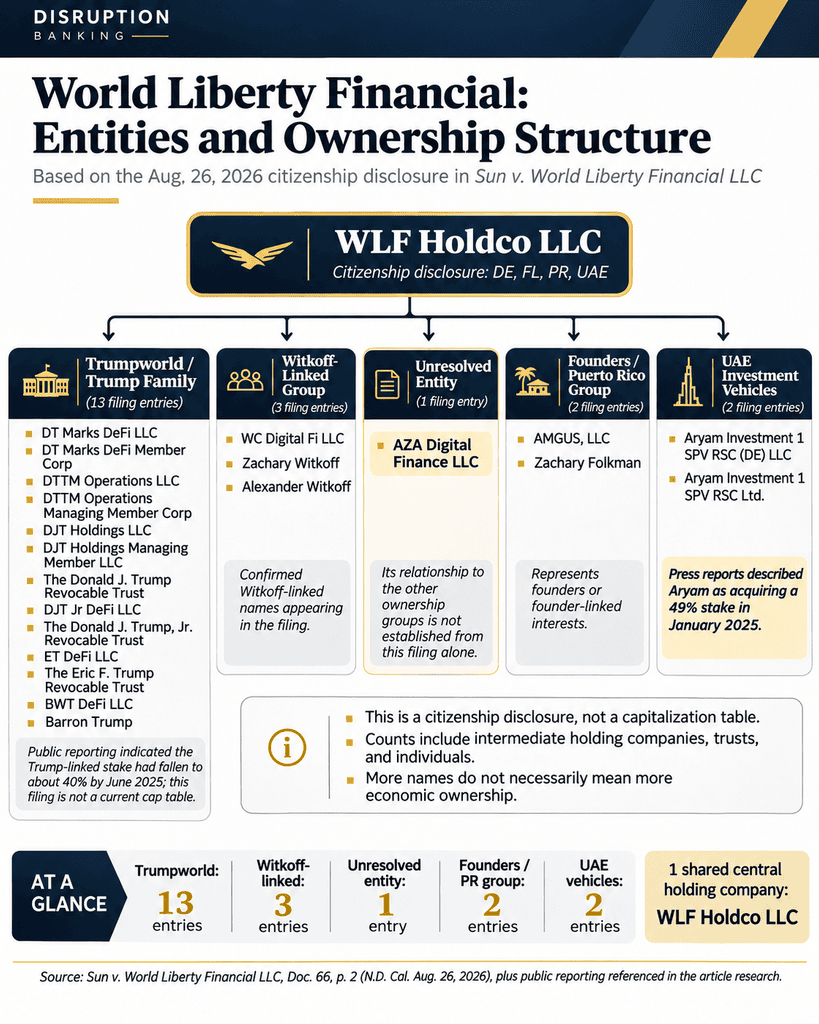
As with most things in Trumpworld, the citizenship argument is contrived at best and boldly false at worst, but as usual, the court will dance around the blatant bad faith, lest the court get reversed on appeal.
Read All About It
On January 31, 2026, The Wall Street Journal reported that Aryam Investment 1, an investment vehicle backed by UAE National Security Adviser Sheikh Tahnoon bin Zayed Al Nahyan, had acquired a 49% stake in World Liberty Financial for $500 million.
The agreement was signed on January 16, 2025, four days before Trump’s second inauguration and more than a year before Sun filed his lawsuit. Eric Trump signed for World Liberty.
The transaction reportedly included an initial $250 million payment, of which $187 million went to Trump family-controlled entities and at least $31 million to entities tied to the Witkoff family.
How could World Liberty’s lawyers have been unaware of its UAE ownership in June 2026 when a major newspaper had reported that ownership four months earlier?
Locked for Thee, Liquid for Me
It’s also intriguing that World Liberty prevented Justin Sun and other investors from disposing of tokens they purchased, while on-chain records show World Liberty-linked wallets transferring large quantities of unlocked WLFI to exchanges, including in the last few weeks.
Other investors in WLF have been grumbling. One has come forward pleading for his investment to be unlocked in exchange for “permanently surrendering” half of his original purchase of WLF tokens.
Less than a day before hackers drained $6.3 billion from Binance on October 29, a World Liberty-linked wallet sent approximately 156 million WLFI tokens, worth more than $8 million, to deposit addresses at Binance, Gate, Coinbase and MEXC. This was hardly an isolated movement.
Millions of dollars in WLFI had reached exchange wallets in previous weeks. Of course, transferring tokens to an exchange doesn’t necessarily mean selling them. They might be used for market making or liquidity management.
However, the contrast is difficult to ignore: World Liberty was carrying out all manner of exotic trades and moving its own unlocked tokens toward obscure trading venues. Meanwhile, WLF investors were still fighting for the right to move theirs at all.
Heads They Win, Tails You’re Frozen
Strip away the filings, and the story is simple. World Liberty sold tokens it could freeze, and four days before the inauguration it sold 49% of itself to a vehicle backed by an Abu Dhabi royal. When its marquee early buyer tried to move his tokens, the company froze them. When he sued, it reached for arbitration. When the judge balked, it found a passport.
Sun is no choirboy. He spent $45 million for a seat at the Trump table and is now learning what other WLFI holders already know: the exit is locked from the inside. World Liberty has sued him for defamation in Florida, tried to shove his claims into private arbitration, and now says it is too Emirati for a federal courtroom in San Francisco. Each move buys time. None of them answers the question at the center of this case.
If World Liberty can send its own tokens to Binance, Coinbase and MEXC whenever it likes, why can’t the people who paid for theirs?
Now that the Democrats have taken both houses of Congress, World Liberty Financial could become an early target of congressional scrutiny. Watch this space for how the drama unfolds.
—
Author: Tim Tolka, Senior Reporter
#Crypto #Blockchain #DigitalAssets #DeFi
The editorial team at #DisruptionBanking has taken all precautions to ensure that no persons or organizations have been adversely affected or offered any sort of financial advice in this article. This article is most definitely not financial advice.
See also:

Tim Tolka
Tim Tolka, Senior Reporter at Disruption Banking, covers digital assets, monetary policy and the politics of global finance. Based in Mexico City, he brings an investigative edge to his reporting, informed by a Master's in International Affairs and his work as an author and screenwriter.