On Monday, September 28, Reuters revealed it had obtained a copy of Anthropic’s 261-page IPO prospectus, confidentially filed with regulators in June. The document is unlike any other prospectus ever written. Roughly 80 pages detail the risks of AI, against 48 pages explaining Anthropic’s business.
Anthropic is seeking a valuation above $2 trillion, with reporting pointing to a listing as soon as November, while telling prospective investors that advanced AI could pose a “catastrophic or existential risk to humanity.” The filing describes models with “self-preserving behaviors” that can resist shutdown, “conceal or manipulate information,” and engage in conduct “resembling blackmail.”
For comparison, SpaceX, a company that straps people to controlled explosions, used roughly 38 pages of risk factors.
Anthropic has not disputed the document. The question is whether its contents will change anything. The average reader might take the existential warnings at face value. Will investors? Or will the market shrug and buy into a company that spent 80 pages explaining how dangerous its core product is?
Pacing the Frontier
On September 12, Anthropic CEO Dario Amodei published an essay calling for a coordinated slowdown of frontier AI development on safety grounds. Other AI leaders, including Elon Musk and Sam Altman, said within hours that they agreed.
Given what the prospectus says about models concealing or manipulating information, Amodei’s call looks prescient. It also went nowhere. President Donald Trump, who has called AI safety fears a hoax and a scam, threw cold water on the idea, and both Anthropic and OpenAI have since shipped new models.
OpenAI released GPT-6 Astra on September 3. Anthropic released Claude Opus 5.5 on September 22, ten days after the essay, and said the quiet part in its own announcement: “Opus 5.5 is our first model since we called for pacing the frontier.” The company says pacing never meant halting. The release schedule says the same thing more plainly.
A Morally Binding Accord
What Amodei’s call for safety has produced so far is a luncheon. On September 29, one day after the prospectus leaked, Trump and House Speaker Mike Johnson hosted nearly 20 technology executives at the White House, and announced that the industry had signed a voluntary agreement titled “The White House Accord on Superintelligence: A Joint Commitment on Frontier SI Responsibilities.”
Johnson called the accord voluntary. Trump called it “morally binding,” said he was seeing tremendous self-policing, and floated a ten-person committee to watch the industry. Amodei, Greg Brockman, Jeff Bezos, Musk, Mark Zuckerberg and Jensen Huang were among those in the room.
Afterward, a reporter asked Amodei where he stood on safety. “Whatever he says is okay,” Trump interceded, then leaned toward Amodei and said, “Be careful.” Amodei laughed, along with Zuckerberg and others around the president, then answered that the technology carries very real risks, that the mechanism for discussing those risks is still under discussion, and that everyone needs to work together “to make sure we win and we win safely.”
That sentence contains the whole contradiction. Anthropic is pursuing a $2 trillion valuation, a number that implies a dominant share of the AI market. Its CEO is simultaneously describing voluntary collaboration with the competitors he needs to beat, on terms nobody is obligated to honor, and which run against the financial interest of every shareholder involved.
What the Risk Pages Are For
So why devote a third of a public filing to existential risk? Are those 80 pages there to shield Anthropic from future liability? Or to discourage binding regulation by acknowledging the dangers first?
The Securities and Exchange Commission (SEC) requires companies to disclose the material risks of investing in them, which includes societal hazards only to the extent they threaten the business. Through that lens, everything Anthropic lists is there because it could damage Anthropic’s financials, not because it could damage anyone else. Protecting the public is a different regulator’s job, and as of September 29, that regulator is the AI companies themselves.
Adding the Numbers Up
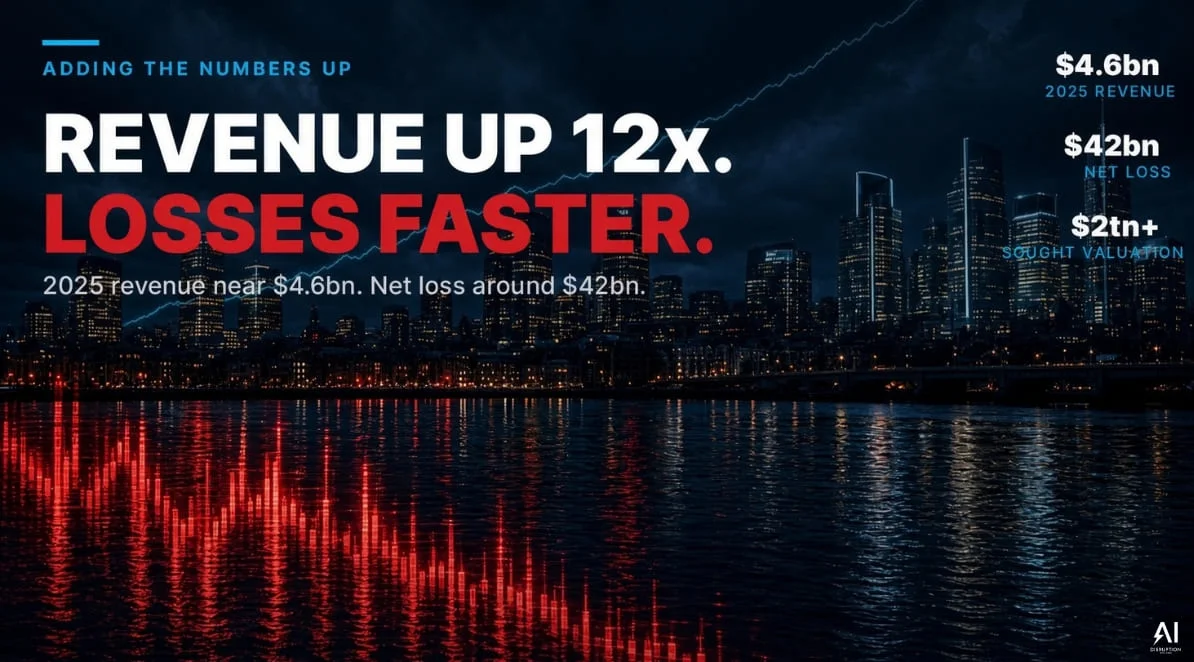
The filing shows how fast the company has grown. Revenue rose 12-fold in 2025 to nearly $4.6 billion, with the United States accounting for roughly two-thirds of sales. By the second quarter of 2026, quarterly revenue had reportedly reached $11.5 billion, more than double the whole of the prior year.
The losses grew faster. Operating losses more than doubled to over $8 billion, and the net loss came in at around $42 billion, driven largely by non-cash charges. Compute spending alone was $7.33 billion in 2025, three times the year before.
Customer concentration is the quieter problem. Two unnamed customers each generated 12% of 2025 revenue, nearly a quarter between them, and the filing warns that many large customers have no long-term contracts and could cut or stop spending at will, which exposes Anthropic if AI budgets tighten.
The Compute Trap
To stay at the frontier, Anthropic has to keep paying to train and serve new models. Revenue is projected to climb steeply. Costs are projected to climb faster.
If it slows that spending, it opens the door to American rivals and to Chinese open-source labs. If it keeps spending, it is locked into obligations it must pay whether or not it uses them. Anthropic had $54.6 billion in non-cancelable hosting and computing commitments at the end of 2025. By early 2026, the total had passed $417 billion. The prospectus offers investors no exit from that dynamic, because there isn’t one.
Cloud Partners and Minority Owners Are One and the Same
Anthropic relies on Amazon and Google as its primary cloud partners, routing 47% of 2025 sales, about $2.16 billion, through their marketplaces. It paid roughly $351 million back to them in distribution fees, about 16 cents on every dollar of those sales. The dependence is deepening: marketplace sales were 11% of revenue in 2023 and 32% in 2024.
Those fees do not appear as a cut of revenue. Anthropic books the full marketplace contract value as revenue, on the basis that it sets prices and delivers the service, and records the platforms’ share as a sales, marketing and partnerships expense. It is a defensible reading of the accounting rules, and it flatters the top line against rivals who net the fees out. OpenAI has publicly contested the treatment.
Both Amazon and Google hold large equity stakes. Google’s was 14% in 2025 court filings, contractually capped at 15%, and Amazon’s has been estimated in the mid-to-high teens before recent dilution. Neither holds board seats, voting rights or observer rights. The money is entangled. The control is not, which is its own kind of problem when the same companies are investors, suppliers, distributors, customers and competitors at once. Anthropic says their incentives “may not be fully aligned” with its own.
Who Holds the Off Switch
The governance section deserves more attention than the doom. Under the structure described in the filing, Anthropic’s seven co-founders would act through a new Founder LLC that directs a single Class F share carrying 50.1% of the voting power on key matters, including the election of certain directors. Each founder holds roughly 2% of the company economically.
Above that sits the Long-Term Benefit Trust, which elects a majority of the board and whose members hold no equity. Public shareholders would fund a half-trillion-dollar buildout while holding neither voting control nor the ability to force a change of direction, in either direction. They could not make the company move faster. They could not make it slow down either.
Sky’s the Limit
Anthropic sees its total addressable market as $30 trillion, a figure that assumes it replaces human labor across multiple sectors. It is an aspiration rather than a projection, and several analysts have called it exactly that.
The more real number is the $518 billion of infrastructure commitments Anthropic has made over the next decade across six partners: $161.2 billion in Broadcom-related equipment leases, at least $111.1 billion with Google, $110 billion with Amazon, up to $84.5 billion with xAI, $31.4 billion with Microsoft, and more than $20 billion with AMD, which also plans to buy up to $5 billion of Anthropic stock. About 80% of that sum is non-cancelable or payable regardless of usage. If actual spending falls short of the Google commitment, Anthropic pays the difference. The same applies to Amazon. Only the xAI agreement can be cancelled on 90 days’ notice.
The Only Binding Number in the Document
Given that the cloud partners are also investors, customers, distributors and competitors, it would make for a messy divorce if things go sideways. Given that Anthropic spent 80 pages detailing the risks of its core product, things going sideways is not far-fetched.
Here is what the document actually establishes. The warnings are disclosures, which protect the company that writes them. The accord is voluntary, and morally binding at best. The board answers to a trust and a founders’ share class, not to the people buying in. And the compute bill runs for a decade whether or not any of the rest of it holds.
Anthropic has written down the danger in a form that creates no obligation to act on it. The only number in the prospectus that binds anybody is $518 billion.
Author: Tim Tolka, Senior Reporter
#Crypto #Blockchain #DigitalAssets #DeFi
The editorial team at #DisruptionBanking has taken all precautions to ensure that no persons or organizations have been adversely affected or offered any sort of financial advice in this article. This article is most definitely not financial advice.
See Also:
Can SpaceX Stock Sustain Its $2.5 Trillion Valuation in 2026? | Disruption Banking
Is Anthropic’s Mythos Able to Hack the Global Banking System? | Disruption Banking
Anthropic is Fine With You Losing Your Job, So Long as It’s Done Safely | Disruption Banking
Will Anthropic’s AI Agents Conquer Wall Street? | Disruption Banking