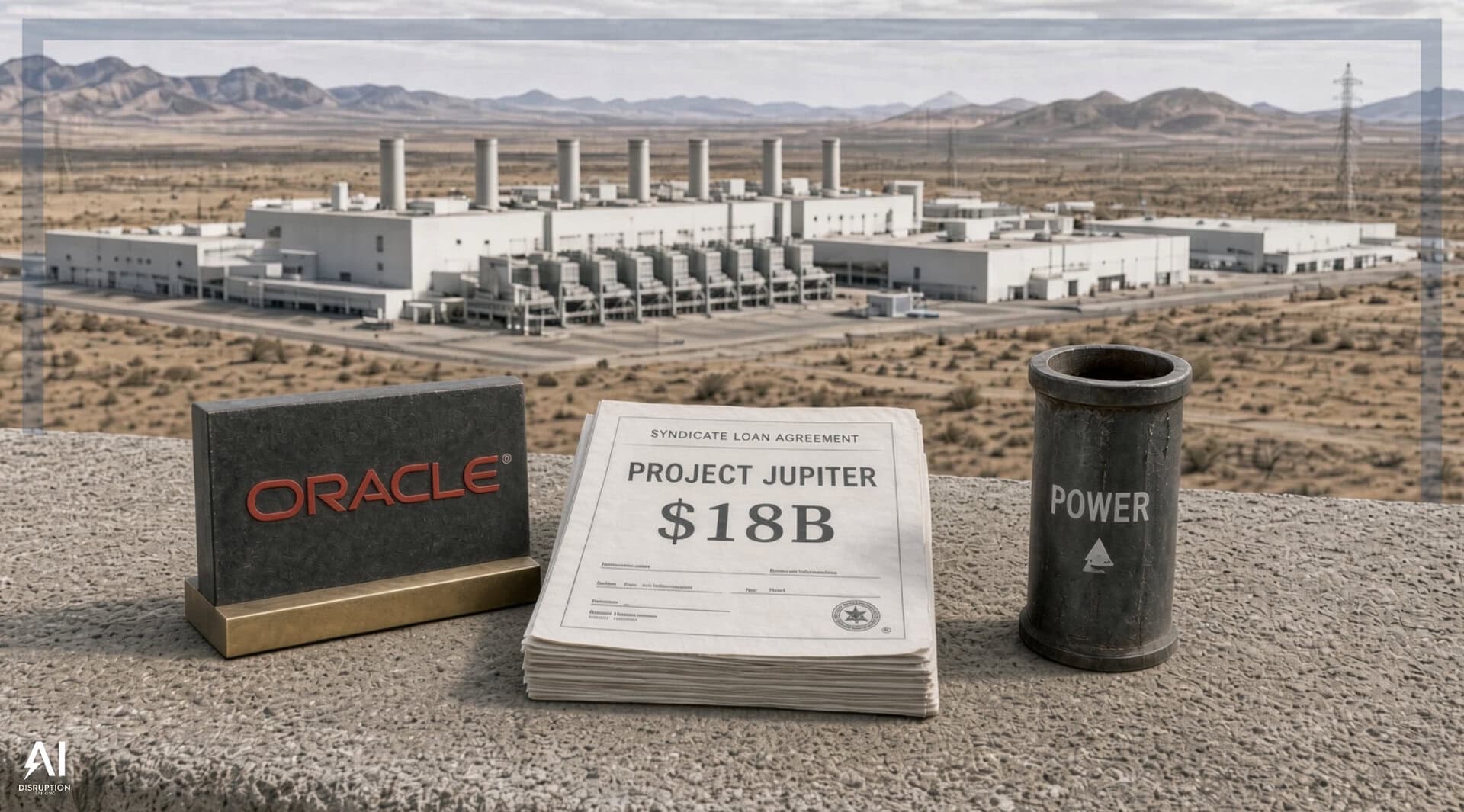
AI data-centre financing could become a systemic risk if a setback in power, demand or asset values forces banks and investors exposed to related debt to retrench at once. No evidence of such a cascade exists today. But syndicate banks, including Santander and Jefferies, quoted about $18 billion in loans tied to an Oracle-leased New Mexico data centre at 89 to 91 cents on the dollar, Reuters reported, citing the Financial Times. The question that follows is how much of that debt the banks can sell, and at what price.
Reuters reported that AI-related corporate bonds carried spreads of around 115 basis points, against 78 for the broader investment-grade market. These are different borrower groups; the gap cannot isolate data-centre default risk. Portfolio managers cited issuance volume and exposure limits, not an expected wave of defaults. Buyers are becoming more selective as financing needs grow.
Why are Oracle-linked loans still with banks?
The loans finance Project Jupiter, a New Mexico campus Oracle is leasing to provide computing capacity under its wider agreement with OpenAI. Attempts to place the debt with a wider investor base have reportedly stalled amid concern about Oracle’s borrowing and local opposition. A state land office also blocked a request for a gas pipeline intended to supply the site, according to the FT report. The blocked request is an obstacle to the original power plan.
The $18 billion is project-linked debt, not an identified corporate loan to Oracle. The reporting does not establish who guarantees the loans or exactly how much each bank still holds. A quote at 89 to 91 cents is neither a completed sale nor a default.
Under US Office of the Comptroller of the Currency guidance, loans transferred to held-for-sale are recorded at the lower of cost or fair value, with any reduction reflected as “a write-down of the recorded investment.” Without the banks’ carrying values, accounting classifications and retained positions, a quoted market price cannot by itself be converted into a bank-loss figure.
BREAKING: About $18 billion in loans tied to an Oracle-leased (ORCL) data center in New Mexico has come under pressure, according to the Financial Times.
— Mohini Maheshwari (@mohinimaheshwa) September 21, 2026
The 1,400-acre "Project Jupiter" campus in Doña Ana County is part of Oracle's broader agreement with OpenAI to provide AI… pic.twitter.com/V46PykaxMR
Who holds the debt after banks sell it?
In April, two QTS Fayetteville entities completed a $4.6 billion offering of senior secured notes due in 2036. Counsel to the initial purchasers described it as a non-recourse bond on a single data-centre asset. The FT reported strong orders, supported by a long-term Microsoft tenancy. Investors bought bonds issued by project entities; they did not buy Microsoft corporate debt.
Meta’s Hyperion campus illustrates the same distinction. In October 2025, Meta announced a Louisiana joint venture owned 80 percent by Blue Owl-managed funds and 20 percent by Meta, with roughly $27 billion in development costs. The initial leases run for four years, with extension options. Meta also provided a conditional, capped residual-value guarantee covering the first 16 years of operations. This protects an agreed asset value under specified circumstances; it is not an unconditional promise to repay every creditor.
Disruption Banking previously examined how Blackstone-owned QTS moved data-centre debt into bond markets. Oracle’s reported syndication problem tests the other end of that process: what happens when a bank cannot find buyers at the expected price? The QTS sale shows there is capital for some structures. It does not show that every unfinished campus can clear on similar terms.
Could credit protection spread the risk further?
In August the FT reported that JPMorgan Chase, Morgan Stanley and SMBC had explored synthetic risk transfers for data-centre exposures. In such a deal, a bank keeps its loans but transfers part of its credit risk through a guarantee or derivative. The report does not establish that those data-centre transactions closed or identify who might have sold protection.
The Bank of England (BoE), in its July Financial Stability Report, highlighted that synthetic-risk-transfer (SRT) allows banks to transfer credit risk to third parties and potentially free capital for further lending. The investor base has broadened to include credit funds, hedge funds, pension funds and insurers. That spreads the exposure beyond the originating bank rather than making it disappear.
The Bank also warns that credit risk transferred outside the banking system may “re-enter it through banks’ exposures to NBFIs holding SRT positions.” That can make “the distribution of risk across the system more complex and less transparent.” Without disclosure of the buyers, leverage and collateral behind any data-centre SRTs, it is not possible to determine where those losses would ultimately sit.
How could data-centre debt become systemic?
One troubled loan does not threaten the system. A broader problem would require several financing channels to tighten together: banks unable to distribute loans, investors repricing similar bonds, and protection sellers pulling back as developers seek fresh funding.
The BoE’s July Financial Stability Report identified a shared vulnerability: long-term debt often finances buildings that may become less valuable sooner if they cannot support newer AI hardware. Its Financial Policy Committee (FPC) also flagged uncertain computing demand, power availability and depreciation. It said outstanding AI-company debt remained relatively modest at the start of 2026, limiting immediate risk, while public, private and structured financing expanded. That debt figure does not capture every project vehicle.
Banks can also be exposed indirectly. The Federal Reserve Bank of Chicago noted in February that “a bank may lend to a private credit institution providing funding for a data center,” meaning stress at the underlying project could also weaken the non-bank borrower that financed it. The Chicago Fed said these indirect channels are difficult to quantify with regulatory data. That makes the risk harder to map: a bank may have exposure to the same investment cycle through direct data-centre loans and through financing provided to funds or private-credit firms backing similar projects.
For now, the evidence points to a vulnerability rather than a systemic event. The Chicago Fed estimated direct outstanding exposure to AI-adjacent industries at about 0.8% of total assets. Across large banks, C&I outstanding to that same group averaged about 9% of Tier 1 capital, with committed exposure closer to 25%. That book includes software and infrastructure borrowers as well as data-centre construction and secured loans; the note did not treat data centres as a separate concentration versus Tier 1. The question is what happens if those direct and indirect exposures come under pressure at the same time.
What should investors watch next?
Bessent’s remarks do not answer the funding question. On September 21, the US Treasury secretary Scott Bessent told CNBC the administration would not give AI laboratories a government “liability shield”. He was talking about legal responsibility for AI systems and their operators. He did not announce a policy on rescuing project lenders or guaranteeing data-centre debt.
"What did they try to do last week? It was, well there's a 10 percent chance that we destroy the world, but we want the government to give us a liability shield and that's good business for them, bad business for the American people."
— CNBC (@CNBC) September 21, 2026
Treasury Secretary Scott Bessent discussed… pic.twitter.com/zCzUdCJx19
For creditors, the next evidence is the amount of Oracle-linked debt actually placed, its sale price, banks’ retained positions and any contractual guarantees. Compare projects by tenant, lease terms, power delivery, construction progress and debt seniority. Equity investors should watch whether a tenant can meet its capital commitments without eroding cash flow; a project-loan quote cannot be treated as an Oracle corporate loss.
The test is whether banks can distribute these loans, transfer risk to investors able to carry it through a downturn, and whether comparable projects still attract buyers without growing concessions. Those outcomes will tell banks, insurers and bondholders more about the chance of a wider financial shock than the headline size of the AI build-out.
Author: Richardson Chinonyerem
The editorial team at #DisruptionBanking has taken all precautions to ensure that no persons or organisations have been adversely affected or offered any sort of financial advice in this article. This article is most definitely not financial advice.
See Also:
Did Blackstone Really Get the Data Center Risk Off Bank Balance Sheets? | Disruption Banking
Why Big Tech Is Borrowing for Data Centers Instead of Spending Its Own Money | Disruption Banking
How Data Centers Came Between Trump and Texas | Disruption Banking