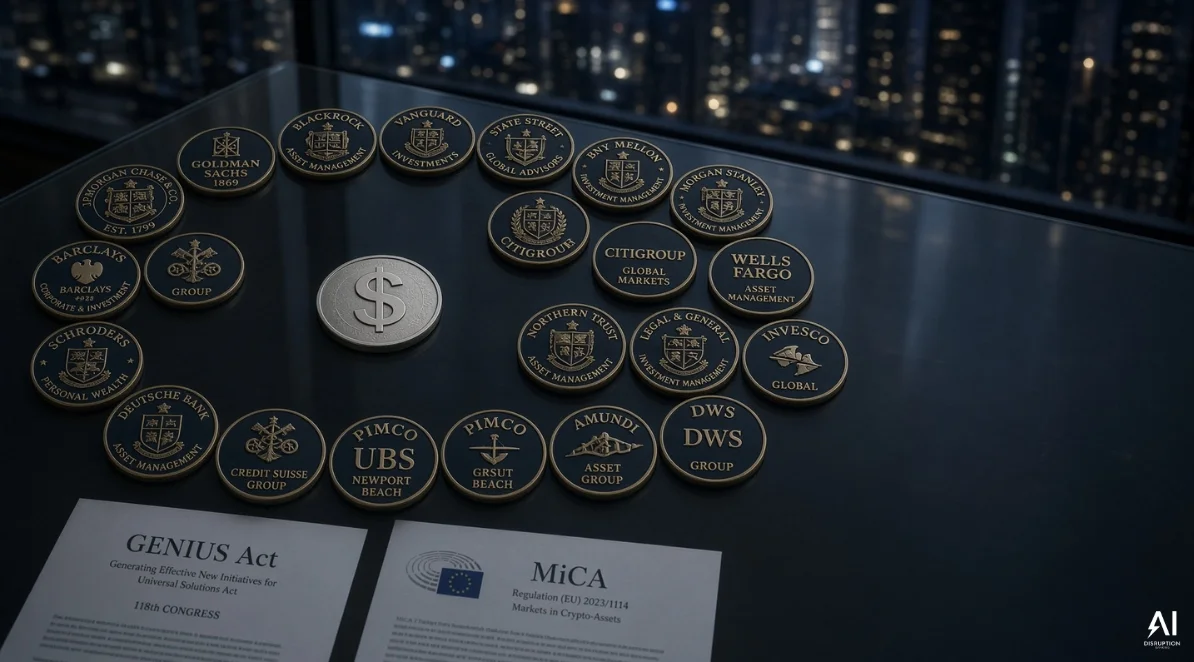
On June 30, 2026, an independent consortium called Open Standard announced Open USD (OUSD), a dollar-pegged stablecoin backed by more than 140 companies spanning payments, banking, and technology.
The roster includes Visa, Mastercard, American Express, Stripe, BlackRock, BNY, Standard Chartered, Google, Shopify, and Coinbase, which confirmed that OUSD is coming to Base and other leading chains this year. The token itself won’t go live until later in 2026. The market reaction arrived within hours.
Open USD is coming to @Base and other leading chains this year.
— Coinbase 🛡️ (@coinbase) June 30, 2026
We're joining 140+ industry leaders to support @openstandard, as we work to bring regulated, high-quality products to our customers, and build stablecoin infrastructure at scale. https://t.co/QmVGmWz8xZ
Open USD Yield Sharing for 140 Firms
Businesses will be able to mint and redeem Open USD with no fees and no volume limits, and most of the income earned on the token’s reserves will flow to participating companies after a management fee. That reverses the model that built the two dominant stablecoins. Circle and Tether park reserves in short-term Treasuries and keep the yield. USDC’s market capitalization sits near $73 billion, while Tether’s USDT circulates around $145 billion, in a stablecoin market that has grown past $300 billion, which Citi projects could reach $4 trillion by 2030.
Open Standard is led by Zach Abrams, co-founder of Bridge, the stablecoin infrastructure firm Stripe acquired in 2024. Abrams argues businesses need a stablecoin that is “open, low-cost, high-throughput, broadly accessible and aligned to their interests.” Governance sits with a board drawn from partner firms rather than a single issuer. Stripe has already said OUSD will become the default stablecoin across its platform.
Circle Shares Fall 17 Percent
Investors treated the announcement as a direct hit on Circle’s revenue model. Shares fell more than 17% on June 30, closing below $63, the stock’s weakest level since late February and down 55% from mid-May. CEO Jeremy Allaire pushed back, saying Circle welcomes “continued innovation and competition in the space.”
Some analysts agree the selloff overshot. William Blair called the competition concerns overblown, comparing OUSD to failed payment consortiums such as MCX and Paze. We examined the fragility behind stablecoin growth in our analysis of stablecoin instability, and the consortium model doesn’t remove those risks. It redistributes them across 140 boardrooms.
Coinbase Open USD Revenue Conflict
Coinbase’s position is the most awkward in the group. The exchange shares revenue collected from USDC reserves with Circle, and its subscription and services segment, which includes USDC income, represented 44% of first-quarter revenue. Its $908 million Circle arrangement comes up for renegotiation in August. There’s history here too: Coinbase co-founded USDC’s Center Consortium with Circle in 2018, before the two dissolved it in 2023, with Circle paying roughly $209.9 million in stock for Coinbase’s stake.
Chief business officer Shan Aggarwal called stablecoins “the most important thing happening in payments right now.” Backing both horses is the tell. As we noted in our coverage of USDC’s Q1 surge, the cash layer of tokenized finance is now contested territory.
OUSD launches natively on Solana, with Stellar, Base, and Polygon to follow later in 2026, under the GENIUS Act framework signed in July 2025. The partner list guarantees attention, not volume. That’s the number to watch when the token ships.
Author: Ayanfe Fakunle
This article is most definitely not financial advice.
See Also:
Why is Coinbase leaving Delaware for Texas? | Disruption Banking
Clarity Act: Ripple Says Yes, Coinbase Walks Away | Disruption Banking