A shell company used by the Trump family to buy its own stablecoin also owns the crypto card company behind Ghana-based fintech that advertised a sanctions-busting bank card. You can’t make this stuff up.
“Instantly get a Crypto Virtual Card that works in Iran. Fund it with Bitcoin, USDT, or other crypto. No KYC is needed. Bitsika Crypto Virtual Cards work on international platforms where Iranian bank cards are declined due to sanctions.”
That’s the promotional page run by Bitsika, a Ghana-based fintech that services mostly emerging markets. It ran for two-and-a-half months before fintech reporter Jason Mikula exposed the page, and Bitsika removed it.
Since then, Bitsika has apologized and offered a clarification on its webpage, in which the company explains how it utilized Anthropic’s Claude to make pages for hundreds of individual markets, and no human eyes had personally reviewed the Iran page before it went live.
Layers Upon Layers
Although the dangers of AI could be seen as the main takeaway from this story, there is another layer. Bitsika doesn’t have a direct relationship with banks. Instead, it employs a middleware fintech company that issues virtual and physical multi-currency payment cards.
That company, located in Quebec, is called MSwipe, (or Stradacarte depending on the location). It is likely through MSwipe’s No KYC (know-your-customer) card offerings, that Bitsika was able to offer a product that evaded Iranian sanctions.
MSwipe, itself, is a subsidiary.
In May of 2025, MSwipe was acquired by ALT5 Sigma, an obscure U.S. fintech. However, Alt5 Sigma’s obscurity would soon end. In August of 2025, ALT5 Sigma acquired $1.5 billion of crypto tokens from WLF, of which the Trump family collected $500 million. The company later changed its name to AI Financial.
WLFI, the governance token of World Liberty Financial (WLF), is the Trump family company’s primary profit engine. While initially propped up by rich foreign nationals, such as Tron founder Justin Sun and UAE Sheikh Tahnoon bin Zayed Al Nahyan, the token was then made available to stock investors via the ALT5 Sigma/AI Financial deal, the firm’s stock acting as a proxy investment for WLFI.
However, since August of 2025, the WLFI token has plummeted over 75% in value, and AI Financial is in danger of being delisted by Nasdaq. This storyline, including the Trump family’s $500 million payout from AI Financial, was previously reported by Disruption Banking in May of 2026.
Where Mikula’s Trail Leads
While most news outlets have zeroed in on the Trump family’s massive payday, Jason Mikula’s investigation points in another direction: AI Financial subsidiary, MSwipe, and its relaxed policies regarding know-your-customer (KYC) protocols, which provided a blatant path to evade Iran sanctions.
Mikula contacted the company directly to see its no-KYC protocols firsthand. What he found alarmed him. The question arises: Is MSwipe’s purported compliance lapses an outlier, or do they speak to the regulatory blind spots still present in fintech and crypto?
The Synapse Rule That Never Happened
After middleware company Synapse collapsed in 2024 and stranded tens of millions of customer dollars, the FDIC proposed a regulation requiring banks to maintain exact records of beneficial ownership and balances for third-party fintech accounts.
Given the precipitous rise of neobanks and fintechs, the need for regulators to revisit compliance standards seemed like a no-brainer. Traditional banks have fiduciary responsibilities that neobanks do not, even while they offer similar services to customers that traditional banks offer.
However, the Synapse Rule, the proposed effort meant to enforce better fintech accountability, never happened. A year and a half into President Trump’s second term, the FDIC still isn’t staffed with its mandatory five-member board of directors, which has brought meaningful action to a standstill.
Crypto legislation, on the other hand, is moving slowly through Congress. It’s still possible that the Clarity Act passes in 2026, but the window is rapidly closing. In the meantime, the SEC has taken a laissez-faire attitude towards enforcement compared to the previous administration.
The Dollar’s Last Line of Defense
Since the Bretton Woods Conference in 1944, the American dollar has acted as the global reserve currency. Commodities are bought with it, cross-border payments are transacted with it, and all other currencies are measured against it.
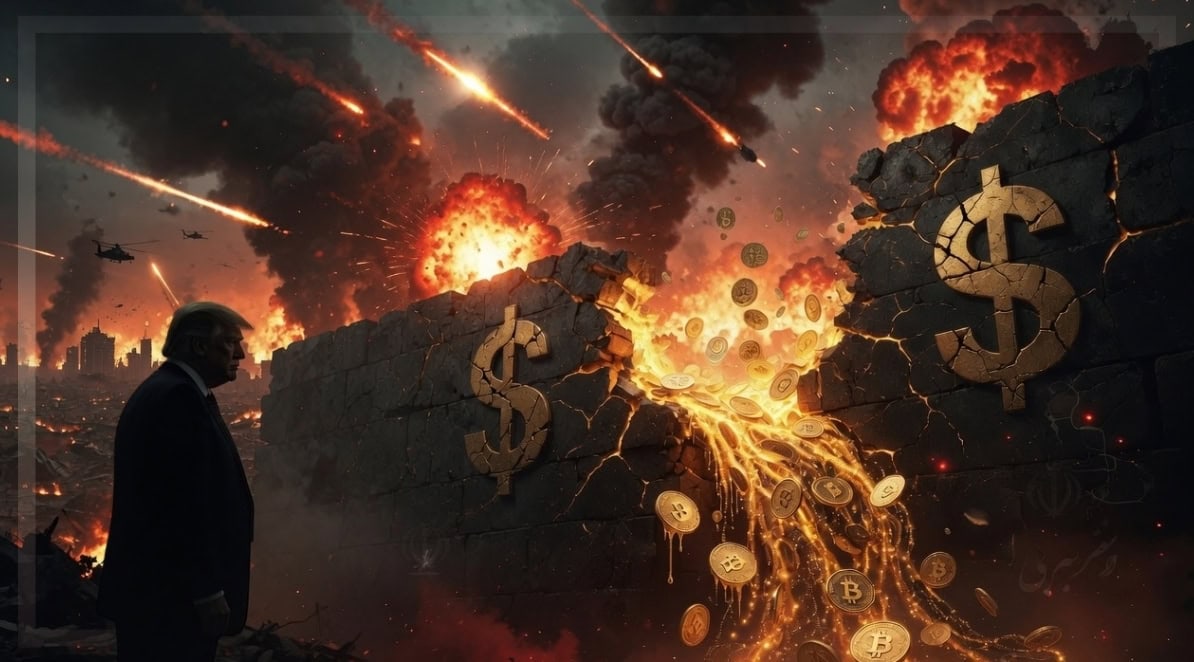
With this privilege, the United States has often used its control of the dollar to enforce economic sanctions on adversaries. The proliferation of cryptocurrencies, however, has created workarounds for sanctioned countries to move money without U.S. control.
While the U.S. government works toward enacting stricter money laundering laws, the Trump family’s crypto deals with dubious partners weigh heavily on the process. Democrats have been up in arms about President Trump’s increasing financial stake in an industry he regulates. Equal concern has been voiced about foreign money going into Trump’s coffers and the various conflicts the money creates.
Recently, it was reported that $2.3 billion was processed through Nobitex, Iran’s crypto exchange, via Tron and BNB Chain, blockchains established by crypto billionaires Justin Sun and Changpeng Zhao.
Two Pardons, One Pattern
The Trump family has had lucrative business dealings with both men. Both men were previously in trouble with the U.S. justice system. Neither is anymore.
Justin Sun invested millions in WLFI when the token had initially stalled out in the fall of 2024, triggering the first multi-million dollar payment to the Trump family. His fraud case with the SEC was later dropped.
Changpeng Zhao, principal owner of Binance, was pardoned by President Trump for money-laundering charges. Binance was vital in legitimizing World Liberty Financial’s stablecoin USD1, by accepting and holding a multi-billion dollar investment paid for in USD1 by Abu Dhabi firm MGX. The pardon came a few months later in October of 2025.
Both blockchains established by Sun and Zhao have been used by Iran to evade sanctions. AI Financial, a company in which the Trump family has a financial stake, has potentially facilitated the evasion of Iran sanctions.
Every piece of this chain traces back to the same design flaw. Sanctions work because the dollar system has chokepoints, and chokepoints only hold if someone is watching them. Bitsika found a gap. MSwipe built the gap into a product.
Who Watches the Chokepoints
AI Financial turned the gap into a balance sheet strategy tied to the president’s family. None of this required a criminal mastermind. It required an AI writing marketing copy nobody read, a middleware company with loose KYC standards, and two blockchain founders who went from federal defendants to White House guests.
The Synapse Rule was supposed to close gaps like this one. It’s still sitting unfinished at an agency, missing half its board. The Clarity Act might close others, if it survives a Senate calendar that’s running out of days.
Until then, the question isn’t whether crypto can route around U.S. sanctions. Nobitex already answered that with $2.3 billion in traffic. The question is who benefits while the fix waits, and how many of those people share a last name with the man in charge of enforcing the sanctions in the first place.
Author: Tim Tolka, Senior Reporter
#Crypto #Blockchain #DigitalAssets #DeFi
The editorial team at #DisruptionBanking has taken all precautions to ensure that no persons or organizations have been adversely affected or offered any sort of financial advice in this article. This article is most definitely not financial advice
See Also:
Clarity Act: Ripple Says Yes, Coinbase Walks Away | Disruption Banking
The $1B Banana Feud: Justin Sun Sues the Trumps | Disruption Banking