
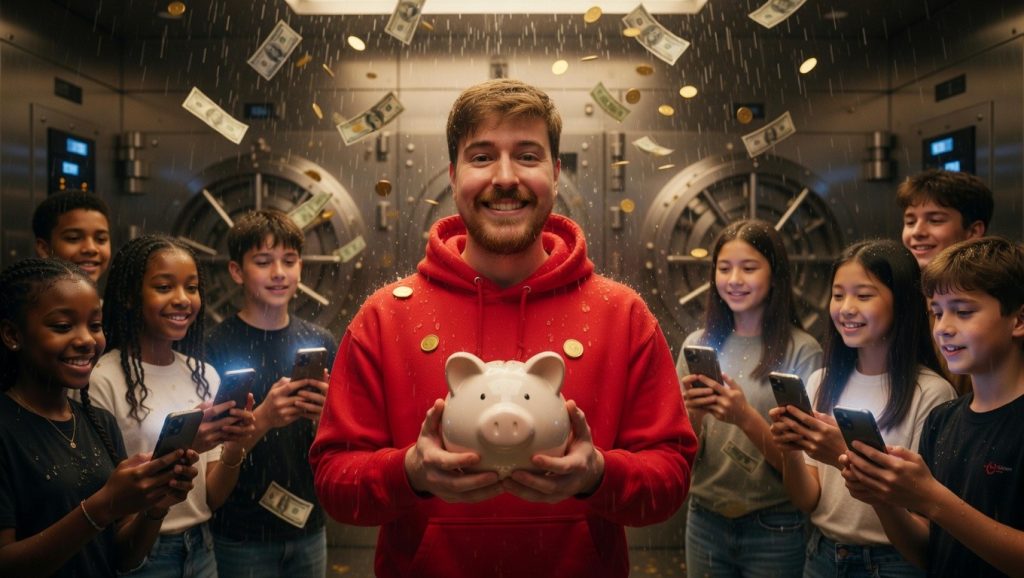
In a move that blurs entertainment and finance, YouTube’s most prominent creator, Jimmy Donaldson—widely known as MrBeast—announced on February 9th that his company, Beast Industries, had acquired the teen-focused banking app Step.
Donaldson said, “Nobody taught me about investing, building credit, or managing money when I was growing up. That’s exactly why we’re joining forces with Step! I want to give millions of young people the financial foundation I never had. Lots to share soon :D”
Donaldson commands an enormous online audience, with more than 460 million YouTube subscribers. This expansive reach provides him with an equally enormous leg up on competitors. He has the attention and brand awareness of nearly half a billion potential customers, many Gen Z, for whom he can provide an entry point into personal finances.
However, despite Donaldson’s altruistic sales pitch that says he simply wants to provide teenagers with a financial foundation, his company’s finances suggest ulterior motives. While Beast Industries is valued roughly at $5 billion on paper, it is not a profitable company.
Market the Beast
MrBeast is known for elaborate game shows in which contestants are asked to compete against one another performing silly, extreme, occasionally demeaning tasks for money and prizes. He also frequently performs filmed acts of philanthropy, such as building homes or water wells in Africa.
While he commands a massive audience, these spectacles aren’t currently profitable. In 2024, Beast Industries reportedly lost $80 million producing content for YouTube and Amazon.
That being said, Beast Industries has in recent years diversified into selling branded candy and burgers. The burgers were a bust. The candy, sold under the banner of Feastables, is profitable, if one doesn’t consider his expensive YouTube videos as a marketing expense.
MrBeast’s branded content sells a “good guy” persona, which may refelct the actual person. However, his altruistic messaging regarding providing teens with a financial foundation echoes Step’s preexisting marketing pitch to a tee.
Pitch Perfect
In 2022, Step was endorsed by TikTok’s then biggest worldwide star, 16-year-old influencer Charli D’Amelio. In her words:
She said, “I’m excited to partner with Step to help teach people at my age about smart money habits.”
However, Step’s tactics for attracting new teenage customers differed in style and content from the teen influencer’s stated desire to encourage financial literacy among her peers. Step’s marketing, while featuring D’Amelio’s visage, veered more into the gamification of personal finance, promoting cash giveaways and emojis of cash bags and smiley faces with dollar signs for eyes.
D’Amelio, for her part, was not alone in her endorsement. Celebrity investors such as Stephen Curry, Will Smith, and Justin Timberlake have also supported the company.
You Got What I Need
Founded in 2018, Step offers services such as savings accounts and credit-building debit cards. In 2021, the startup gained significant investor support, raising $175 million at a roughly $1 billion valuation with backing from firms including General Catalyst and Stripe.
Despite its strong funding and infrastructure, Step has struggled with profitability. While the company has acquired 7 million users, its customer acquisition costs have outweighed low revenue. Despite having millions of users, Step’s demographic, teenagers, typically carry low account balances, attributing to thin margins for the fintech startup.
MrBeast’s built in customer base solves this problem. Whereas a typical fintech company would need to spend millions to reach customers, Donaldson can simply make a YouTube video–he has 460 million subscribers who will see it. However, the cost in gaining those 460 million subscribers hasn’t been free.
What Now?
Therein lies the rub. MrBeast has accumulated a massive audience through his entertaining videos. He has enormous powers of scale and distribution. But the media enterprise itself loses money. So he needs to sell his customers something. Candy is increasingly profitable. Financial services could be as well. It’s just not clear what it will look like.
A trademark filing for “MrBeast Financial” suggests future offerings such as credit cards, student loans, insurance products, crypto payment processing and a decentralized exchange.
Notably, in January of this year, Beast Industries received a $200 million investment from Tom Lee, owner of BitMine Immersion Technologies, (BMNR), the world’s leading ethereum treasury company.
Tom Lee explains the $200M Moonshot into MrBeast. Is the world's biggest creator the key to future finance? Gen Z adoption is coming. Essential viewing! #TomLee #MrBeast #FinTech pic.twitter.com/vwWdATfbAK
— Wolf Of Dubai 💲 (@realwolfofdubai) March 13, 2026
Given the mention of a decentralized exchange in MrBeast Financial’s trademark filing, it will be interesting to see BitMine’s involvement in the project.
Evolve Bank & Trust
Like any other fintech or neobank, Step is not a bank. It is not FDIC insured and does not legally have to comply with the rigorous fiduciary responsibilities that banks do. Step, and now MrBeast Financial, however, partners with a bank.
That bank is Evolve Bank & Trust. Some readers may remember Evolve from a story reported by DisruptionBanking last year, involving the 2024 collapse of fintech middleware firm Synapse. Evolve was Synapse’s partner bank and seen by some as partially responsible for the $85 million of customer funds that went missing.
In a lawsuit brought by fintech platform Yotta, Evolve Bank recently faced allegations that it misrepresented its ability to track user funds and the insured status of certain deposits.
During legal proceedings, former Evolve banking-as-a-service president Hank Word invoked the Fifth Amendment when questioned about whether Yotta user funds were FDIC insured. To this day, many users caught up in the Synapse collapse have not had any compensation and some never will.
However, recently, the Consumer Financial Protection Bureau (CFPB) announced a $46 million bailout for victims of the Synapse collapse, the first of its kind for the fintech industry. This is notable given that the acting director of the CFPB, Russell Vought, has publicly stated his intentions to dismantle the agency.
Financial Literacy Requires Reading Between the Lines
Amidst the fallout from the Synapse collapse, a new rule colloquially known as the “Synapse Rule” was proposed in September 2024 at the FDIC. The rule would require banks to much more closely monitor funds flowing in and out of partner fintechs, to prevent a similar collapse. However, a year and a half after its proposal, the Synapse Rule has completely stalled.
Additionally, the CFPB has been gutted to the point that it can not effectively monitor the activities of banks and fintechs. While some see the CFPB as government bloat, others see it as an essential safeguard for consumers.
What this means for the future of MrBeast Financial is undetermined. To what extent MrBeast chooses to gamify personal finance for teenagers is also undetermined. But there are risks.
The underlying regulatory gap between banks and neobanks still remains, the latter not being FDIC-insured or held to the same standards as traditional financial institutions. As part of Jimmy Donaldson’s mission to teach his audience about financial literacy, this would be an important distinction to make.
Author: Tim Tolka, Senior Reporter
#Crypto #Blockchain #DigitalAssets #DeFi
The editorial team at #DisruptionBanking has taken all precautions to ensure that no persons or organizations have been adversely affected or offered any sort of financial advice in this article. This article is most definitely not financial advice.
See Also:
How the Collapse of Synapse Has Affected the Fintech Landscape | Disruption Banking

Tim Tolka
Tim Tolka, Senior Reporter at Disruption Banking, covers digital assets, monetary policy and the politics of global finance. Based in Mexico City, he brings an investigative edge to his reporting, informed by a Master's in International Affairs and his work as an author and screenwriter.