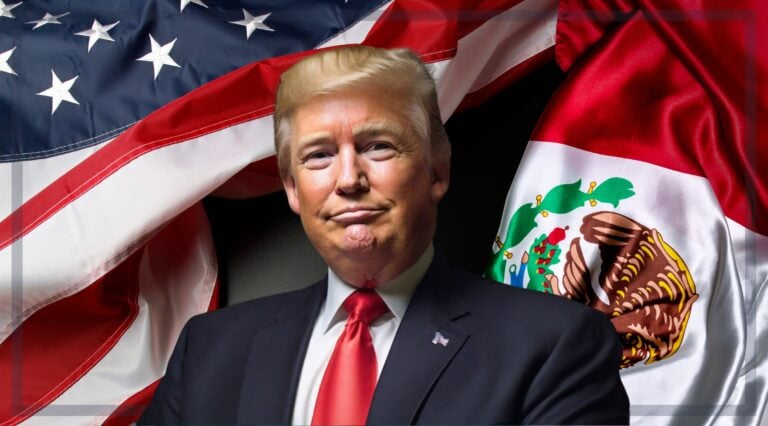

The Mexican peso (MXN) appreciated nearly 16% against the U.S dollar (USD) in 2025, trading on average at 18 pesos per dollar in 2025, up from 20.7 in 2024. This happened despite several downward pressure points.
In 2026 thus far, the peso has traded in a narrow range between 17 and 18 pesos per dollar. Forecasters expect this number to stay in a 17-20 range for 2026, although there are several factors that could inform a move upwards or downwards.
All About the Benjamins
The appreciation of the peso against the U.S. dollar in 2025 can partly be attributed to the aggregate decline of the U.S. dollar in forex markets. The greenback experienced a significant depreciation in 2025, falling approximately 9% to 10% over the course of the year.
Several factors have contributed to the dollar’s decline, namely tariff uncertainty, anticipation of rate cuts by the Federal Reserve, and increasing concerns over U.S. debt sustainability. However, the U.S. dollar is still the dominant reserve currency of the world, so this decline could be short-lived. Domestic fiscal and monetary policies have boosted the peso, but the Mexican currency is still largely beholden to foreign money.
Super Peso
Starting in 2022, the peso began to rise against the U.S. dollar. This was notable because, concurrent with the peso’s rise, the Fed was actively raising benchmark interest rates, which had the effect of strengthening the U.S. dollar against most currencies, particularly emerging markets.
However, while the Federal Reserve was hiking rates, the Bank of Mexico was aggressively hiking rates itself, going from 5.50% to 10.50% by the end of the year. By keeping rates consistently higher than those of the U.S., Mexico encouraged substantial “carry trade” flows into the country.
A carry trade is a trading strategy in which an investor borrows money in a low-interest-rate currency, such as the Japanese yen (JPY) or lately the U.S. dollar, then buys assets in a high-yield currency, such as the peso. This phenomenon has been a major driving force behind the peso’s resilience.
Additionally, remittances from Mexicans living abroad have in recent years provided a substantial boost to the peso, reaching $64.7 billion in 2024. This influx of capital, combined with the government’s fiscal austerity, has helped lift the peso while combating inflation brought on by the aftereffects of Covid 19.
The term “super peso” started getting thrown around in 2022, becoming so ubiquitous it was used by then Mexican President Andrés Manuel López Obrador.
What’s Happening Now
Despite the strength of the peso, Mexico’s economic growth in the past few years has been anemic. Its GDP only grew .8% in 2025, the fourth straight year of contracting GDP growth. A tightened money supply, while boosting the price of the peso, has led to weak domestic demand and an investment slump.
Meanwhile, inflation is also a nagging concern, as it has persistently stayed higher than the Mexican government’s 3% goal. The Bank of Mexico now estimates that goal as reachable in 2027.
In light of this, analysts expect the Banco de México (Banxico) to maintain the interest rate at 7% during the coming months, accomplishing the dual purpose of combating inflation and maintaining a rate differential with the 3.75% rate set by the US Federal Reserve.
The 3.25% differential should continue to encourage carry trade inflows, in which investors buy Mexican bonds and financial instruments. Arguably, the carry trade has been the single largest driver of the peso’s strength. However, geopolitical events and war could diminish these investments.
Volatility Could Return
According to the Bank for International Settlements (BIS), the Mexican peso is the third most traded currency among emerging markets, following the Chinese renminbi and the Indian rupee. BIS data also show that around 82% of peso transactions take place outside Mexico.
The peso is considered a high-beta currency, meaning it tends to react strongly to global market developments and can be volatile. A significant share of its value is influenced by global risk appetite, liquidity conditions, and investor sentiment.
Recent events in the Middle East threaten the Mexican peso’s tenuous hold on investors. Hostilities have already prompted some investors to seek safe havens, namely the U.S. dollar. Given this, the peso has already fallen against the U.S. dollar since Israel and the United States attacked Iran in late February.
Thus far, the peso’s depreciation against the dollar has been limited. But the Middle Eastern conflict is still in its early stages and unpredictable, so it’s yet to be seen how investors react.
In the meantime, Mexican remittances, 95% coming from the United States, have fallen off since January of 2025. Arising from President Trump’s aggressive immigration enforcement, remittances in 2025 fell to $61.8 billion from $64.7 billion a year earlier, the first drop in twelve years.
Then, of course, there is the issue of tariffs. The U.S. imported $475 billion worth of goods from Mexico in 2024. This trading relationship has been under strain since the Liberation Day tariffs set by the Trump administration last year.
While those tariffs were recently struck down by the Supreme Court, the announcement of which briefly sent the peso soaring, the US recently instituted fresh tariffs on Mexico. The current response is unclear, as no one knows the long-term viability of the current tariffs.
Practical Interpretations
According to ChatGPT, a realistic base case for 2026 among economists is:
≈19–20 pesos per U.S. dollar
But the historically plausible band is wider:
16–23 MXN/USD depending on global conditions.
According to Gemini, the key drivers for the Peso in 2026 will be:
- Interest Rate Differentials: The Bank of Mexico (Banxico) has maintained a relatively high interest rate (currently around 7.00%), which is significantly higher than the US Federal Reserve’s rate (approx. 3.75%). This 3.25% gap makes Mexican assets attractive to investors, supporting the peso’s value.
- Trade and Tariffs: The peso remains sensitive to US trade policy. Recent 10% global import taxes introduced in early 2026 and the upcoming USMCA review are major points of uncertainty that could trigger sudden sell-offs.
- Geopolitical “Risk-Off” Events: As of March 2026, escalating tensions in the Middle East have caused investors to move money into “safe-haven” assets like the US dollar and gold, putting downward pressure on emerging market currencies like the peso.
- Economic Growth: Mexico’s GDP growth is projected to be modest in 2026, with a median forecast of 1.3% to 1.8%. Stronger-than-expected growth could help the peso defy the predicted depreciation.
What is clear is Mexico’s deep entanglements with the United States. The Central Bank of Mexico’s interest rate differential with the United States has sustained investor demand for the Mexican peso, but geopolitical instability could quickly change that. Then, Mexico is left to contend with nagging inflation, tariffs, and tepid GDP growth.
Author: Tim Tolka, Senior Reporter
#Crypto #Blockchain #DigitalAssets #DeFi
The editorial team at #DisruptionBanking has taken all precautions to ensure that no persons or organizations have been adversely affected or offered any sort of financial advice in this article. This article is most definitely not financial advice.

Tim Tolka
Tim Tolka, Senior Reporter at Disruption Banking, covers digital assets, monetary policy and the politics of global finance. Based in Mexico City, he brings an investigative edge to his reporting, informed by a Master's in International Affairs and his work as an author and screenwriter.