
Asian equities staged a sharp recovery on November 24 as investors rushed back into the region’s AI-linked technology names after Nvidia reinstated Jensen Huang as chief executive.
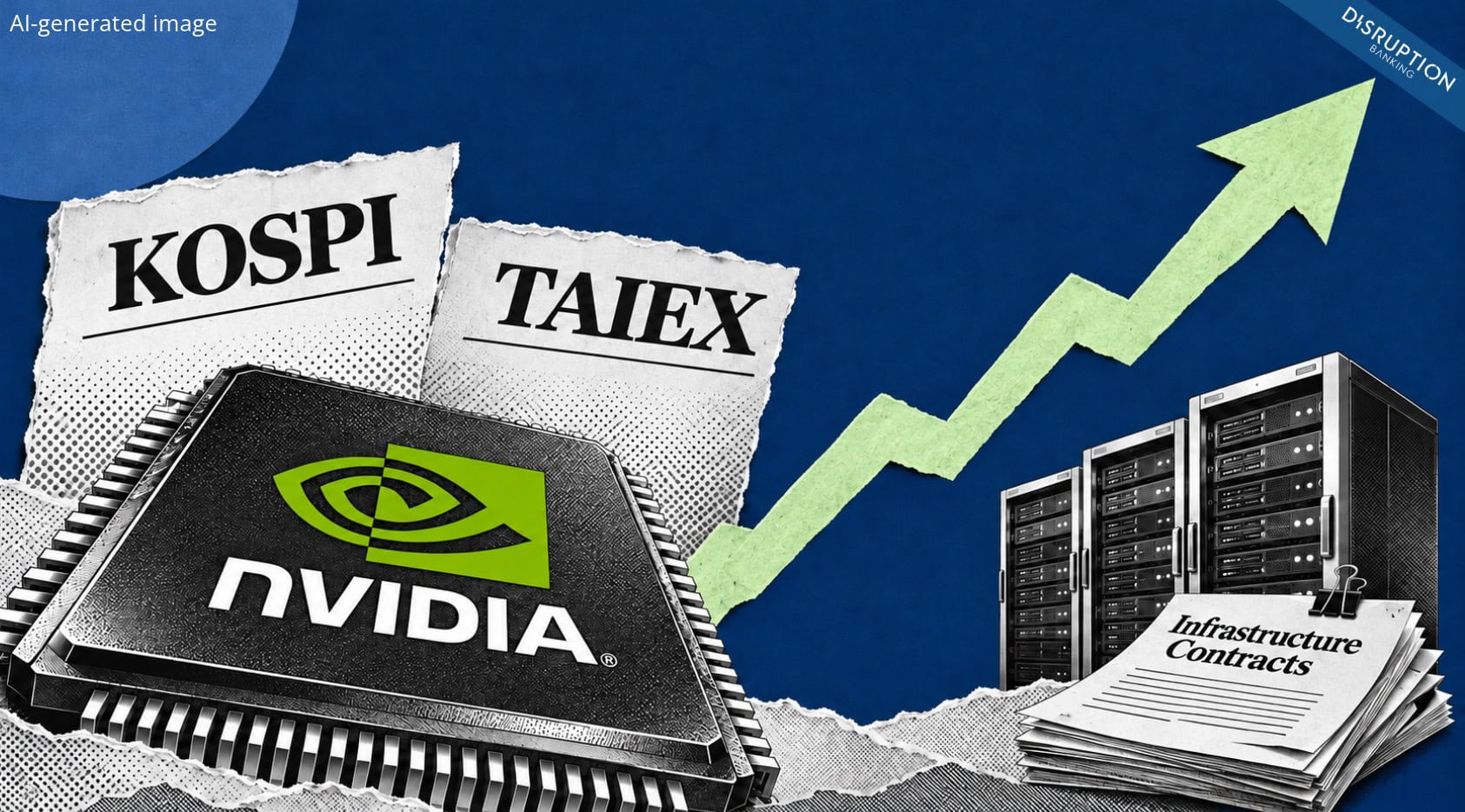
Taiwan’s Taiex climbed about 9%, while South Korea’s KOSPI rose roughly 7% – 7.5% and reclaimed the 5,000 level. Japan’s Nikkei 225 advanced 4% – 5%, as trading resumed after a holiday. The bounce reversed a portion of the steep losses that had hit technology shares in recent sessions.
Tech-heavy Asian indexes had been under heavy pressure in the preceding week. A broader technology rout, driven by concerns over AI valuations, spending returns and leadership uncertainty at Nvidia, wiped out significant value. Taiwan and South Korea in particular recorded some of their sharpest weekly declines in years as investors de-risked from the AI supply chain.
Huang’s return removed a key source of leadership uncertainty at the center of the AI supply chain and restored near-term confidence. However, longer-term questions about capital expenditure and returns continue to hang over the trade.
Nvidia Leadership Uncertainty Resolved
Huang’s return removed a major near-term uncertainty. He had resigned on 12 November as president, CEO and board member, creating a leadership vacuum that amplified existing doubts about the durability of AI spending and the reliability of the supply chain.
On 23 November the board voted unanimously to reinstate him as president, CEO and director, effective immediately. In its statement the board said it had held a series of discussions with Huang and was satisfied with his candor and ability to lead.
Critically, it added that it had received input from senior levels of the United States government and, based on that input, was confident that his reinstatement posed no national security risk.
President Donald Trump publicly claimed credit for the outcome. He said in an interview that he had spoken to the board directly and indirectly and had convinced them to reverse course, describing his intervention as important and Huang as a great patriot and national treasure.
Trump said the board had sought assurances on any national-security threat and that the administration provided them based on available information. He also stated that the Attorney General had confirmed the government possessed no evidence of unlawful conduct by Huang.
White House officials confirmed the president was totally involved. The independent investigation into the foreign-intelligence allegations continues, with Huang’s cooperation, and the company announced plans to hire a chief compliance officer.
Wall Street and Regional Market Reaction
The restoration of confidence triggered an immediate and emphatic market response.
Nvidia shares surged more than 30 percent on Monday, restoring nearly $1 trillion in market value and powering a sharp recovery across the wider AI trade. The S&P 500 rose 4.7% and the Nasdaq Composite jumped 6.5 percent, their strongest sessions since early 2025.
Asian indexes, particularly those most exposed to the AI supply chain, followed the Wall Street lead with even sharper gains on Tuesday. Taiwan’s Taiex climbed about 9% as TSMC and other key Nvidia partners approached daily trading limits.
South Korea’s KOSPI advanced roughly 7% – 7.5% , with Samsung Electronics and SK Hynix posting high-single-digit rises. Japan’s Nikkei 225 gained 4% – 5%, lifted by semiconductor equipment makers and memory stocks.
With Huang back, investors regained confidence that the company would continue to drive product roadmaps, customer relationships and the broader investment narrative that had supported the multi-year AI rally. Analysts described the move as a catalyst after the AI trade had become heavily oversold.
Lingering Doubts on AI Capital Expenditure and Profitability
The sharp rebound has not erased deeper concerns that had already been weighing on technology stocks well before Huang’s departure.
Investors had grown increasingly uneasy about the scale of capital expenditure required to build out AI infrastructure, the uncertain timeline for returns on that spending, and the risk that hyperscalers and neocloud providers could pull back if financing conditions tightened or demand proved softer than expected.
Those worries were compounded by the outcome of the US midterm elections, which handed Democrats control of Congress and raised the prospect of greater scrutiny of data-centre construction, energy use and technology exports.
Tighter US restrictions on China’s access to advanced AI chips, announced in mid-November, further dampened sentiment across the Asian semiconductor supply chain.
Nvidia’s extensive financing commitments remain a focal point. Equity stakes, lease guarantees and capacity backstops effectively make the company a major backer of AI infrastructure. While the company has signalled it will evaluate future commitments more rigorously, any slowdown in that support could feed through the broader ecosystem of chip suppliers, memory makers and equipment firms that dominate the KOSPI, Nikkei and Taiwan’s Taiex. Regulatory overhang also persists.
Despite the board’s statement that Huang’s return poses no national security risk, lawmakers from both parties have signalled continued scrutiny. Huang is expected to testify before Congress in the coming weeks on export-control compliance and the company’s China-related activities.
Huang’s Return Provides Some Confidence, But Doubts Still Remain
Huang’s reinstatement has cleared one major source of uncertainty and restored near-term confidence in the AI trade. It has not, however, answered questions about the longer-term profitability of the infrastructure build-out or the durability of demand that underpins the KOSPI and Taiex.
Those indexes remain tightly leveraged to the same capital-expenditure and return-on-investment concerns that drove the earlier sell-off, leaving them exposed if spending growth slows or regulatory risks intensify.
Author: Scott Danaher
See Also:
Why Did Anthropic’s IPO Fail To Rescue The KOSPI? | Disruption Banking
Is the AI Boom Over for KOSPI and Asian Tech Stocks? | Disruption Banking
TAIEX Slumps 3.8% as AI Bubble Contagion Spreads from Korea to Taiwan | Disruption Banking