
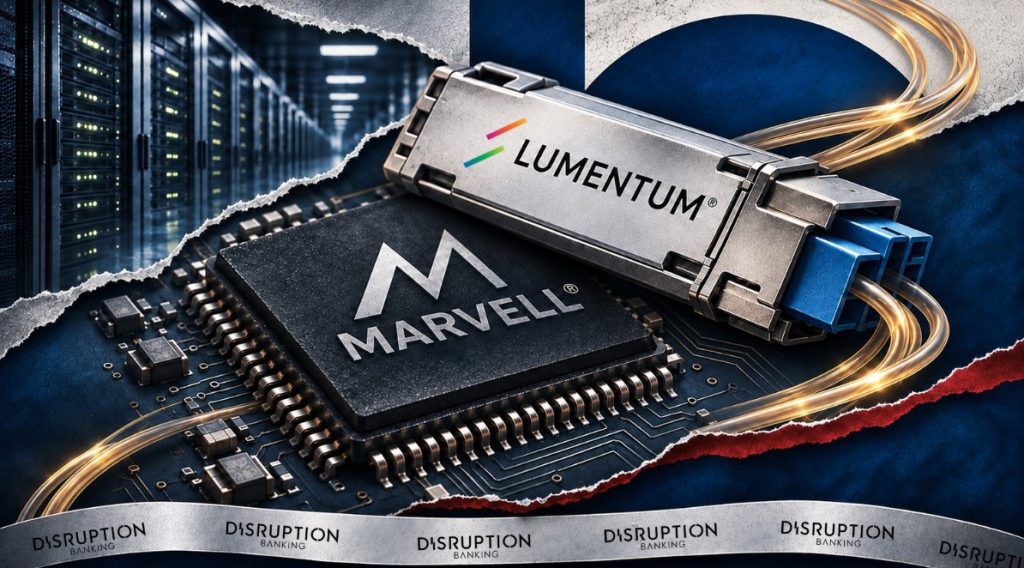
On November 2 Marvell Technology agreed to buy Lumentum Holdings in an all-stock deal at an enterprise value of $115 billion, one of the largest technology transactions on record. Both stocks fell on the news. Marvell closed down 12.7 per cent at $171.41 and Lumentum fell 18.6 per cent to $684.40.
The more interesting development has come since the news broke. Because Lumentum holders are paid entirely in Marvell shares at a fixed ratio, Marvell’s subsequent slide has cut the value of the offer well below its headline figure. Lumentum now trades at a wide discount even to that reduced value. That discount, the gap between the current value of the offer and Lumentum’s trading price, is the market’s clearest expression of how much doubt remains about whether the deal will close.
Marvell-Lumentum Deal Terms
Each Lumentum share converts into 4.500 Marvell shares, with no cash element. Marvell stockholders will own about 67 per cent of the combined company and Lumentum stockholders about 33 per cent. Matt Murphy remains chairman and chief executive. Three Lumentum directors, including chief executive Michael Hurlston, will join Marvell’s board.
At announcement the ratio implied roughly $1,132 a Lumentum share, a 23.9 per cent premium to the unaffected closes on October 28. Closing is expected in the first half of 2028, subject to shareholder votes and regulatory approvals. Marvell has targeted more than $1 billion of annual run-rate synergies, mostly from lower cost of goods sold, and says the transaction will be accretive to non-GAAP earnings per share in the first year after closing.
The deal continues a run of optical and interconnect acquisitions. Marvell closed the purchase of Celestial AI earlier this year and also acquired XConn.
The Marvell-Lumentum Arbitrage Spread
Merger arbitrage in an all-stock deal typically involves buying the target and shorting the acquirer in the exchange ratio. Here that means buying Lumentum and selling short 4.5 Marvell shares for each Lumentum share. The position profits if the deal completes, regardless of where Marvell’s share price sits. The size of the remaining gap is therefore the market’s price for the risk that the transaction fails or is delayed.
At one recent close, 4.5 Marvell shares were worth $719.10. That is already 21.3 per cent below Lumentum’s $913.95 unaffected price, after Marvell had fallen 36.5 per cent from its pre-deal level. On the same day Lumentum itself traded at $626.75, roughly 15 per cent below even the reduced deal value. Analysts estimate that gap equates to an annualised return of roughly 8 to 13 per cent, depending on the exact closing date.
For a signed transaction between two large, investment-grade-sized companies, that is a wide spread. The main reasons are straightforward: a long timetable to the first half of 2028, the need for antitrust and foreign-investment approvals, and the requirement for votes from both sets of shareholders. Time alone widens the spread because arbitrage capital is locked up for roughly 18 months. There is also no collar on the exchange ratio, so every further dollar decline in Marvell reduces the value received by Lumentum holders by $4.50.
If the deal is blocked by a final antitrust or foreign-investment restraint, or if the outside date passes with only regulatory conditions outstanding, Marvell would pay Lumentum a $3.2 billion regulatory termination fee. Separately, Marvell owes $5.8 billion if its board changes its recommendation or accepts a superior proposal.
The Strategic Rationale for the Marvell-Lumentum Deal
Marvell designs the electrical and optical interconnect chips that move data between AI processors. Lumentum makes the lasers and optical transceivers. Together, the companies argue, the combination moves Marvell from supplying components to supplying full optical modules.
On the call Murphy said AI infrastructure is “undergoing a fundamental architectural shift toward optical connectivity, creating an opportunity that comes along once in a generation.” Hurlston told Lumentum staff that in a block diagram of any optical product, each company owns critical pieces. Both executives also addressed the obvious objection that the combined company would supply its own competitors. Murphy said Marvell intends to keep its existing component supply model, and Hurlston noted that supplying competitors is already standard in optics. The language is similar to the assurance GE Aerospace gave when it agreed to buy Consolidated Precision Products earlier this year.
Shareholder Votes and Deal Risk
Both stocks falling on announcement is unusual. Normally the target rises. Marvell holders are absorbing a large issue of new shares and a long integration period, while Lumentum holders have already lost the premium they were offered. The deal now needs both sets of stockholders to vote in favour of an offer that is currently worth less than Lumentum’s pre-talks price.
The transaction also increases Marvell’s concentration in AI data-centre spending. If that spending slows before 2028, Lumentum holders take the hit entirely through Marvell’s share price, with no floor. On the other side, if the deal breaks, Lumentum keeps a business that grew revenue 136.5 per cent in its most recent quarter and may collect the regulatory termination fee.
Two questions will determine how the spread evolves. Whether regulatory approvals arrive in a way that narrows the gap, and whether Lumentum holders are willing to vote for an offer that is currently worth less than their shares traded at before the talks began.
Author: Tejas Bansal
See Also:
GE Aerospace Says Its $11.75bn Castings Deal Is Not Just for GE | Disruption Banking