
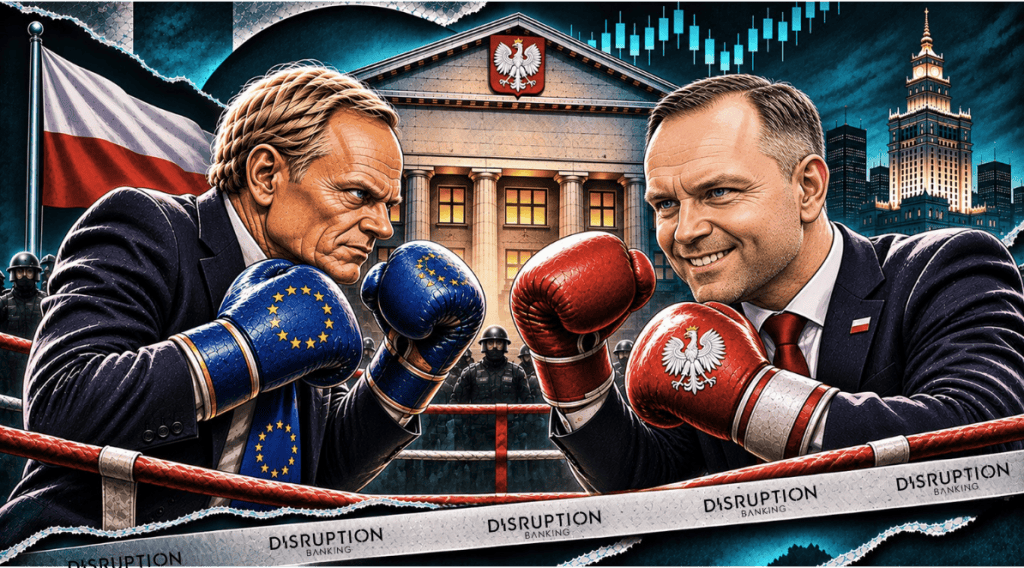
Tusk’s government is seeking to refer NBP Governor Adam Glapiński to the State Tribunal over claims he politicised the central bank for the previous PiS government. The NBP warns it would set a dangerous precedent for central-bank independence.
Poland’s central bank governor is facing a parliamentary vote that could lead to his suspension, as Donald Tusk’s government seeks to hold Adam Glapiński to account for allegedly turning the National Bank of Poland into a political instrument for the previous populist administration.
The Polish parliament is set to vote in the second half of November on referring National Bank of Poland (NBP) Governor Adam Glapiński to the State Tribunal. Speaker Włodzimierz Czarzasty scheduled the vote after a parliamentary committee recommended the move in early October. Under ordinary rules an absolute majority would suffice and trigger suspension; Glapiński’s term runs until 2028. He and the NBP reject the charges. The contested three-fifths threshold and disputed automatic-suspension rule mean the outcome is not automatic.
Weaponising the bank
The core allegation is that Glapiński politicised the central bank to help the then-ruling Law and Justice (PiS) party before the October 2023 election. Glapiński, a long-standing ally of PiS leader Jarosław Kaczyński, was appointed by the previous government.
The NBP cut rates by 75 basis points in September 2023, from 6.75% to 6%, despite inflation still sitting above 10%. The size of the move surprised markets and was viewed by critics as an attempt to downplay inflation fears ahead of the October 2023 election and bolster the then-ruling PiS. A further 25 basis point cut followed in October.
Critics have also pointed to large-scale asset purchases in 2020–21 that indirectly supported the budget deficit, and to foreign-exchange interventions in the zloty. They argue both sets of operations lacked clear authorisation from the Monetary Policy Council. The NBP maintains that all actions were within its mandate. Critics say the combination amounted to politicisation of the central bank.
A committee majority backed these charges after closed-door hearings of more than 50 witnesses. Glapiński was not called to testify.
A dangerous precedent
The NBP board and Monetary Policy Council have branded the proceedings “unprecedented” and a direct assault on independence protected by the constitution and EU law. They say referring Glapiński to the State Tribunal would set a dangerous precedent, undermine the central bank and damage Poland’s credibility.
In 2024 the Constitutional Tribunal ruled that any referral needs a three-fifths majority and does not automatically suspend the governor. Glapiński treats those rulings as binding and has signalled he will not recognise a suspension based on a lower threshold. The ruling coalition does not recognise the Tribunal and regards the judgments as void.
The ECB has previously signalled concern about any unlawful interference with the governor’s ability to perform his duties, including in 2023 correspondence, but has not issued a fresh, detailed public warning specifically on the current committee report.
The wider crisis
The standoff is part of a larger institutional fight. On October 30, government-backed judges suspended Constitutional Tribunal President Bogdan Święczkowski and his deputy. Riot police secured the building while protesters gathered; the opposition called it a coup d’état. President Karol Nawrocki cut short a trip to Senegal, returned and forced entry to the court. Tusk calls the steps a restoration of the rule of law; PiS and Nawrocki reject the new judges’ authority.
Nawrocki’s resistance has stalled much of Tusk’s agenda and left Poland stuck with a deficit near 7% of GDP. Moody’s downgraded the country to A3 in September, citing the fiscal deterioration and limited scope for consolidation before 2027.
The European Commission has sided with the government. A spokesperson said it is for the Polish authorities to ensure the Tribunal can function and that appointing the new judges lies within the Sejm’s constitutional powers. Justice Commissioner Michael McGrath added that the court must be able to operate in line with the Polish constitution and EU case law. The Commission has remained silent on the Glapiński proceedings.
Market Reaction
Markets have attached a clear risk premium to the institutional clash. The zloty weakened as the Tribunal confrontation intensified, with EUR/PLN touching around 4.42 on 3 November (NBP fixing 4.4233) — its highest in nearly three years — before easing back toward 4.39. The move left the currency lagging other Central European peers.
Polish 10-year bond yields traded higher through the week, rising with the political escalation before pulling back somewhat. Equity selling was limited, with the WIG20 down more than 1.5% on 2 November. Investors have priced higher political and fiscal risk without a disorderly exit from Polish assets.
Author: Scott Danaher
See Also:
Is Poland’s Regulatory Environment Limiting Its Crypto Market? | Disruption Banking
Is Hungary’s National Bank Bankrupt? | Disruption Banking
Slovakian Bribery Scandal Tests Faith in the ECB | Disruption Banking