In November 2025 Texas Governor Greg Abbott proudly announced a $40 billion investment in Texas by Alphabet’s Google. The investment was to boost cloud and artificial intelligence (AI) infrastructure, with the development of data center facilities, and more. It was described as Google’s largest investment in any state in the U.S.
Today things have changed. Instead of fighting for America to remain at the forefront of the AI revolution with Texas as the place where that can happen, Texans are pushing back.
In May of this year the University of Houston highlighted the problem in a survey. The results included how 63% of the residents of Greater Houston opposed the construction of data centers within one mile of their homes. A June poll from the University of Texas’ Texas Politics Project shows a similar reaction, this time by the majority of Texans.
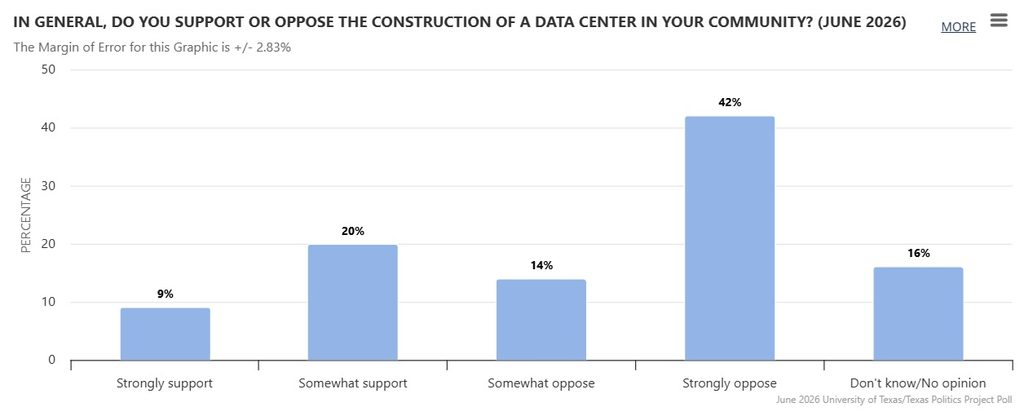
What is Governor Abbott’s approach to data centers now?
On June 10 Governor Abbott told regulators that “data centers must operate in ways that reduce costs for residential electricity customers, do not drain water needed for our communities, and take into consideration the needs of our neighborhoods.” That was three weeks after the University of Houston survey. The Texas Politics Project poll was still in the field.
It was a big shift from his message in 2025. And it got more interesting when Governor Abbott posted on X on June 23 how data centers will have their incentives slashed to protect Texas neighborhoods:
On August 3 Governor Abbott ordered a pause on approvals of new data center projects in Texas pending an audit.
Who pays for the boom?
The fight is not only about neighborhoods. It is about subsidies and the grid bill.
Texas created a data center sales tax exemption in 2013. Lawmakers were told it would cost about $14.6 million in the first two-year budget cycle. The Comptroller now projects the state will forgo roughly $3.2 billion to $3.3 billion in sales tax in the 2028 to 2029 biennium. The state’s own estimator has said that figure is already too low. New certifications are running at about ten a month. Qualifying sites skip the 6.25 percent state sales tax on servers, software, cooling equipment, generators and the electricity that runs them. The bar is $200 million of investment, 100,000 square feet and 20 permanent jobs. Of 138 certified centers, only 20 have been audited. Six failed.
ERCOT’s large load queue stands at about 474 gigawatts of requested connections. That is more than five times the grid’s record peak of 91,089 megawatts, set in July. Abbott says roughly 90 percent of those requests are data centers, across some 1,800 projects. A queue is not a construction forecast. Many filings will never be built. It is still why the governor hit pause. BloombergNEF has said the freeze touches nearly 50 gigawatts of tracked Texas projects, about a fifth of the U.S. pipeline.
Trump and Abbott are closer on the bill than the headlines suggest. In March the White House launched a Ratepayer Protection Pledge. Hyperscalers agreed to build, bring or buy their own power and pay for the wires so household rates do not rise. In July, 23 Republican governors signed on, Abbott among them. They agree the companies should pay. They disagree on speed, siting and whether Texas should keep writing tax checks while hundreds of gigawatts sit in the queue.
Google’s $40 billion pledge remains the largest single state AI infrastructure bet in the country. A multi-month interconnection audit does not kill that capital. It changes the timing, and it asks who covers the grid and the tax gap while the servers wait.
How did Trump react?
In early August Trump told Punchbowl News that Texas’s stance was a “mistake.”
“For Texas to say no to data centers is a mistake in the sense that it could be bigger than oil,” Trump stated, adding that “data centers could be bigger than oil.”
The President later cooled his approach to fellow Republicans by signaling how he may give GOP candidates room to oppose data center facilities as they become a political lightning rod in the midterms.
Trump heads to Texas as midterms take center stage
The President is heading to Houston, Texas today to support Ken Paxton, the Republican candidate for the Senate. According to polls, Paxton is currently trailing Democrat James Talarico, who Trump refers to as “Talafreako”.
The trip is a Paxton fundraiser. There is no public plan for Trump to meet with his long-term ally Governor Abbott. However, Trump will be back again on September 9-10 for the GOP midterm convention in Dallas.
Can the Republicans align properly to this new challenge to Trump’s plan to be the global leader in AI? Or is the Governor of Texas right to point out that data center companies need to be more transparent with people who are most affected by the energy and water demands of a data center? Republicans are divided; most Texans aren’t.
Author: Andy Samu
See Also:
Governor Greg Abbott’s Texas Bitcoin State Fund ‘Future of Finance’ | Disruption Banking