
Fourteen months is a short time to flip a basketball team. It is an even shorter time to add $2.5bn to the sale price.
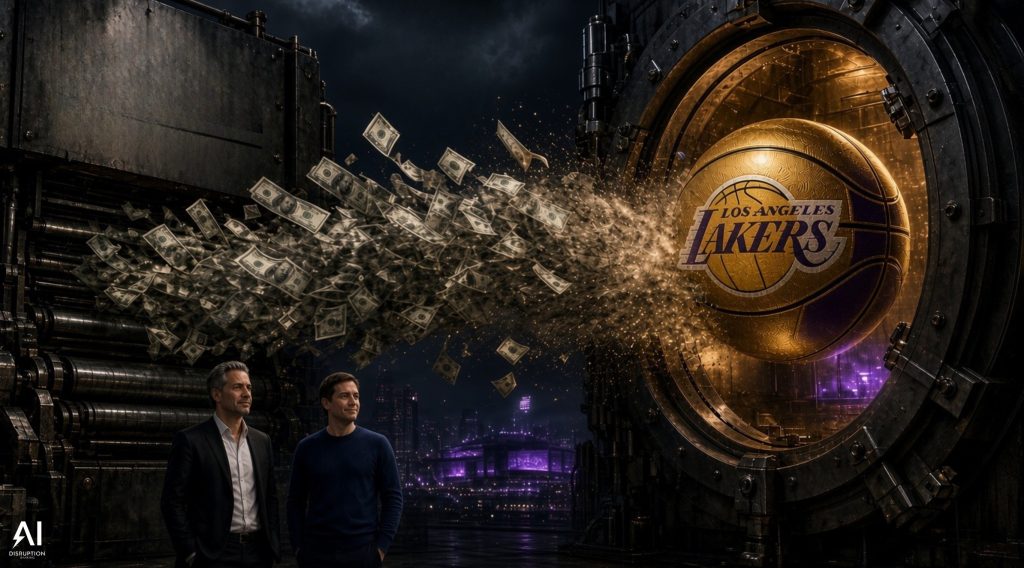
On 12 August, Josh Kushner and Bob Iger agreed to buy control of the Los Angeles Lakers at a $12.5bn valuation, a record for any US sports franchise. ESPN broke it. Forbes and Variety followed. Seller Mark Walter, the Guggenheim Partners and TWG Global chief, had bought control from the Buss family only about 14 months earlier at $10bn.
Two buyers worth roughly $6bn between them are taking on a $12.5bn asset. That only works if sports franchises have stopped being billionaires’ trophies and started behaving like a mainstream institutional asset class.
The deal is not closed. Thrive still has due diligence to finish. The NBA still has to say yes.
Who is actually writing the cheque?
Kushner founded Thrive Capital, the firm behind early bets on Instagram, Stripe and OpenAI, and has recently raised $10bn across new funds. Iger is the former Disney CEO and a Thrive adviser. They had been circling an NBA expansion side in Las Vegas. Then they called Walter. Iger has said the agreement came together in three days.
The Buss family kept about 15% and will stay involved. Sportico puts the effective transaction nearer $10.6bn. The cap table is not public, so treat that as an estimate rather than a filing.
Kushner already holds minority stakes in the Memphis Grizzlies and the Miami Heat. League rules mean those stakes would have to go if he takes control in Los Angeles. Institutions can sit in several clubs. A controlling owner cannot do the same.
How do two people fund a $12.5bn team?
They do not, not alone.
NBA rules let institutional funds hold up to 30% of a team’s equity. There is a per-club debt ceiling of $475m. On those numbers, more than $3.5bn of this deal can sit with private-equity capital, including Thrive’s own funds. The control buyer writes a minority cheque. Institutions supply the rest.
That structure is now the norm. Most of the NBA’s recent control deals have been multi-part transactions with phased closings, because almost nobody can fund a modern franchise out of one chequebook. Private equity filled the gap. Franchise prices have kept rising through 2026, Front Office Sports has set out.
Sportico’s read on the Lakers sale is the same: agree the deal first, syndicate the capital later. The Celtics, Trail Blazers, Padres and Seahawks all followed some version of that path.
What have the returns actually been?
The Ross-Arctos Sports Franchise Index, built from more than 400 transactions over six decades, shows franchise values compounding at roughly 13% a year. NFL valuations have outpaced the S&P 500 over the past 20 years. Crystal Funds walked through the construction here. It is a price-return index, not an investable product, and it does not capture fees, carry or the haircut that comes with a passive minority stake. Even so, 13% a year on scarce assets with contracted media cash flow is why pensions, endowments and sovereigns asked to be let in.
The stock of capital already inside the asset class is no longer a rounding error. Private equity put more than $55bn into sports assets between 2019 and 2024. More than 74 North American teams now have private-equity involvement, according to the CFA Institute. Those PE-linked clubs represent about $258bn of combined value, per Citizens. Franchise values across the NFL, NBA, MLB and the Premier League now sit above $500bn.
In February 2026 KKR paid $1.4bn for Arctos Partners. Arctos had spent five years buying minority stakes across the major leagues. A firm of KKR’s size does not pay that for a sideline.
Why are the prices this high?
Scarcity first. There are 30 NBA teams and no new ones in the pipeline.
Media rights do more of the work. The NBA’s $76bn national package is a 2.6x step-up on the previous deals, worth close to $200m per team per year, and it began with the 2025-26 season. Akin Gump has argued that step-up has not fully fed through into published valuations yet. Long-dated broadcast contracts give clubs visible, recession-resistant income. That is the kind of revenue institutional buyers want.
The record price landed weeks after LeBron James left for Philadelphia. Buyers are paying for contracted revenue and scarcity, not the current roster.
How did the leagues open the door?
MLB moved first in 2019. The NBA, NHL and MLS followed. The NFL held out until August 2024.
Covid was the catalyst. Empty stadiums left MLB clubs collectively carrying $8.3bn of debt and up to $3bn of operating losses in 2020. Leagues needed liquidity. Existing owners did not want to hand over the keys.
The rules were written to keep control where it was. The NFL caps institutional investors at 10% of a team’s equity, with a 3% minimum, no governance rights, a six-year minimum hold, a limit of six teams per fund, and a $2bn committed-capital requirement. The NBA is more permissive: up to 30%, and it will take pensions, endowments and sovereign funds in passive seats.
Restrictive on purpose. Open enough to let the money in.
Is this a bubble, or a repricing?
Gross returns are not investor returns. Minority sports stakes are passive. They carry no voting rights. They come with minimum hold periods, six years in the NFL, five in the NBA and NHL. Fees and carry sit between franchise appreciation and what an LP actually keeps.
A roughly 25% mark-up on the same asset in 14 months invites the obvious question. Are prices running ahead of the economics, or is this what happens when a scarce asset is opened to a much larger pool of capital? Reasonable people can land on either side. The media-rights step-up and the Ross-Arctos compounding rate argue for repricing. The speed of the flip argues for caution.
There is deal risk too. NBA owner approval is not a formality, and a young control owner is not waved through because the valuation looks good. Thrive’s diligence is still running.
On the seller, Bloomberg reported in July that US prosecutors and the SEC are examining insurers controlled by Walter over disclosure of private-credit holdings. That sits in the background of a very fast sale. It does not, on its own, explain a $12.5bn price.
What did the buyers say?
Kushner and Iger put out a joint statement:
“As lifelong NBA fans, we are deeply honored for the opportunity to become stewards of the Los Angeles Lakers, one of the most iconic sports franchises in the world. We have immense respect for the leadership and vision of Jerry and Jeanie Buss. Our long-term commitment is to build on that foundation, compete at the highest level, and serve this extraordinary team, its fans, and the city of Los Angeles.”
Variety carried the statement on X. Official @Lakers and @NBA posts on the transaction were thin at the time of writing.
None of this is done until the NBA’s Board of Governors votes and Thrive finishes its work. If the sale clears, last year’s $10bn price stops being the benchmark. The next owner who wants to sell a controlling stake will be measured against $12.5bn.
Author: Tejas Bansal
See Also:
Why Did McLaren Racing Join the Hedera Council? | Disruption Banking
How Chiliz Rewired Football Fan Engagement Before the 2026 World Cup | Disruption Banking