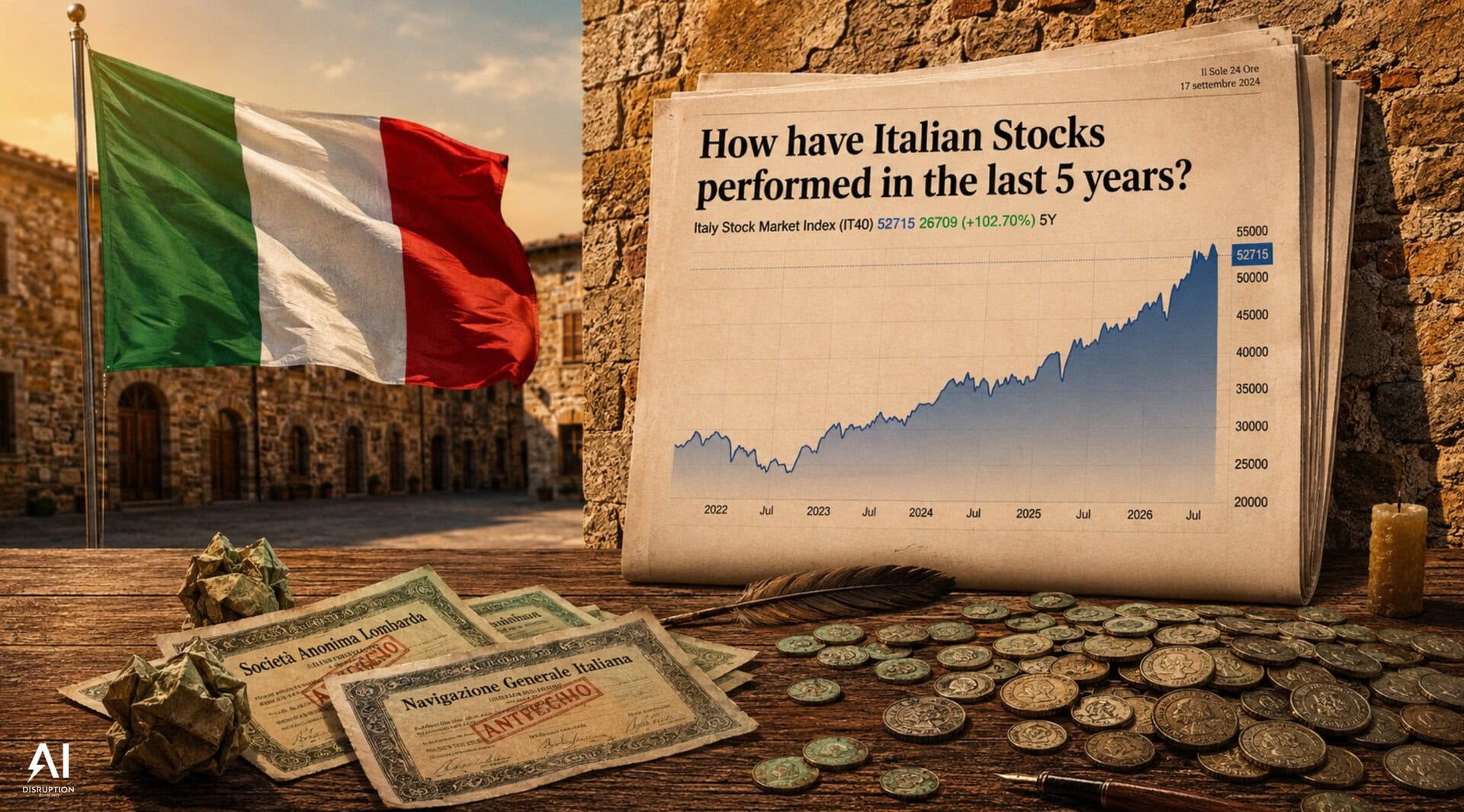
It has been a very hot summer for most of Europe. As many people do during the holiday season, I stopped off to see friends in Sicily. It was during one of those warm and atmospheric Sicilian evenings that I broached the topic of investing. I pointed to a story we wrote in December about some of the best stocks to consider for 2026. The reaction was not what I was expecting.
We do not offer financial advice at DisruptionBanking. We do, however, show people the benefits of investing and we highlight various portfolio strategies. Normally our audience is keen to hear more. Investing is a good way to balance out your portfolio. In Italy the tax treatment is different: 26 percent on stocks, 33 percent on crypto, and just 12.5 percent on government bonds.
Italy is not alone in its tax policy. Denmark is even more restrictive with a 42 percent tax rate on returns from equity investing. France, Finland, Ireland, Sweden all take more than 30 percent in tax.
Crypto has been treated even more severely. In 2025 the government abolished the previous €2,000 annual exemption and raised the capital gains rate to 33 percent (an earlier proposal had gone as high as 42 percent). That change has further reduced appetite for the asset class.
Italy’s Tax-Advantaged Wrapper: The PIR
As for any tax incentives, like the ISA in the UK, there are some similar schemes like this in Europe. Even Italy has an Individual Long-term Savings Plan which offers significant tax advantages called PIR.
The PIR’s design is one of the main reasons take-up remains so low. To qualify for the full tax exemption, investors must keep at least 70% of the portfolio in Italian equities or bonds and hold the investment for a minimum of five years. That combination creates two problems. First, it forces heavy concentration in a single domestic market, reducing diversification. Second, the five-year lock-in removes the flexibility that most ordinary savers want.
By contrast, the UK ISA and Sweden’s ISK impose almost no restrictions on what can be held inside them and allow money to be moved in and out freely (subject only to annual contribution limits in the case of the ISA). The tax benefit is straightforward and the products are simple to understand. The PIR, by requiring both geographic concentration and a multi-year commitment, ends up feeling more like a constrained product than a genuine incentive for broader retail ownership.
How have Italian Stocks performed in the last 5 years?
The FTSE MIB (Milano Indice di Borsa) is the benchmark stock market index for the Borsa Italiana. The index consists of the 40 most traded stock classes on the exchange. It includes companies like Campari, Ferrari, Iveco, Stellantis, UniCredit and many others. Over the last 4 years growth has been exceptional.
Almost exactly four years ago the index was at about 22,000 points. Today it is above 52,700 points. The PIR scheme came into place in 2017, which means that some investors managed to participate in the Italian stock exchange’s boom years. The strong returns overlap with Giorgia Meloni’s leadership since October 2022.
The problem is that not enough retail investors are engaging with the scheme.
According to the 2026 EQUITA-Bocconi study on retail investments in Europe, PIR adoption in Italy stands at just 1.5% of the adult population (0.5% of financial wealth). This is markedly lower than the UK ISA (around 39–40% of adults) and Sweden’s ISK (the highest-penetration instrument in the comparison, exceeding 50%).
With the need to allocate at least 70% to Italian companies and hold the investment for 5 years, many savers find the rules too rigid, and the product too complicated compared with a straightforward bank deposit or government bond.
How do Italian investors compare to other countries?
I spoke to my Italian friends. They confirmed that they had some investments in government bonds and were looking at real estate. Stocks and shares were less appealing to them, especially U.S. stocks which some may find surprising.
According to a 2025 report by HelloSafe, only around 7% of Italians invest in shares. That figure sits well below France (15%) and Germany (14%), and dramatically below the United States, where more than half the population holds equities.
With limited attractive options available, the incentive for ordinary Italians to learn and master equity investing remains low.
Is the Italian government doing the right thing?
You may have your own opinion about Meloni, I know that my Italian friends do. One thing anyone can see though, is that things are improving, albeit slowly. Since late 2022 the FTSE MIB has more than doubled, one of the stronger equity performances in Europe. The government has also taken pragmatic steps on the fiscal side: reductions in IRPEF (Imposta sul Reddito delle Persone Fisiche) rates for middle-income earners, targeted incentives for government bonds, and a continued focus on managing Italy’s high public debt.
Yet the dinner-table conversations in Sicily kept returning to the same unresolved question. A stock market that is surging is one thing. Turning that performance into broader retail ownership of productive capital is another. Italy still taxes most equity gains at a flat 26% with no generous annual tax-free wrapper of the kind that has proved effective in the UK or Sweden, and the existing PIR scheme remains tightly restricted and lightly used.
With the stock market delivering strong returns and Italy needing more private capital to flow into productive assets, the question becomes harder to avoid: does the current tax treatment of retail equity investing actually support broader ownership? Or quietly discourage it?
The Questions that linger
Those conversations over dinner in Sicily stayed with me. Not because anyone had all the answers, but because the questions themselves mattered: why more Italians don’t invest in their own stock market, whether the current tax treatment of equity is helping or holding them back, and what it would take for ordinary households to feel more ownership of the country’s productive capital.
These are the kinds of real-world discussions that make the coverage worthwhile. At Disruption Banking we will keep following the incentives, the capital-market reforms, and the quiet rewiring of how money actually moves. In Italy and beyond.
This article is not financial advice.
Author: Andy Samu
See Also:
Top 7 Stocks for 2026: The Hidden Winners Experts Are Quietly Buying | Disruption Banking