


Disruption Banking has followed the unfolding of the TEXITcoin scam for nearly a year now. We warned investors that the company had illusory staff, fake sponsorships, frequent security breaches, and a founder with a history of fraud. The Texas State Securities Board finally came forward with cease and desist orders back in February, and Bobby Gray, the colorful and charismatic founder of TEXITcoin, has dug in his heels, insisting that the laws he allegedly broke lacked clarity, an argument borrowing bigly from the big crypto moguls and the Clarity Act.
Meanwhile, Gray hides out in foreign countries; TEXITcoin’s value hovers around $ 0.20 after crashing from a high of $6.00, and investors pray for a last pump so they can exit without heavy losses.
Same Scam, Bigger Law Firm
Bobby Gray’s legal team wants a Texas judge to dismiss the securities case against TEXITcoin before trial. Days after Gray and TEXITcoin’s legal team, Quinn Emanuel Urquhart & Sullivan, asked a Texas administrative judge to toss the TSSB‘s enforcement action against TEXITcoin, Gray’s publicist forwarded Disruption Banking a press release that further absolved Bobby Gray and TEXITcoin from any culpability.
The motion argues MineTXC ran a mining pool, not a security, but the underlying numbers tell a different story: the mine is running at roughly 29% of the hash power sold to customers. Add a newly admitted exploit, a pivot to Wyoming’s Iskander Networks, and a founder who keeps turning up in extradition-friendly countries, and the defense looks thinner than the press release suggests.
Gray wants the action dismissed before the evidentiary hearing scheduled for August 17th, 2026, but it’s unclear if that’s what will happen. Does “proof-of-work mining pool” hold up legally when the pool physically doesn’t have the hash power it sold, or is that exactly the kind of gap a judge is going to seize on?
While the Dubai-based PR firm, Luna PR, categorizes the legal dispute as a misunderstanding, its press release glosses over aspects of the dispute Bobby Gray still hasn’t properly explained. It’s the seventh time in under a year that TEXITcoin’s operation has landed in front of the Disruption desk, and the release reads like the previous five: confident, lawyered, and thin on the details a mining company under a cease-and-desist order might actually need to explain.
Enter the Fact-Checker
The independent researcher CoinMLS has thoroughly analyzed the Motion for Summary Disposition in a detailed analysis, wherein he cites several discrepancies and contradictory statements made by Gray and his legal team.
Quinn Emanuel’s core argument hinges on the idea that MineTXC sold mining packages as part of a proof-of-work mining pool, as opposed to selling an unregistered security. However, MineTXC’s distribution of rewards based on share ownership undermines the argument.
Then comes the shifting categorization of MineTXC. In some instances, it’s nothing more than a brand name. In others, it’s a mining pool operator where a user buys hash power to mine TEXITcoin. If that sounds a little foggy, that’s perhaps the idea. What’s also foggy is that, according to CoinMLS, the TXC mine is only 29% the size of the total hash power sold. Where’s the rest of it?
Exploit After Exploit
What the release also does not mention is the exploit Bobby Gray announced himself, on camera, in the last two weeks. Whether it’s a full-on hack or a little glitch is unclear. Gray called it a “little uh exploit,” while admitting he was up until 3 a.m. making backups and still could not say what system it touched, what it cost, or whether customer funds moved.
It would be TEXITcoin’s third or fourth breach, depending on how you count, and Gray has offered no scope, no timeline, and no promise beyond more debugging, which is par for the course with Gray.
The Wyoming Escape Hatch
Since the Cease and Desist letter, Gray has set his sights on Wyoming’s permissive legal framework and created Iskander (ISK), a cryptocurrency and digital mining cooperative organized as a Wyoming Decentralized Unincorporated Nonprofit Association (DUNA).
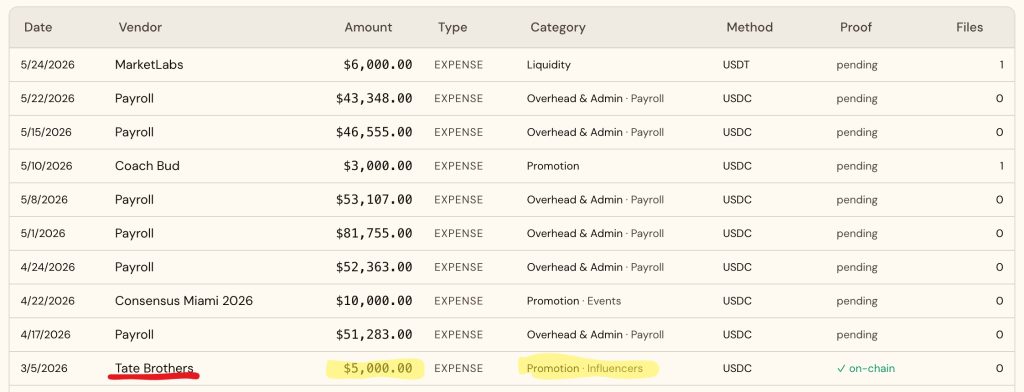
Iskander coin is essentially a copy-and-paste version of TEXITcoin’s code, only this time mined in Dubai and endorsed by influencers like the Tate Brothers, whom Bobby Gray paid $5,000 to promote Iskander.
To emphasize the project’s “integrity,” Gray appears as a cartoon armadillo in an AI-created video in which he downplays the Cease and Desist letter and explains why everything is above board in the new venture.
The video, utilizing infantile graphics that would bore a toddler, maintains the same chipper messaging present in earlier Texit marketing campaigns. “Our guiding principles have always been authenticity and full transparency,” says Gray’s cartoon armadillo avatar.
Not All the Boats Got Burned
However, as CoinMLS points out repeatedly in his analysis of The Motion for Summary Disposition, Bobby Gray doesn’t really follow those principles. Instead, like past marketing for TEXITcoin, the promotional language for Iskander is aspirational while short on details. Under the Our Story section of the Iskander website, the following Bobby Gray quote appears:
“We burned the boats long ago. Failure was never an option. The only way out is up.”
It’s an interesting choice of words. If the only way out is up, one can reasonably assume that Bobby Gray is in a hole. How and where boats enter the equation can perhaps just be attributed to a case of mixed metaphors.
It should be noted, however, that Bobby Gray appeared in a video not long ago, presumably in Singapore, on what looks like a yacht. It seems he didn’t burn all the boats after all.
On the same “Our Story” page, Gray addresses TEXITcoin’s current legal scrutiny by blaming investors for being too concerned with making money:
“But if we’re being honest, the real challenges started long before that, when participants lost sight of the mission and got caught up in the money. The C&D was the headline. The drift was the root cause.”
A hyperlink appears below the text for those who want to “Read the full details on the TEXITcoin site.” Not surprisingly, the link doesn’t work. Instead, it takes you to a page with the cheeky message:
404
Lost in the Lone Star State
“Reckon this URL seceded without tellin’ nobody.”
A Debt Gray Didn’t Bother to Fight
While Quinn Emanuel argues in front of the Texas State Securities Board that Bobby Gray’s mining operation ran exactly as advertised, a different Texas court has spent the past two years chasing him for a debt he never showed up to contest. On September 17, 2024, a Pennsylvania court entered a default judgment against d’Anconia Copper LLC and Robert Gray personally, in favor of De Lage Landen Financial Services, a Wayne, Pennsylvania equipment finance company, for $44,530.56. Gray didn’t answer the complaint. He didn’t send a lawyer. The judgment landed by default and sat there, uncollected, for nearly two years.
On June 19, 2026, less than a month before Quinn Emanuel filed its Motion for Summary Disposition, Fort Worth firm Padfield & Stout domesticated that Pennsylvania judgment in Tarrant County, Texas, and mailed notice to Gray at three separate McKinney addresses. The filing doesn’t say what equipment the debt was for. What it confirms is that Gray is currently sitting on a documented, court-ordered debt he let slide into default rather than answer, the same season his legal team was telling a different Texas court that his mining business runs clean books.
The Company Named After Its Own Sabotage
D’Anconia Copper LLC is not new to Texas courtrooms. In 2022, Texas Precious Metals LLC sued the company, then doing business as Patriot Coins, for trademark infringement, accusing Gray’s outfit of stamping a copyrighted Texas silhouette onto silver and copper bullion rounds sold under a “Constitutional Open Carry Collection.” TPM’s complaint noted, almost in passing, that d’Anconia Copper appears to take its name from Ayn Rand’s Atlas Shrugged, the novel’s fictional mining company whose owner, Francisco d’Anconia, deliberately runs it into the ground as a protest against a corrupt system. The case settled with prejudice in November 2023, terms undisclosed, each side covering its own fees.
Whether Gray picked the name as a wink to Rand fans or an accidental confession is beside the point now. The fictional d’Anconia Copper burned itself down on purpose. The real one just has an unresolved judgment nobody bothered to contest.
Twenty Years of the Same Shape
Gray’s paper trail runs back further than TEXITcoin, further than Patriot Coins, to a Chapter 7 bankruptcy he and his then-wife filed in the Eastern District of Texas in October 2006. The petition lists his occupation as “Speaker” for a company called Changes International, with a second job as a hypnotist and sole shareholder of Effortless Changes Hypnosis Centers. By then he’d already run two technology consulting firms into the ground, Silicon East Consulting and PMP Technologies, and was watching a cheesesteak shop called Philly’s Finest Foods fold after eight months. The schedules list $395,525.56 in debt against $235,516 in assets, including an $84,979 personal loan from a man named Glenn Tener that helped fund Silicon East and was never paid back.
Line up the filings and a shape emerges. A venture starts under a new name, debt piles up, and the venture ends, sometimes in bankruptcy, sometimes in a quiet settlement, sometimes in a default judgment nobody shows up to fight. TEXITcoin was never the first name on that list. Going by what’s sitting in a Tarrant County courthouse right now, Iskander Networks won’t be the last.
Running Out of Countries, Not Out of Excuses
The TEXITcoin founder has been bouncing around the globe, avoiding the United States. This week he is scheduled to speak in person at the Blockchain Futurist Conference in Toronto.
While Dubai, Hong Kong, and Singapore have weak or non-existent extradition treaties with the United States, Canada certainly has one. And yet Gray is scheduled to speak there, with the possibility that the FBI or DOJ are building a criminal case against him. Perhaps he feels safe having employed a high-powered law firm. If the Tate Brothers’ recent arrest is any indication, that only takes you so far.
Gray has spent a year selling the same pitch: trust the process, ignore the noise, wait for vindication. Quinn Emanuel might win him a dismissal on paper, but a favorable ruling on whether mining packages meet the legal definition of a security does nothing to explain the missing hash power, the exploit he still can’t describe, or the line on his own website blaming customers for wanting their money back.
TEXITcoin’s defense keeps getting more expensive and no more convincing. Whatever the judge decides on August 17th, Bobby Gray’s problem was never really about legal semantics. It was about honesty, and by his own admission, that ran out long before the Cease and Desist order did.
Author: Tim Tolka, Senior Reporter
#Crypto #Blockchain #DigitalAssets #DeFi
The editorial team at #DisruptionBanking has taken all precautions to ensure that no persons or organizations have been adversely affected or offered any sort of financial advice in this article. This article is most definitely not financial advice.

Tim Tolka
Tim Tolka, Senior Reporter at Disruption Banking, covers digital assets, monetary policy and the politics of global finance. Based in Mexico City, he brings an investigative edge to his reporting, informed by a Master's in International Affairs and his work as an author and screenwriter.


One Response
It will be interesting to see how this pans out. Seems that the stories rise add more details that “poof” from thin air. Time will tell, of course for truth always prevails.