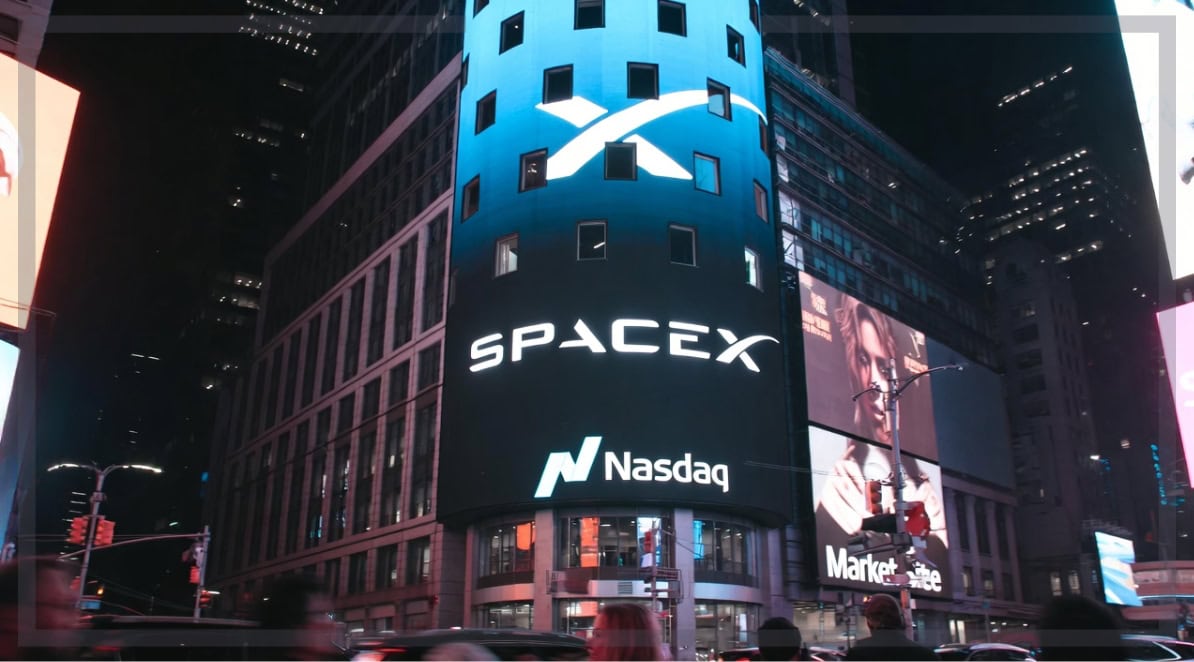
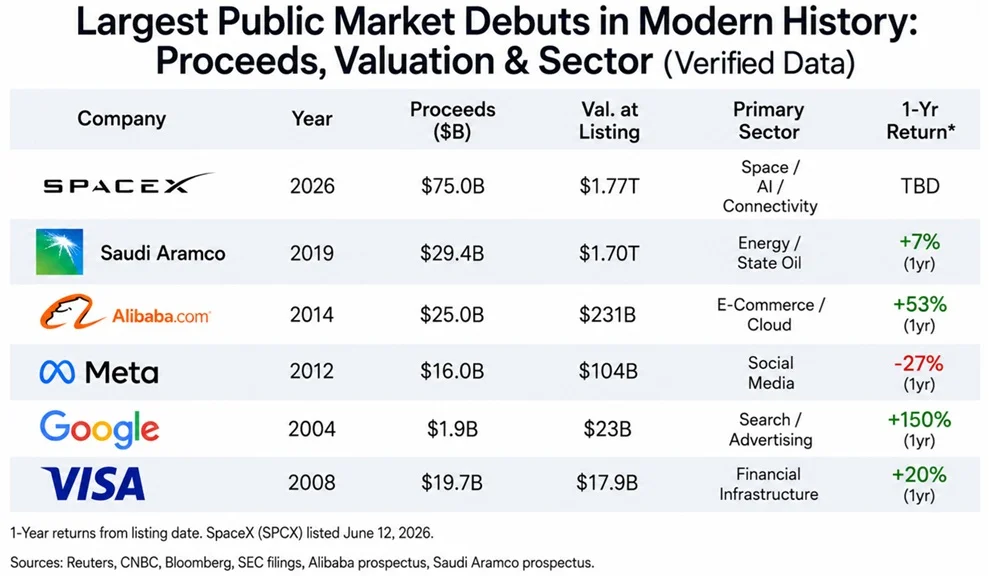
SpaceX began trading on Nasdaq this morning, June 12, 2026, under the ticker SPCX. For 555.6 million shares priced at $135 per share, the offering raised $75 billion. It valued Elon Musk’s combined rocket, satellite, and AI powerhouse at approximately $1.77 trillion, reportedly the largest IPO in stock market history, surpassing Saudi Aramcos $29.4 billion record in 2019. The raise is more than triple the $25 billion Alibaba raised in its 2014 US debut. That is why CEO Mark Boggett of venture capital Seraphim Space calls SpaceX a one-of-a-kind opportunity, for a start.
The question facing capital markets is how a $1.77 trillion company affects how investors allocate capital.
SpaceX’s IPO Is Selling Wall Street Three Businesses at Once: Rockets, Starlink, and AI
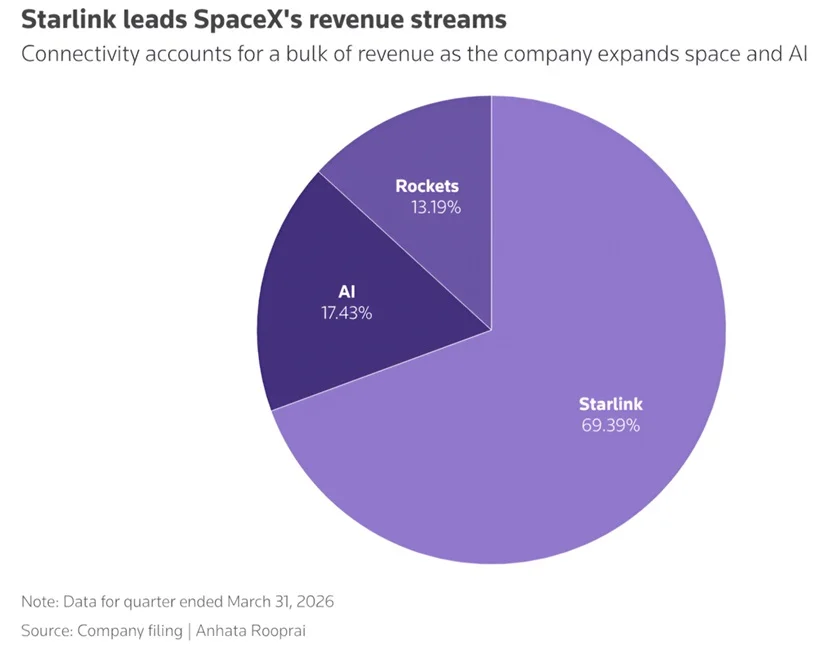
The entity that came to market defies simple categorisation. In February 2026, SpaceX acquired xAI, Musk’s artificial intelligence venture which also owns X (formerly Twitter), in an all-stock deal valued at $1.25 trillion, the largest private merger in recorded history. The S-1 filed publicly with the US Securities and Exchange Commission on May 20, 2026 presents three segments: Space (rocket launches), Connectivity (Starlink), and AI (xAI). Combined 2025 revenue totalled $18.67 billion.
SpaceX completed 165 orbital launches in 2025, its sixth consecutive annual record. It holds approximately 82 percent of the global commercial launch market and has accumulated more than $22 billion in federal contracts from NASA, the Department of Defense, and the Space Force. The Pentagon awarded SpaceX a $4.16 billion contract in late May 2026 for key elements for the U.S. Golden Dome missile-tracking constellation/shield project.
At 94x Sales, SpaceX Has Almost No Room for Execution Errors
At $1.77 trillion, SPCX enters public markets at roughly 94 times its 2025 revenue. Morningstar equity analyst Nicolas Owens described that multiple as requiring flawless execution from a company currently posting net losses. Owens discounted cash flow model values SpaceX at $780 billion. That implies significant downside from the IPO price.
“We think the company has been significantly overvalued and investors will have opportunities to buy the stock at more attractive levels after the IPO,” Nicolas opined.
Morningstar’s most optimistic moonshot scenario, in which Starship becomes rapidly reusable and orbital AI data centres scale commercially, only gets SpaceX to $154 per share. Owens assigns that scenario just a 7 percent probability.
Goldman Sachs, SPCX IPO lead underwriter, forecasts SpaceX’s AI segment generating $322 billion in revenue by 2030. Morgan Stanley’s roadshow research projects total group revenue reaching $3.4 trillion by 2040. Both projections assume Starship becomes commercially operational, orbital AI compute satellites deploy from 2028, and Starlink subscriber growth continues without significant average revenue per user pressure.
Owens separately cautioned that xAI poses a “material threat of value destruction” with its competitive position versus OpenAI and Anthropic leaving its “economic moat indeterminate.”
$250B of Demand, $75B of Stock: The SpaceX Allocation Squeeze Begins
Investor demand for SPCX reportedly surpassed $250 billion against the $75 billion offering, oversubscribed approximately 3.5 to 4 times. SpaceX President and COO Gwynne Shotwell and CFO Bret Johnsen conducted institutional roadshow events attended by hundreds of fund managers, with Musk joining selected investor calls.
“SpaceX represents one of the most exciting opportunities in the global IPO market and has been on the dream list of several investors for years,” Samuel Kerr, Head of Equity Capital Markets, Mergermarket, said on SpaceX’s historic IPO listing. “It is a genuine growth industry, with space technology seen as a key frontier in both defence, satellite proliferation, and in tech infrastructure.”
Whether institutional funds materially sold other positions to raise IPO cash for SPCX remains unconfirmed. Some market commentary linked selling in crypto and growth assets ahead of June 12 to allocation preparation, though direct causal evidence is limited. What is confirmed: approximately 30 percent of the SPCX offering, unusual for a US mega IPO, was allocated to retail investors via Fidelity, Robinhood, Schwab, and others.
Starlink Is the Cash Engine. Falling ARPU Is the Risk Wall Street Mustn’t Ignore
Starlink remains the financial engine underpinning the valuation case. The satellite internet service generated $11.4 billion in 2025 revenue, a 50 percent increase year on year, and $4.4 billion in operating income, the only profitable segment in the S-1. Subscribers reached 10.3 million in Q1 2026, up from 5 million a year earlier. The S-1 estimates a total addressable market of $28.5 trillion across space, connectivity, and AI.
The S-1 also discloses headwinds. ARPU declined from $99 per month in 2023 to $66 by Q1 2026, a 33 percent compression as cheaper international tiers expanded the subscriber base. The xAI segment posted a $6.36 billion operating loss in 2025. Total group capex hit $20.7 billion, with AI representing the largest share.
The $1.77 trillion valuation also assumes the pending EchoStar spectrum acquisition for enhanced Starlink direct to device services and the potential Cursor AI coding platform transaction both close successfully.
Why SpaceX Could Become the Most Important IPO Since Alibaba and Aramco
No prior IPO has combined launch monopoly economics with broadband infrastructure growth and an AI platform bet at this scale. SpaceX enters public markets as the dominant commercial launch provider, the fastest growing broadband operator by subscriber count, a national security infrastructure contractor, and, through xAI, a participant in the AI platform economy.
Nasdaq amended its inclusion rules, shortening the megacap waiting period to 15 trading days. Based on the June 12 listing, SPCX would be eligible for Nasdaq-100 inclusion by approximately early July, triggering mandatory buying from every passive tracker benchmarked against the index.
What Investors Should Watch: Seven Numbers That Will Decide Whether SpaceX’s IPO Works
Here are key variables investors should keep an eye on in the coming days and months of SpaceX’s IPO listing:
- Starlink ARPU stabilisation following a May 2026 price increase;
- Starlink economics: can $11B plus in 2025 sales scale toward $20B, as researchers project?
- Starships first commercial orbital launches expected in H2 2026;
- Starship milestones: NASA needs it for Artemis IV in 2027, and Administrator Jared Isaacman recently told the Artemis III crew, “We wish you Godspeed on the journey ahead.”
- xAI revenue growth against OpenAI and Anthropic;
- The pace of Nasdaq-100 passive fund buying in July;
- The 180-day lockup expiration, after which existing institutional holders can begin selling.
SPCX Is a New Asset Class Test for Tech, Telecom, and Defense Investors
SPCX is now public. The bull case requires Starlink’s cash engine to fund Starships operational ramp, with orbital AI infrastructure generating revenue at the scale Goldman Sachs projects. The bear case requires only that AI execution falls short and a 94x revenue multiple proves unsustainable.
What is not in dispute is this: with $1.77 trillion in market capitalization, a 15-day pathway to Nasdaq 100 inclusion, and more than $250 billion in reported demand, SpaceX is a capital markets test of whether investors will pay mega cap multiples for a company that sells launches, sells bandwidth, sells defense capacity, and sells an option on Mars.
If markets accept it, SpaceX would not just join the public markets. It would force every technology, telecom, and defense portfolio to answer a new allocation question.
Author: Richardson Chinonyerem
The editorial team at #DisruptionBanking has taken all precautions to ensure that no persons or organisations have been adversely affected or offered any sort of financial advice in this article. This article is most definitely not financial advice.
See Also:
Will HBAR Break Out in 2025? Hedera’s Upgrades and SpaceX Connection Explored | Disruption Banking