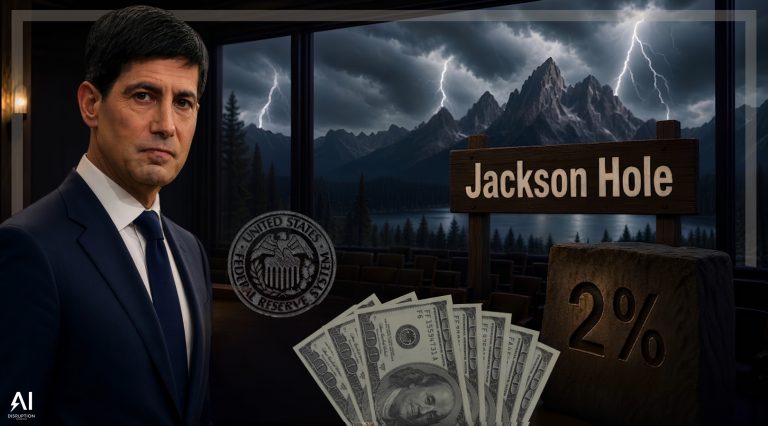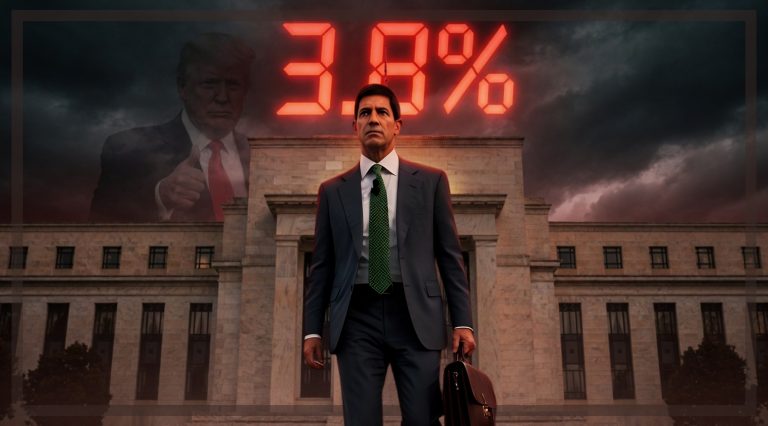

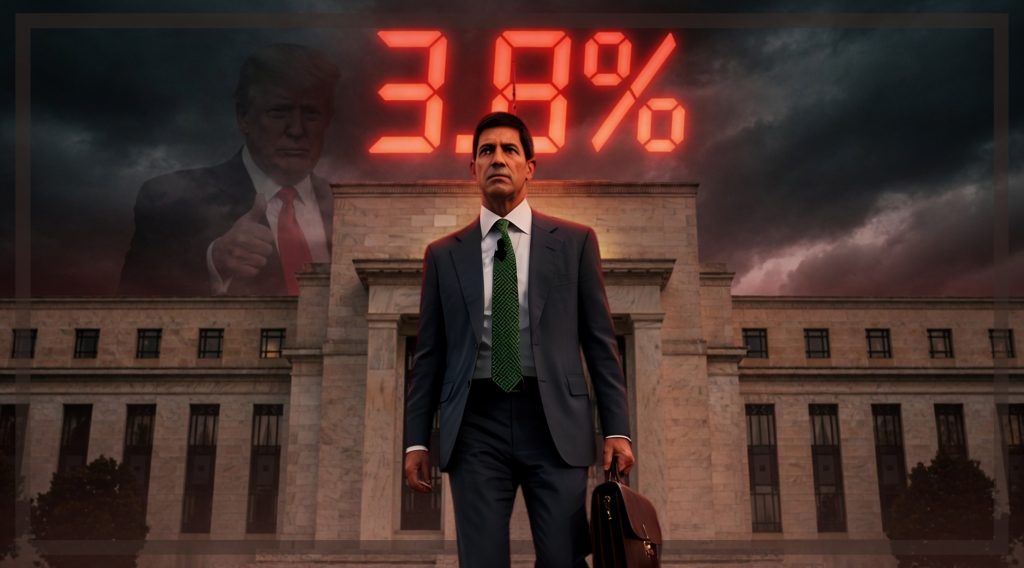
Donald Trump wants lower interest rates, and he wants them fast. He picked Kevin Warsh as the new Federal Reserve Chair expecting a more market-friendly, proactive central bank that would anticipate economic needs rather than react slowly.
The timing could hardly be worse.
Just days before Warsh officially takes the helm, the U.S. Bureau of Labor Statistics released April 2026 CPI data showing headline inflation jumping to 3.8% year-over-year. The data shows the highest reading since May 2023. Energy prices were the dominant driver, surging 3.8% in a single month and accounting for more than 40% of the overall increase. Gasoline prices alone rose 28.4% annually, while the broader energy index climbed 17.9% over the past year.
This surge is directly tied to the ongoing Middle East conflict, particularly disruptions in the Strait of Hormuz, which handles roughly 20% of global oil shipments. Brent crude has been trading between $107 and $111 per barrel in mid-May, with sharp Monday morning spikes becoming almost routine as markets react to weekend geopolitical developments.
Wholesale prices (PPI) also came in hot, rising 6% in April, further complicating the picture.
The Rate Cut Dream vs. Harsh Reality
The federal funds rate currently sits at 3.75%, which is significantly higher than in Japan or Canada. Many in the market and the White House expected Warsh to quickly signal cuts, possibly toward 3.5%, at the upcoming FOMC meetings on June 16–17 and July 28–29.
That scenario now looks increasingly unlikely. Markets have started pricing in the possibility of a rate hike later in the year rather than cuts, as persistent energy-driven inflation reshapes expectations.
Not Trump’s Human Sock Puppet
During his Senate confirmation hearings, Warsh faced intense scrutiny from both parties. Senator Elizabeth Warren pressed him hard on independence, while Republican Senator John Kennedy delivered one of the most memorable lines of the process:
“Are you going to be the president’s human sock puppet?”
Warsh pushed back firmly: “I believe we try to keep politics out of the Fed… Nor would I agree to predetermine any interest rate decision.”
He also stated clearly that President Trump had never asked him to commit to specific rate moves in their discussions.
Warsh’s Economic Philosophy: A True Regime Change
Kevin Warsh is no typical central banker. His views represent a sharp break from the post-2008 “Fed put” era under Bernanke, Yellen, and Powell. Key elements of his philosophy include:
- Less Forward Guidance: Warsh believes the Fed talks too much. He wants to reduce reliance on detailed “dot plots,” projections, and heavy communication that can lock the Fed into positions even when the data changes. He prefers a return to more traditional, opaque central banking.
- Smaller Balance Sheet: He strongly opposed QE2 ($600 billion in Treasury purchases) in 2010 while still a Fed Governor. He views the current ~$6.7 trillion balance sheet as distorting markets, artificially suppressing yields, and contributing to wealth inequality. He advocates for faster quantitative tightening (QT) and reserving large-scale asset purchases strictly for genuine emergencies.
- Interest Rates as the Primary Tool: Rely more heavily on the federal funds rate rather than balance sheet tools or constant market intervention.
- Greater Tolerance for Volatility: Warsh is comfortable letting markets price risk naturally instead of the Fed constantly stepping in to smooth every bump.
This “regime change” approach aims to restore credibility and make monetary policy more effective in the long term. But it will be tested immediately by today’s volatile environment.
The Real Challenges Waiting on Day One
Warsh inherits a difficult inbox: energy-driven inflation shocks, a divided FOMC, political pressure, and personal scrutiny over his holdings (including the Juggernaut Fund).
Glenn Hubbard, former economic adviser to President George W. Bush and Dean Emeritus of Columbia Business School, summarized the situation well. While acknowledging that Iran and oil volatility add external pressure, Hubbard believes the core challenge for Warsh is internal:
“Iran adds to the problems the Fed faces, but it’s not really the core problem. How do you talk about the economy? That will have to be job one for our new Chair.”
Hubbard stressed that Warsh’s success will depend on his ability to unify the FOMC and clearly articulate his “theory of the case” for monetary policy.
Warsh’s preference for less forward guidance and greater tolerance for volatility is likely to create a fundamentally different market regime. Expect:
- Higher short-term volatility in rates, FX, and equities as the market loses the comfort of detailed Fed projections
- Wider dispersion in fixed income positioning, with greater opportunities (and risks) in the yield curve and credit spreads
- More frequent repricing of rate paths, creating alpha opportunities for quants and macro traders who can better model regime shifts
- Increased importance of real-time data and geopolitical signals over traditional Fed “dots”
The combination of sticky 3.8% inflation, repeated oil shocks, and a reform-minded Fed Chair suggests we are entering a period of higher volatility with less predictable policy signaling. Exactly the kind of environment where skilled quant strategies, relative value trades, and active fixed income management can outperform.
The next 30–60 days will be critical in determining whether Warsh can execute his regime change vision, or whether current macro realities will force a more pragmatic approach.
Author: Andy Samu
See Also:
Powell Stays, Warsh Takes Over: How Will This Define the Next FOMC Era? | Disruption Banking
Warsh Triggers Massive Market Crash Metals and Crypto Plunge | Disruption Banking

Andrew Samu
Andrew Samu, Editor-at-Large at Disruption Banking, shapes the publication’s global coverage of banking, capital markets and digital assets. Based at London’s Level39, he combines market analysis with a strong commercial perspective, informed in part by his role as Commercial Director at Verita HR.