
Gold (XAU) is not playing games in 2026, with prices slipping below $4,750 per ounce after Iran peace talks collapsed. Just days earlier, spot gold (XAU) surged over 2% to $4,803 amid a weaker dollar and short-lived US-Iran ceasefire. As the Iran war escalates, the big question remains: how strong will gold be in 2026?
By Monday, April 13, gold had given back those gains, sliding to around 0.4% to $4,730.75 an ounce, after sliding as low as $4,643, as weekend peace talks in Islamabad collapsed and the U.S. announced a naval blockade of Iranian ports, pushing oil back above $100 a barrel and temporarily lifting the dollar.
For investors watching the yellow metal, one question keeps recurring: how much higher can gold go before 2026 is over? The answer, according to every major bank on Wall Street, still leans materially higher. But the path from here is not a straight line, and the risks deserve attention.
From $2,600 to $5,595 to $4,730: Gold’s Fastest Run in a Generation
Gold started in 2025 at roughly $2,624-$2,662 per ounce. By late December 2025, it had briefly traded above $4,500, and by early January 2026 spot gold was still around $4,372 after posting roughly a 64%-66% annual gain in 2025, its strongest year since 1979.
The metal surged to an all-time high of $5,594.82 on January 29 before pulling back hard during the Iran war and settling into the mid-$4,000s by April. At roughly $4,731 today, gold is still about 46% above the roughly $3,236 area where it traded in mid-April 2025.
DisruptionBanking‘s 2025 gold outlook questioned whether gold could push past $3,000. It did, and then doubled. Every price ceiling that analysts set in this cycle has been cleared. $3,000. $4,000. $5,000. None held for long.
Central Banks Bought 27 Tonnes of Gold. Poland and China Lead Gold Accumulation
The engine behind this rally is sovereign and institutional demand on a historic scale, not retail speculation.
The World Gold Council (WGC) saw a record 1,313 tonnes ($146 billion), a 5% increase year-on-year of gold demand in Q3 2025, the strongest quarterly total ever, as geopolitical uncertainties pushed investors toward safe-haven assets.
WGC found that central banks were net buyers of 27 tonnes in February 2026 (till March 20 available data), the 23rd straight month of net purchases. The National Bank of Poland led buying with 20 tonnes, taking reserves to 570 tonnes (31% of total) and keeping its 700-tonne target in play under Governor Adam Glapiński.
The Central Bank of the Republic of Uzbekistan and the National Bank of Kazakhstan each added 8 tonnes, lifting holdings to 407 tonnes (88% of reserves) and 348 tonnes respectively. Bank Negara Malaysia added 2 tonnes, the Czech National Bank continued steady accumulation to 75 tonnes, and the People’s Bank of China (PBoC) extended its run to a 16th consecutive month with a modest +1 tonne, reaching 2,308 tonnes (about 10% of reserves).
On April 7, Reuters reported that China extended its own run to a 17th straight month as of March-end, rising by approximately 5 tonnes to ~2,313 tonnes, taking official holdings to 74.38 million fine troy ounces. Countries that had been inactive buyers for years, including Malaysia and South Korea, resumed accumulating reserves.
On the sell side, the Central Bank of the Republic of Türkiye and the Central Bank of the Russian Federation reduced holdings by 8 tonnes and 6 tonnes, respectively in February. France added a different kind of signal: Banque de France booked nearly €13 billion in one-off gains after upgrading 129 tonnes of non-standard bars between July 2025 and January 2026, replacing New York-held bullion with Paris-held compliant bars while keeping total reserves unchanged.
This is de-dollarisation. Not a theory. A trend visible in reserve behavior, even if the motives differ country by country. It is not the death of the dollar. It is a slow erosion of absolute trust, and gold keeps absorbing part of that shift.
A Stronger Dollar, Higher Oil, and a Failed Peace Process Changed the Short-Term Setup
Three structural forces are accelerating the gold rally beyond central bank demand.
First: the dollar. DisruptionBanking reported that the U.S. Dollar Index (DXY) fell nearly 10% in 2025, its worst year since 2017, but the greenback has rebounded sharply over the last few days as peace talks with Iran collapsed.
Second: oil and Fed pricing. The April 8 ceasefire sent crude plunging and briefly supported gold through a weaker dollar and lower inflation pressure. By April 13, that move had reversed. Oil was back above $100 after Washington moved toward blockading Iranian ports, and traders saw only minimal likelihood of Fed cuts in 2026.
Third: the Iran war. The conflict disrupted the Strait of Hormuz, drove crude oil higher, and pushed safe-haven flows into gold throughout early 2026. A two-week ceasefire brokered by Pakistan took effect on April 8, briefly triggering a 15% crude crash and a simultaneous gold surge. But the ceasefire immediately showed cracks as Israel continued strikes on Hezbollah in Lebanon. Iran disputed the deal’s scope, and the Strait of Hormuz remained largely closed.
By April 12, marathon peace talks in Islamabad between U.S. Vice President JD Vance and Iran’s delegation ended without an agreement after 21 hours of negotiations. On April 13, the U.S. announced a naval blockade of all traffic entering and exiting Iranian ports, effective 10 a.m. ET. Oil surged back above $100 a barrel, WTI at $104.89, Brent at $102.15.
The ceasefire is nominally still in place, but its survival is in serious doubt.
Banks Still See $5,400 to $6,300 Gold, Even After the Pullback
In December 2025, J.P. Morgan argued gold demand had “enough firepower” to push prices toward $5,000 in 2026. By February, JPMorgan had raised its year-end 2026 target to $6,300 an ounce and its long-term forecast to $4,500.
UBS lifted its targets to $6,200 for March, June and September 2026, while still seeing $5,900 by year-end. Goldman Sachs raised its end-2026 forecast to $5,400. Deutsche Bank and Societe Generale moved to $6,000. Bank of America said it sees a pathway to $6,000 within the next 12 months. And in a February Reuters poll, the median 2026 gold forecast from 30 analysts and traders rose to $4,746.50 an ounce, the highest annual forecast in that survey since 2012.
These are the emerging consensus among the banks that trade the most gold on earth. The long-term bull case is still alive. April has simply reminded the market that even a structurally bullish setup does not remove drawdown risk.
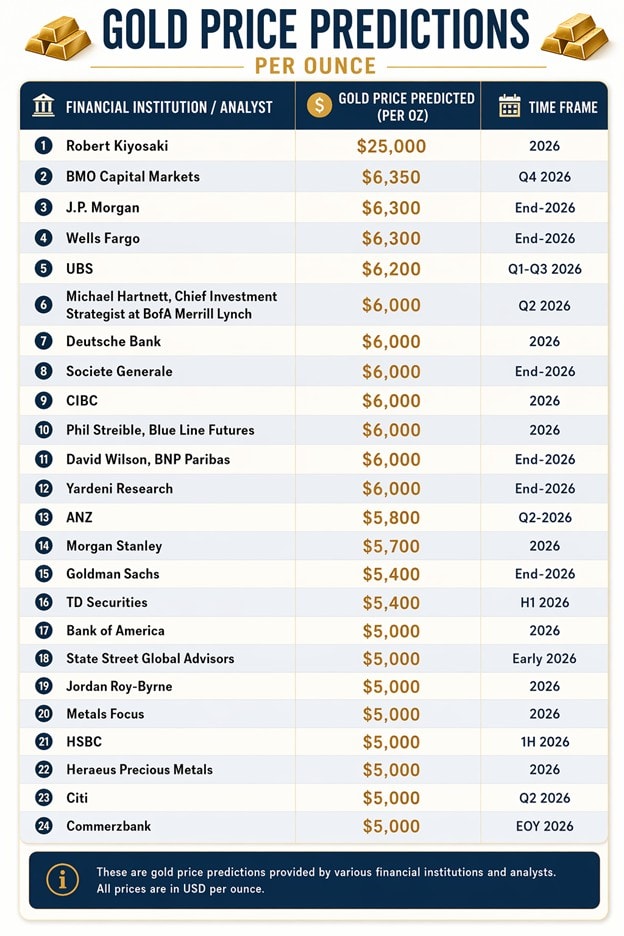
Gold Price Forecast 2026 by Various Financial Institutions. Source: SBC Gold
What’s Next for the Yellow Metal? The Risks That Could Cap Gold’s Run
The upside case for gold is strong. The risks are real. Profit-taking after extreme moves remains obvious; 2026 has already shown that even a structural bull market can produce savage air pockets, including the collapse from January’s record to April’s lows.
The Federal Reserve meets next on April 28-29, and the short-term policy backdrop is no longer friendly for bullion. Reuters reported on April 10 that futures traders still saw only about a one-in-three chance of a cut by December, and by April 13 rate-cut expectations had been pushed back further by the oil shock and stronger dollar.
Supply is not exploding either. The World Gold Council said total gold supply rose just 1% in 2025, with mine production inching up to a record 3,672 tonnes. And the WGC’s 2026 outlook still shows ETF holdings in this bull cycle well below prior bull-market expansions, leaving room for more investment demand if macro conditions swing back in gold’s favour.
Gold does not need everything to go right from here to reach $5,000 again. It needs the ceasefire to fracture fully, which, as of April 13, looks increasingly likely; the Fed to stay cautious, or the dollar to slip another few points. With Islamabad talks already collapsed, a U.S. naval blockade now underway, and oil back above $100, none of those outcomes requires imagination. They are the base case.
Author: Richardson Chinonyerem
See Also:
Iran War Sparks Gold Surge Past $5,400, Silver to $96 | Disruption Banking
The 7 Biggest Capital Markets Disruptors of 2026 (So Far) | Disruption Banking
Larry Fink’s 2026 Letter: Own Assets or Miss the AI Wealth Boom in 2026 | Disruption Banking

Richardson Chinonyerem
Contributing author at Disruption Banking, covering capital markets.