




In a rare display of investor impatience, a BlackRock portfolio manager didn’t mince words on an emergency call: “What exactly was it?” The cryptic resignation of HDFC Bank’s part-time Chairman Atanu Chakraborty has rocked confidence in a leading Indian bank. Citing “happenings and practices” clashing with his personal ethics, his move has erased billions in market value and reignited scrutiny over governance at India’s largest private lender. This comes as the sector grapples with post-merger realities and rising foreign investor stakes.
The Trigger: A Cryptic Exit Letter (March 18, 2026)
Atanu Chakraborty, a former senior bureaucrat who assumed the non-executive chairman role in 2021, resigned with immediate effect. His letter, filed with exchanges, was pointed yet vague: “Certain happenings and practices within the bank, that I have observed over the last two years, are not in congruence with my personal values and ethics.” No specifics, no named issues, but enough to send alarm bells ringing and raise serious questions.
HDFC Bank moved fast to contain the fallout: no material compliance problems, no regulatory red flags, possibly just a personal/management rift. The RBI (India’s central bank) backed the narrative, stating “no governance issues” and approving veteran insider Keki Mistry (ex-HDFC CEO) as interim part-time chairman for three months. Board members appeared “baffled” on a follow-up call, insisting robust governance remains intact.
Market Carnage: $12B+ Vanishes Overnight
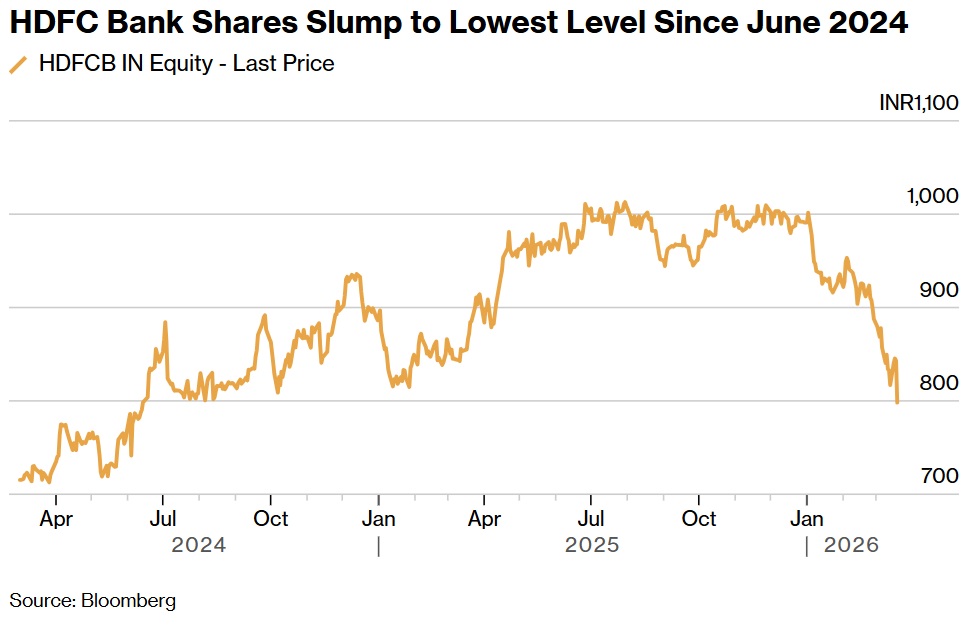
Shares cratered up to 8.7-9% intraday on March 19. This is the steepest drop since the COVID crash. They then closed down around 5%. Market cap shed roughly ₹1 lakh crore (~$12B), pushing the stock to 52-week lows not seen since mid-2024. Foreign institutional investors (holding ~48%) bore the brunt, with ADRs tumbling 7.5% in US trading.
The BlackRock Moment: Investor Frustration Boils Over
The real fireworks came during the investor/analyst call. Prashant Periwal, portfolio manager at BlackRock Asset Management (with significant exposure via funds like BlackRock India Fund, where HDFC ranks high among top holdings), went off-script:
“So far, whatever I heard on this call doesn’t make me any wiser than I was an hour ago… What exactly was it? Because he was the chairman of the bank. He was not like any other employee that resign saying something and it means nothing.”
His pointed questioning underscored a broader sentiment: big global funds aren’t satisfied with platitudes when billions are at stake. Analysts like Macquarie have yanked HDFC from buy lists, warning of near-term underperformance due to the “governance overhang.”
Broader Context: Post-Merger Hangover Meets EM Realities
This isn’t isolated. HDFC Bank’s 2022-2023 mega-merger with HDFC Ltd was hailed for creating a banking behemoth, but integration challenges linger. These include loan book management, cultural alignment, leadership transitions (including ongoing questions around CEO Sashidhar Jagdishan’s reappointment). Peers like the Industrial Credit and Investment Corporation of India (ICICI) have occasionally been viewed as more stable on governance optics.
In India’s private banking space, one where foreign ownership caps and RBI oversight loom large, such episodes highlight vulnerabilities. One high-profile exit can trigger outsized volatility, especially with Foreign Institutional Investors now so influential.
Forward-Looking: Recovery Path or Lingering Shadow?
Fundamentals remain solid, like strong ROA, deposit growth, digital momentum, but sentiment is fragile. The interim chair move buys time, but full transparency (or at least clearer communication) will be key to rebuilding trust. For global investors like BlackRock, this saga is a reminder: in emerging markets, governance isn’t just compliance, it’s a market-moving force.
If unresolved whispers persist, HDFC could face prolonged underperformance relative to peers. For India’s banking ecosystem, it’s a wake-up call: even the giants aren’t immune to ethical flashpoints in an era of activist shareholders and real-time scrutiny.
See Also:
Should Jane Street be Banned in India? | Disruption Banking
India: BlackRock’s Newest Growth Market? | Disruption Banking







3 Responses
It’s non sensical to doubt hdfc governance, merger issues continue. Good, they have moved keki . Cannot trust these ex bureaucrats, they would have sought favors, since uts not worked out, he is blaming the governance.
Investors are loosing faith and confidence in Indian Banking System as nowhere their money is safe. It appears that private banks management are more corrupt than any public sector bank where retail investors are left to fend themselves. It is the situation bank after bank- ICICI, Yes Bank, IndusInd Bank,India first Bank and now HDFC most trusted one.This situation is the outcome of corrupt banking eco-systems involving politicians, bureaucrates, judiciary, bank promoters and top management, and patron industrialists. These entities will be nowhere if middle class hardworking existence is jeopardised.
I always hated this bank because they wronged me when I first got a credit card from them…the amount I spent using their new credit card and the amount I was asked to pay was 4 times the amount I spent….no matter how much I explained to them….I even got the bills for the purchases I made… but they wouldn’t hear of it….told me to pay the amount and then the matter would go to hq in Mumbai and then…if any discrepancy they would reimburse the difference…that was the first and last…I never used a credit card in my life… I also closed the account with them…they are spineless Corporate leeches who only cater to the rich…and not the working class…ill never step into any of their offices or even entertain them over a call or a message…BTW…that incident was when I first joined work…and I made purchases with my first salary. That incident had a drastic impact on my mind…I never used a credit card again in my life.