
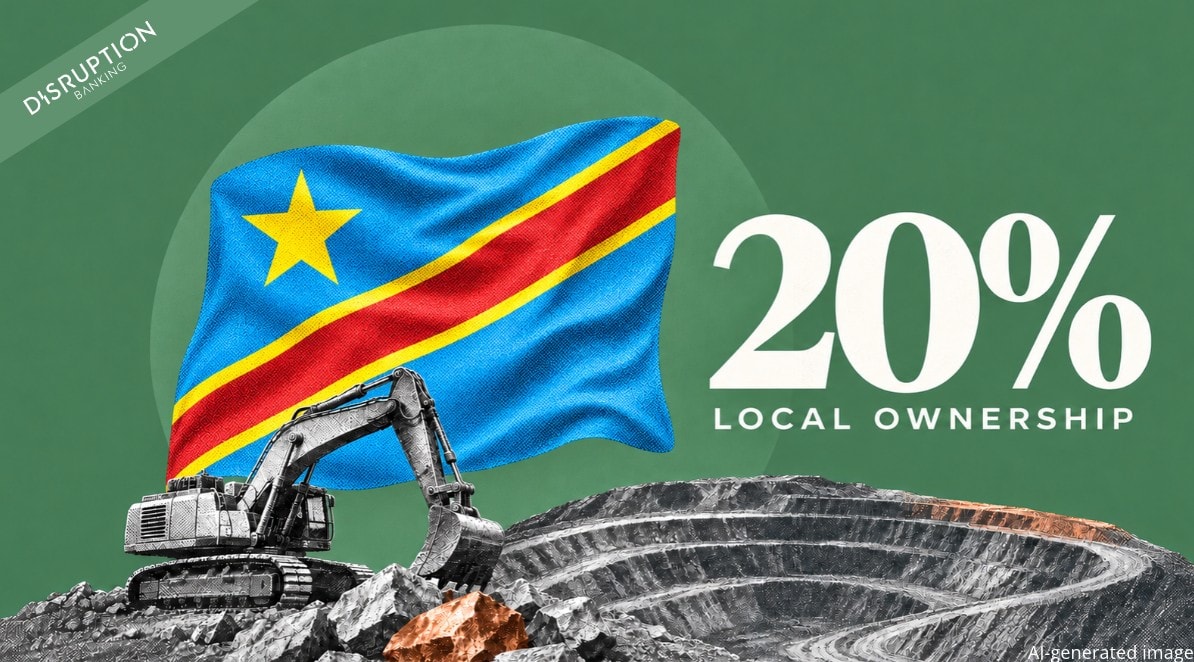
The Democratic Republic of the Congo will require foreign mining companies to open 20% of the shares in their local units to Congolese interests by the end of January 2027.
Mines Minister Louis Watum Kabamba told executives at the Makutano Mining 2026 forum in Kinshasa on November 23 that a draft decree implementing the rule is on his desk and will pass within two months.
The measure reserves 10% of shares for Congolese citizens, half for employees and half for other individuals, in addition to the state’s existing mandatory 10% stake. Watum made these claims despite the fact that talks with companies have left key terms unsettled.
The DRC is a major producer of cobalt and copper but has long captured only a small share of the value after a history of colonial dominance. The forum sought to convert discussions on local processing, supplier development and regional value chains into concrete commitments that retain more mineral value inside the DRC.
How Did the Mining Industry React to the Law?
Analysts and mining executives have warned that lingering uncertainty over pricing, retroactivity and enforcement could weaken investor confidence at a moment when Kinshasa is courting Western capital to diversify away from Chinese dominance.
Watum rejected objections. He told those who disagree that he will “see you in court” and said the matter “is no longer up for discussion.” The Minister accused the industry of a double standard: miners sell stakes to companies but resist Congolese buyers.
He likened the rule to stock options multinationals give executives, which the DRC is “democratising.” Congolese investors outside the workforce would pay market value.
His remarks did not clarify whether employees pay, though an October draft reportedly proposed free shares for them. Watum’s comments also left unclear whether the citizen stake dilutes existing shareholders or how it interacts with other transactions.
Separately, Glencore is negotiating a sale of 40% of its Kamoto Copper Company and Mutanda operations to a consortium backed by the United States and Abu Dhabi. The deal is priced at about $9 billion and rests on a non-binding agreement signed in February.
The arrangement would let buyers decide where their portion of copper and cobalt goes, while Washington and its allies work to loosen China’s grip.
At the same time, the head of the subcontracting regulator ARSP, Beleshayi Kasanda Ted, has said the DRC will audit major miners annually from 2027 on subcontracting practices and local-content compliance as part of a broader local-content law taking effect in January 2027.
What is the Makutano Mining Forum?
The statements formed the sharpest regulatory signal from the first Makutano Mining forum, held in Kinshasa from 23 to 25 November under the theme “Mine. Refine. Define.”
It brought together regional counterparts from Zambia, Burundi, Tanzania and Chad, mining executives and financiers. Discussions centred on shifting African producers from raw-material export to domestic processing, local supplier development, project financing, power and transport infrastructure, and regional value chains for critical minerals including copper, cobalt and battery materials.
Organisers announced $965 million in new mining-sector commitments, including $700 million from financial institutions for the Congolese value chain and $265 million from the International Finance Corporation for private-sector support covering SMEs, subcontracting, local processing and trade finance.
Louis Watum set concrete targets at the forum: cobalt to leave the country as hydroxide by 2028 at the earliest, copper as cathode or anode by 2030, and a longer 2050 horizon for deeper industrial capacity.
Closed sessions also addressed building Congolese “national champions” through better access to finance and the 10% local-ownership rules. Justice Minister Guillaume Ngefa linked credible courts and mineral traceability to investor confidence.
The forum aims to turn these discussions into timed, named commitments that increase the share of mineral value retained inside the DRC and neighbouring producers, create skilled local employment and support industrialisation beyond extraction.
President Félix Tshisekedi framed the goal as converting finite underground wealth into lasting economic capacity rather than higher export volumes alone. Participants were asked to return at the close with specific deliverables, responsible parties and deadlines.
The DRC’s Long History of Exploitation
The Democratic Republic of Congo produces roughly three-quarters of the world’s cobalt and ranks as its second-largest copper producer, with 2024 copper output of about 3.1 million tonnes according to the Congolese Ministry of Mines.
However, the country has long captured only a small share of the value generated by those resources. Mining accounts for a large share of exports and has attracted more than $40 billion in cumulative investment, yet domestic processing capacity is limited and Congolese firms still hold minority roles in ownership and supply chains.
President Félix Tshisekedi has repeatedly framed this imbalance as the central problem: the DRC supplies critical metals for global industry while refining, manufacturing and most of the economic returns remain abroad.
These measures sit in a longer pattern of resource nationalism that runs from the colonial period through independence. Belgian companies such as Union Minière du Haut-Katanga dominated the Copperbelt until nationalisation in 1967 produced state miner Gécamines, which at its peak supplied the bulk of government revenue.
Under Mobutu Sese Seko, Gécamines was used as a cash source through marketing commissions and political extraction, contributing to its later decline. Under Tshisekedi, the government has returned to the argument that raw-material exports alone do not generate lasting industrial capacity, skilled jobs or domestic capital.
Local equity stakes, annual audits of subcontracting and stronger local-content rules are presented as tools to reverse that pattern and build Congolese “champions” able to retain more value inside the country.
Author: Scott Danaher
See Also:
Can the Lobito Corridor Help the DRC? | Disruption Banking
2024: A Year Of Change For The DRC’s Mining Industry? | Disruption Banking
DRC responsible cobalt initiative needs breakthrough on mine access | Disruption Banking