
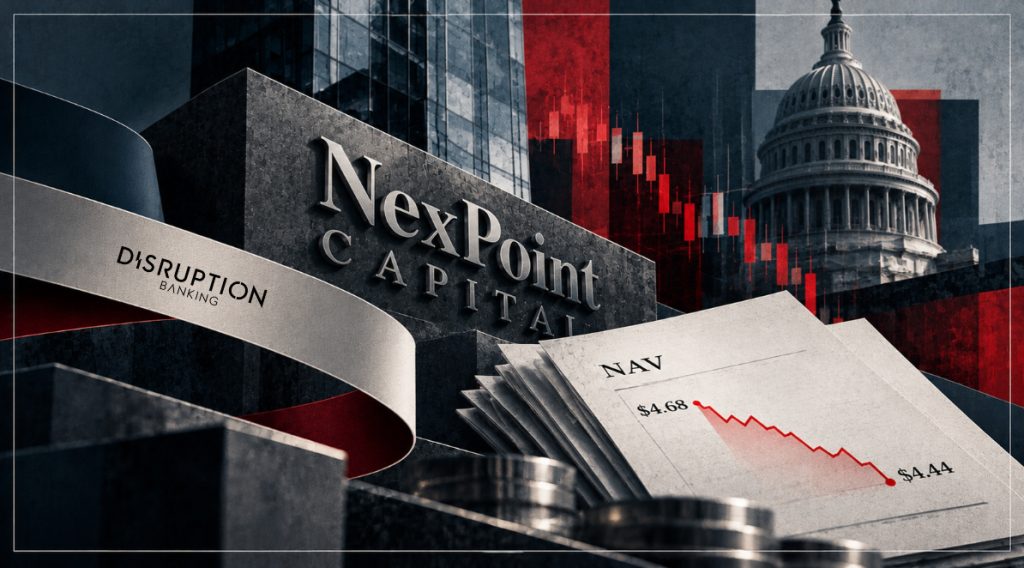
A Dallas fund called NexPoint Capital reported that its net asset value fell 5.1% in September, from $4.68 a share to $4.44. Most of that happened in eight days. NAV stood at $4.64 on September 22, the day its most recent tender offer expired, then dropped 20 cents over the rest of the month.
The timing is the part worth noticing. Investors get a narrow window each quarter to ask for their money back. That window closed on September 22. Over the next eight days, with no announcement, the fund marked itself down by 4.3%. So the people who got out just before did better than the people who stayed in.
At a normal public company, somebody would have been asked about it within the hour. The company gave no reason. No statement, no breakdown, nothing. And because it isn’t listed on a stock exchange, there’s no earnings call where an analyst can put their hand up and ask what happened.
The same filings show that 75.7% of the fund’s fixed-income investments sat on nonaccrual status as of June 30, meaning the borrowers had stopped paying on schedule. At the close of 2025, that figure was 9.4%. That jump also went unexplained.
NexPoint Capital is a non-traded BDC, or business development company, a structure Congress created in 1980 to channel capital into small and mid-sized firms, including distressed ones. It is a small fund. Total net assets were $37.7 million across 21 investments at the end of June.
Seventy-Five Percent of Not Very Much
The nonaccrual number needs context the filing does not supply. It describes 75.7% of the fund’s fixed-income book, and fixed income is a minority of what NexPoint holds. Senior secured loans and corporate bonds together came to roughly 13% of the portfolio at fair value on June 30. Common and preferred stock accounted for about 70%.
So three quarters of a small slice is impaired. In a fund of $37.7 million, that is real money for the people who own it and a rounding error to everyone else. It also means the September markdown almost certainly came from somewhere other than the loan book. Equity positions get revalued. When 70% of a portfolio is stock in private companies, a quarterly mark can move the whole fund.
Worth noting alongside that: the second quarter was positive. NexPoint posted diluted earnings of $0.30 a share and a $2.49 million increase in net assets from operations. The fund made no new investments in the first half of 2026 and took in about $1.99 million from sales and repayments.
Feeling the Squeeze of Higher Interest Rates
In a high-rate environment, the floating-rate loans a BDC issues throw off larger interest payments, which in theory produce larger dividends for investors. The same rates squeeze the borrowers on the other side.
Sustained high rates drain borrower cash flow and push loans onto nonaccrual. BDCs also borrow to fund themselves, so their own cost of debt rises too, compressing margins from both directions.
What the Boston Fed Found
In August, three economists at the Federal Reserve Bank of Boston, José L. Fillat, Leslie Sheng Shen and J. Christina Wang, published an analysis of SEC filings from 168 BDCs covering nearly 890,000 loan observations. Their conclusions are not reassuring.
The share of BDC loans paying interest in kind rather than cash rose from about 6% to about 10% by early 2026, a 67% increase in three years. In construction, it went from under 5% to nearly 20%. The authors read this plainly: the increase “suggests there is growing pressure on borrower cash flows.”
Median spreads narrowed by roughly a percentage point over the same period, which they note could reflect competition or quiet restructuring. BDC equities fell about 20% against the S&P 500 between early 2025 and mid-2026. Committed bank credit to BDCs grew from around $10 billion in 2013 to more than $50 billion in 2025.
The paper also makes the point that matters most for NexPoint: many floating-rate borrowers now face far higher debt service because SOFR sits well above the near-zero levels of earlier years.
BDCs in the News
The AI boom has put stress on the Software-as-a-Service (SaaS) sector, one of the largest concentrations in private credit. Revenue that looked durable three years ago is being repriced by investors who expect AI to eat into it. The Boston Fed found internet and software to be the single largest sector in the median BDC portfolio, at about 20%, with some funds holding more than a third of their lending in technology.
On July 1, Reuters reported that a majority of publicly traded BDCs had turned unprofitable “due to falling asset values and rising costs.” Using balance sheet data from S&P Global Market Intelligence, it found 28 of 53 publicly traded BDCs were loss-making in the first quarter, against 12 a year earlier and 10 in 2024. Average profit swung from $26 million to negative $7.6 million.
Blue Owl’s OTF fund took a $490 million markdown, its largest ever. Leyla Kunimoto of Accredited Investor Insights told Reuters that “fund managers are marking assets down more widely than we’ve seen in this cycle.”
The Part Nobody Can See
BDCs are the visible edge of a private credit industry that has grown to roughly $3.5 trillion, though estimates range from $1.5 trillion up depending on what gets counted. Their filings draw scrutiny precisely because so much of the sector files nothing at all.
Even the visible part has a basement. At 14 BDCs that disclose joint venture data, Reuters calculated that off-balance-sheet borrowing grew 80% across 2025 and another 14% in the first quarter of 2026. Payment-in-kind income reached 8.1% of interest and dividend income in 2025, roughly double where it sat before 2020, according to Fitch Ratings.
Trade press was flagging cracks in BDC loans to mid-market issuers as far back as mid-2025. Credit deterioration has produced markdowns, markdowns have produced redemption requests, and those requests are being throttled at the gate. The result is a liquidity squeeze that feeds the scrutiny that feeds the next round of requests.
NexPoint’s Challenges Lie Elsewhere
By sector, NexPoint’s portfolio at the end of June ran 37.2% healthcare, 19.2% telecommunication services and 16.9% real estate. There is no meaningful SaaS exposure, so the story bending every other BDC out of shape is not this fund’s story.
Healthcare is not an accident here. The fund’s own mandate names middle-market companies with revenue between $50 million and $2.5 billion, plus larger private healthcare companies. It was built this way.
The Healthcare Question
American healthcare is under real cost pressure. Kaufman Hall data from January 2026 showed hospital expenses per calendar day up 5% year over year, drug costs up 7%, labor up 5%, and bad debt and charity care up 8%, while discharges fell 2% and emergency visits fell 5%. Costs up, volume down.
Private equity has made that worse in places. The Private Equity Stakeholder Project counted at least 17 PE-backed healthcare bankruptcies in 2023, up from 8 in 2019, with buyout leverage running above seven times earnings against roughly three times for public healthcare companies. That data is from 2023 and has not been refreshed, so treat it as background rather than a current reading.
Whether any of this touches NexPoint’s book is unknowable from outside. As a non-traded BDC, it holds no live earnings calls and faces none of the quarterly interrogation a listed company does. Sentiment toward the whole asset class has turned over two years, which may be driving redemptions regardless of what any individual fund holds.
A Portfolio Frozen in 2018
Here is the detail that deserves more weight than it has been given. NexPoint Capital closed to new investments on February 14, 2018, when its primary offering terminated. Nothing new has come in for more than eight years. What remains is a legacy book of middle-market debt and equity originated in a different world.
Most BDCs structure their corporate loans as floating-rate debt tied to a benchmark like the Secured Overnight Financing Rate or the federal funds rate. SOFR stood at 3.90% on October 22, 2026. The federal funds target range is 3.75% to 4.00%.
When NexPoint stopped taking money in 2018, SOFR had only just begun publishing, in April of that year, and averaged under 2% across the months it existed. The fed funds target ended 2018 at 2.25% to 2.50%.
A borrower underwritten in 2017 or 2018 on the assumption of cheap floating-rate debt is now paying roughly double the benchmark on the same loan, with no new capital coming into the fund to refinance anything. That dynamic does not need a public explanation to be doing damage.
The Eight Days After the Window Closed
None of this is proof. It is inference, which is all an outside reader can do with a fund that discloses the minimum and explains nothing.
What is on the record is a sequence. The tender offer expired on September 22 with NAV at $4.64. Over the following eight days, with no filing, no call, and no statement, the fund wrote down 4.3% of its value. Investors who took the exit at $4.64 did better than the ones who held. Investors who asked for an explanation got none.
That may be coincidence, and the timing of quarterly valuation work makes it entirely possible. It is also the kind of sequence that, at a listed company, an analyst would ask about on a call within the hour. NexPoint Capital does not hold one.
For a $37.7 million fund, the stakes look small. For the $3.5 trillion industry it sits inside, the pattern is the thing: markdowns arriving without explanation, redemption windows closing just before them, and a structure that owes its investors a number every quarter but not a reason.
—
Author: Tim Tolka, Senior Reporter
#Crypto #Blockchain #DigitalAssets #DeFi
The editorial team at #DisruptionBanking has taken all precautions to ensure that no persons or organizations have been adversely affected or offered any sort of financial advice in this article. This article is most definitely not financial advice.
See Also:
Risk Laundering and BDCs: How to Hide $11.8 Billion Where No One Will Find It | Disruption Banking

Tim Tolka
Tim Tolka, Senior Reporter at Disruption Banking, covers digital assets, monetary policy and the politics of global finance. Based in Mexico City, he brings an investigative edge to his reporting, informed by a Master's in International Affairs and his work as an author and screenwriter.