
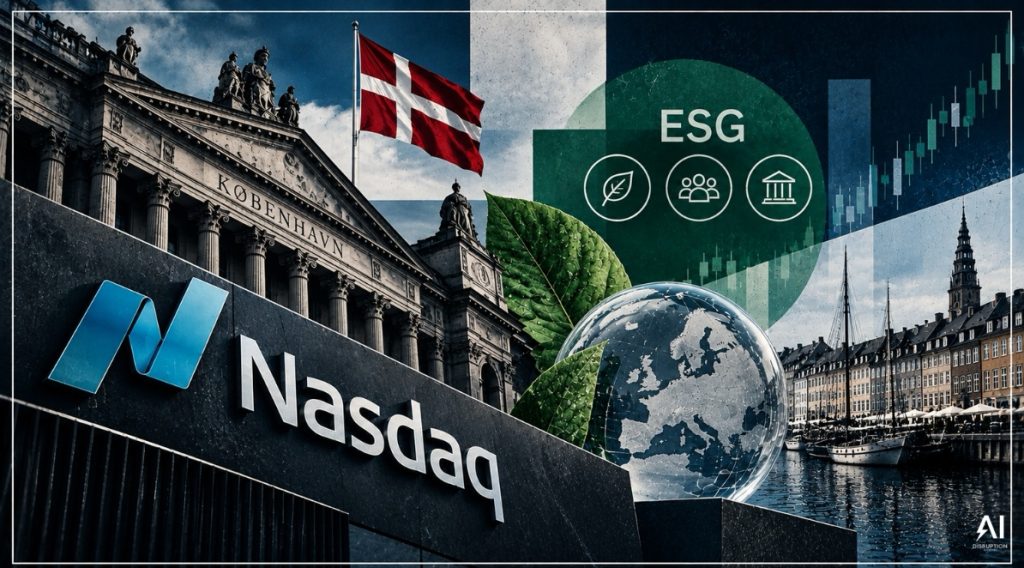
The Danish exchange has built a sizeable sustainability offering, but as ESG regulation in major markets ease, how much weight does its commitment carry?
How Nasdaq Copenhagen Sits Inside the Group
The Copenhagen Stock Exchange has a Danish identity and an American parent. Acquired by OMX in 2005 and brought into Nasdaq in 2008, it now operates within Nasdaq Nordic alongside Stockholm, Helsinki and Iceland. The exchanges share trading infrastructure and a common market framework, but it remains subject to local regulations.
That matters when examining Nasdaq’s ESG credentials. The group has spent years promoting sustainability reporting and responsible investment across its Nordic markets. Yet an exchange offering an ESG index is not the same as one requiring every listed company to meet common standards.
Nasdaq’s push began well before ESG became a fixture of finance. In 2008, Nasdaq OMX launched the OMX GES Nordic Sustainability Index, covering 50 leading Nordic companies assessed against environmental, social and governance criteria. In 2017, it introduced an ESG Reporting Guide to encourage more consistent corporate disclosures. The initiative developed further in 2022 with the launch of the OMX Copenhagen 25 ESG Responsible Index, applying exclusions linked to international norms and specified business activities. The index represents around a quarter of the 111 companies on Nasdaq Copenhagen’s Main Market, though the comparison is indicative.
Recent Performance and Concentration
Nasdaq Copenhagen remains a substantial exchange, reporting market capitalisation exceeding €500 billion as of Q4 2025. But recent returns have been uneven.
Nasdaq data show the OMX Copenhagen 25 fell 2.4% in 2024 and recovered 2.7% in 2025. As of September 30, 2026, the index was flat for the year. The ESG version of the index performed slightly better in 2025, rising 4.5%, though the two benchmarks have different compositions.
Novo Nordisk demonstrates the problem. The Danish pharmaceutical giant’s B shares were worth around DKK 1.04 trillion at the end of 2025, equivalent to roughly a quarter of the exchange’s market cap. Yet its share price tumbled at the end of that year by almost 48%. Denmark’s headline indices are so exposed to the fortunes of a small number of heavyweights that a fall of this scale makes it difficult to isolate the effect of ESG criteria from broader market conditions.
Foreign ownership adds another dimension. International investors held up to 62% of the value of Denmark’s OMX Copenhagen 25 in January 2024, up from 58% in January 2020. At Novo Nordisk, foreign investors owned 77% of its B shares in October 2025. Investors comparing businesses across borders may value consistent ESG data when assessing risk, but ownership figures alone cannot tell how much weight they place on sustainability disclosures.
In 2025 the S&P 500 Sustainability Screened Index gained 16% and the FTSE UK 100 ESG Select Index returned more than 20%. Those figures sit well above the Copenhagen ESG benchmark, but the measurement periods and methodologies differ and the comparison is only indicative.
ESG Reporting Versus Listing Rules
That competition is unfolding as the regulatory environment shifts. In May 2026, Wall Street’s top regulator, the Securities and Exchange Commission (SEC) proposed rescinding all its 2024 climate-disclosure rules to move away from the original disclosure framework. In October, UK’s Financial Conduct Authority (FCA) has also pursued a more flexible approach to sustainability reporting, including a “comply or explain” model. The precise scope of these changes differs, but the direction raises questions about how much companies will be required to disclose and how much they will choose to provide voluntarily.
For Nasdaq Copenhagen, that raises questions about whether ESG reporting will remain a competitive advantage for Danish-listed companies, or whether lighter-touch approaches elsewhere will reduce the incentive to invest in it.
That is why Nasdaq Copenhagen’s ESG credentials need to be separated from its listing requirements. After all, Nasdaq has not abandoned sustainability as a policy. Its 2025 Sustainability Report says its science-based emissions targets were validated by the Science Based Targets initiative. Nasdaq also reported market-based greenhouse-gas emissions reduction between 2024 and 2025. Those figures concern Nasdaq’s own operations and value chain, but they do not mandate companies listed in Copenhagen to meet equivalent standards.
The same distinction applies to the group’s reporting initiatives. Nasdaq’s ESG Reporting Guide seeks to encourage comparable corporate disclosures. A Nordic and Baltic reporting pilot invited issuers to use the guidance and share their experiences. But the participation remains voluntary.
Similarly, Nasdaq Nordic operates a harmonised Main Market framework across its exchanges, but local laws and regulatory responsibilities remain in place. In Denmark, these include the Capital Markets Act and supervision by the Danish Financial Supervisory Authority, Finanstilsynet. Companies may also face mandatory sustainability-reporting duties under applicable EU and Danish legislation. That said, the EU’s recent 2026 Omnibus Directive reduced the number of companies required to report ESG data. Revised standards adopted in July also cut mandatory disclosures by more than 60% for companies still covered by the rules.
Moreover, Nasdaq’s published Main Market rules do not establish a universal ESG-reporting obligation for every Copenhagen-listed company. Its OMX Copenhagen 25 ESG Responsible Index instead applies its own eligibility screens, including criteria linked to international norms, severe Sustainalytics controversy ratings and specified business activities. Companies that fail those screens may be excluded from the index while remaining listed on the Main Market.
What Nasdaq Copenhagen Actually Requires
That is the distinction at the heart of Nasdaq Copenhagen’s ESG proposition. The group has sustainability targets, issuer guidance and an index with a defined screening methodology. But none of these, by itself, imposes a common ESG standard on the entire exchange.
The question is not whether Nasdaq continues to talk about sustainability. It clearly does. The question is whether its ESG guidance offer enough value to remain relevant as regulation evolves. For Nasdaq Copenhagen, the credibility of its promise will depend less on the presence of an ESG index than on what its rules require and whether investors consider the result worth using.
Author: Michal Pawlak
See Also:
Has Morgan Stanley Turned its Back on ESG? | Disruption Banking
The Future of ESG Investing Under President Trump | Disruption Banking