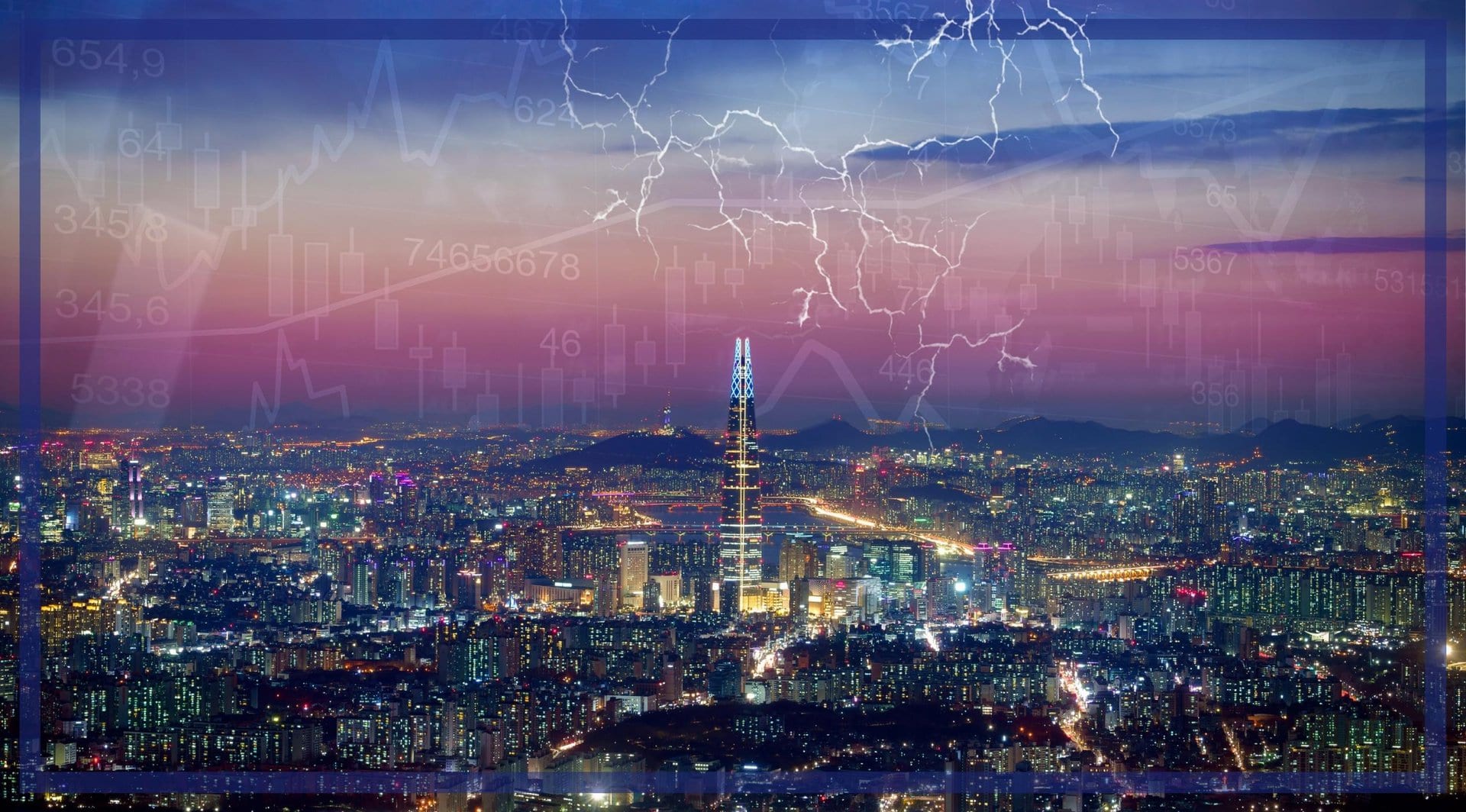
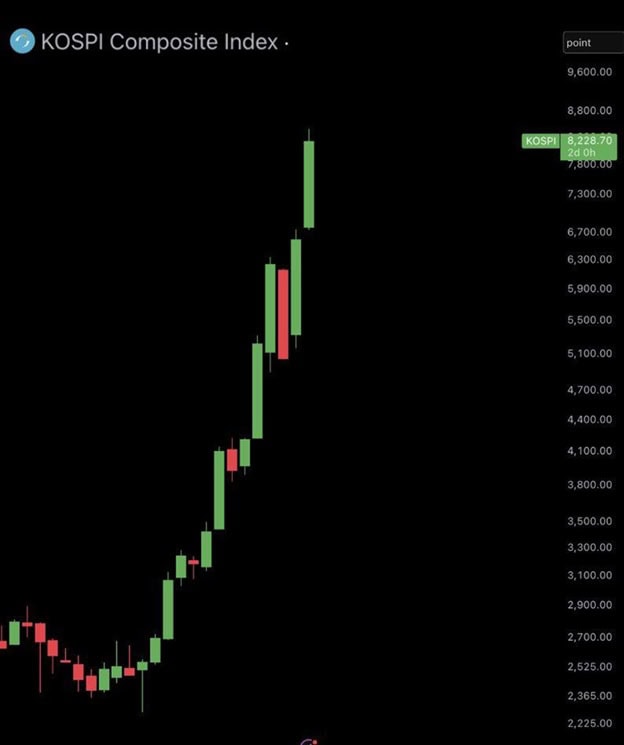
South Korea’s KOSPI hit 8,228 points on May 27, 2026, a 4.65% single-session surge that pushed the benchmark index’s year-to-date gain to exactly 100%. The record high was driven by heavy buying in Samsung Electronics and SK Hynix, with SK Hynix jumping 9.9% and joining rivals Samsung and Micron in the $1 trillion market capitalization club. No major index on earth has come close to matching that pace in 2026. Not the S&P 500 or even Nasdaq.
To find a Korean rally this sharp, you’d need to go back to the pre-dotcom collapse of 1999 or the industrial boom of the late 1980s. The benchmark KOSPI is now 119% higher than it was exactly a year ago, and the run has turned heads from Seoul to Wall Street.
Samsung and SK Hynix Are Carrying Almost the Entire Market
According to Korea Exchange data, Samsung Electronics has surged 149% year-to-date, and SK Hynix has climbed 215%, serving as the primary engines of the entire KOSPI rally. The combined weight of these two stocks in the KOSPI has now surpassed 47%, and excluding them, the year-to-date gain of the index’s remaining hundreds of constituents narrows sharply to approximately 30%.
The KOSPI’s daily average trading value surpassed 40 trillion won for the first time this month, reaching a record 48 trillion won, but Samsung and SK Hynix alone account for 43% of that total, deepening large-cap concentration.
Goldman Sachs Calls It the Highest-Conviction Trade in Asia
Wall Street hasn’t flinched. Goldman Sachs Research describes the KOSPI as its “highest-conviction equity market” in the region, forecasting 300% earnings growth in 2026, the strongest annual profit expansion in any Asian market since the 1999 Asian financial crisis recovery. A semiconductor memory supercycle driven by record chip shortfalls, hyperscaler demand, and AI compute is the core factor. Goldman’s 12-month KOSPI target stands at 9,000. JPMorgan’s bull case goes even further, to 10,000.
The fuel behind these forecasts is straightforward. “It’s the AI hardware theme that’s clearly what is propelling things,” Goldman strategist Tim Moe told CNBC. HBM chips, the memory technology inside AI accelerators, are in tight supply. Samsung and SK Hynix control the bulk of that global supply chain.
100% Gains in Five Months But Bubble Warnings Are Getting Louder
Not everyone is celebrating. The Korea Herald noted the KOSPI has been exhibiting extreme volatility comparable to that seen during the 1997 Asian financial crisis, the 1999 dot-com bubble, and the 2008 global financial crisis, all making these comparisons comfortable for any long-term investor.
Disruption Banking covered the brutal March 2026 correction when geopolitical shock from the Middle East triggered a 12% single-day crash, the steepest in the KOSPI’s 65-year history. The index plunged as much as 12% on one day, then staged a near-10% rebound the very next session, marking its best day since 2008. That kind of two-day swing doesn’t happen in healthy, broad markets.
Hana Securities warned that SK Hynix overtaking Samsung Electronics in market cap could signal bubble territory, though the firm also noted that, with Samsung and SK Hynix together accounting for about 48% of total KOSPI market cap but 72% of projected net profit, earnings still back up the concentration.
That last point matters. This rally isn’t purely speculative. But a market where two companies drive most of the index, in an industry with a notoriously cyclical history, offers very little margin for error if AI capex slows or memory prices reverse.
The KOSPI doubling in five months is extraordinary. It builds on an already historic 75% gain in 2025, the benchmark’s strongest annual performance since 1999, leaving the index up over 200% across just 17 months. For context, even the Nasdaq’s most fevered dotcom-era runs didn’t sustain this pace for this long.
Whether the KOSPI keeps climbing to Goldman’s 9,000 target or runs into a wall depends almost entirely on what Samsung and SK Hynix report next quarter, a narrow foundation for the world’s hottest stock market.
Author: Ayanfe Fakunle
See Also:
Korea’s Crypto Crash: 80% Volume Drop and ₩160T Exodus | Disruption Banking
South Korea Market Crash: KOSPI Plunges 7%, $270B Wiped Out in Iran War Shock | Disruption Banking