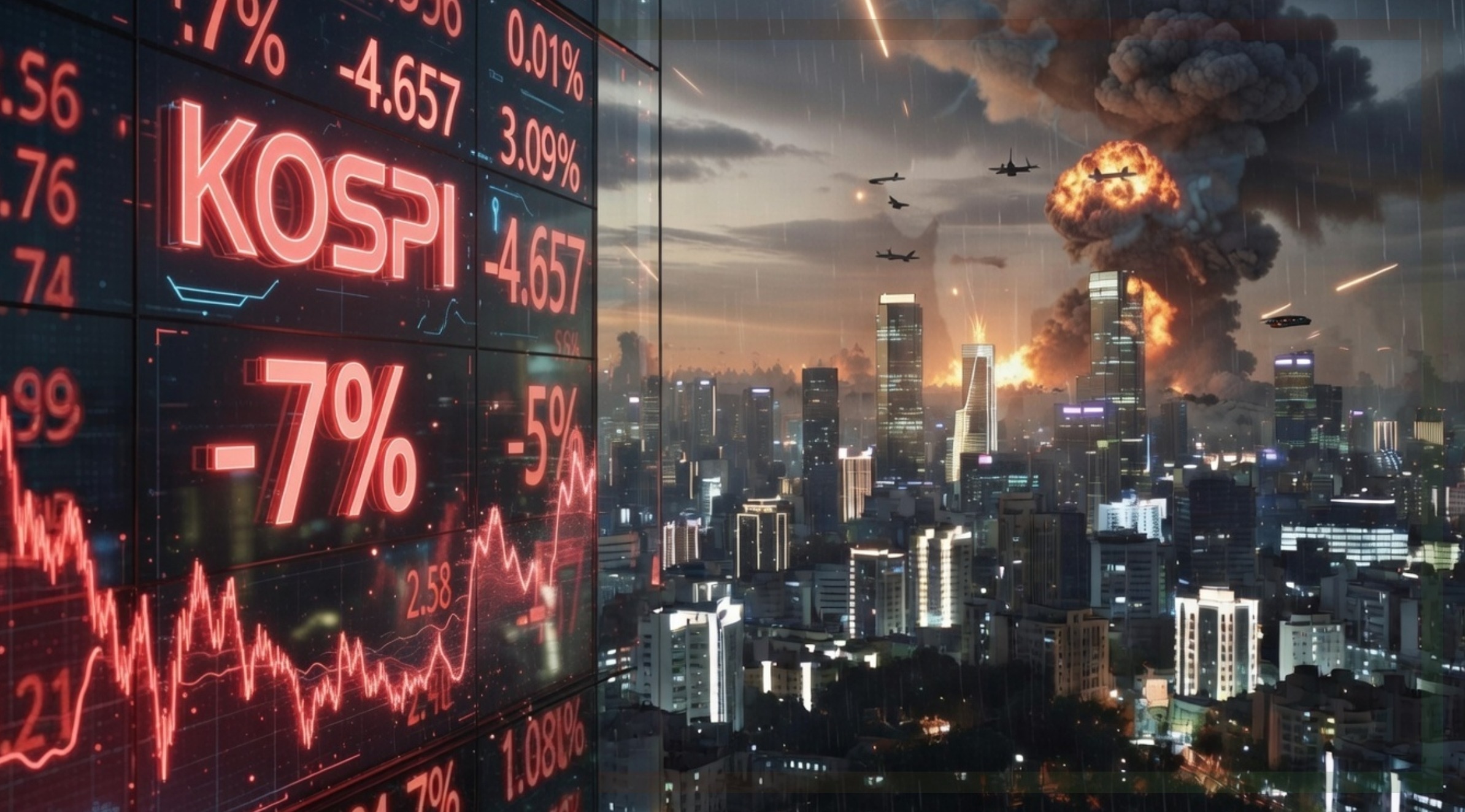
South Korea’s benchmark stock index, KOSPI, just delivered its worst single-day drop in 19 months. On March 3, the KOSPI fell 452.22 points, or 7.24%, to close at 5,791.91. That erased roughly ₩377-390 trillion ($270 billion) in market value, the largest one-day wipeout since the August 2024 yen carry trade meltdown.
Markets had been shut on Monday for Independence Movement Day. When trading resumed, the pent-up selling hit like a hammer. Foreign investors dumped more than $3 billion in local stocks. The won slid to 1,466.1 per dollar, its weakest in nearly a month. This Korean market crash wasn’t about weak earnings or rate hikes. It was pure geopolitics: the US-Israel strikes on Iran and Tehran’s threats to choke the Strait of Hormuz.
From AI Record Highs to Iran War Market Crash Reality Check
Just days ago, the KOSPI was the world’s hottest major index. It smashed through 6,000 for the first time on February 25, 2026, and hit an all-time high above 6,347 in late February. Year-to-date gains sat near 45-50% before today; over the past 12 months, the index had surged more than 129%. Samsung and SK Hynix, the AI memory kings, powered the entire rally.
That run looked unstoppable. Analysts at Nomura called for 8,000; JPMorgan eyed 7,500. Retail investors poured in. Then reality arrived. Former J.P. Morgan strategist Marko Kolanovic had warned just five days earlier of a “blow-off top.” He was right.
Iran War Trigger: Oil Shock Hammers Energy-Hungry Economy in Market Crash
South Korea imports about 70% of its crude from the Middle East, much of it through the Strait of Hormuz, the chokepoint carrying 20% of global oil and LNG. Iran warned it would attack any ship trying to pass. Tanker traffic halted. Oil prices jumped sharply; Brent crude climbed toward $80, with fears of $100+ if the disruption drags on.
Higher energy costs mean instant pain for Korea. Refiners, airlines, and shippers take the first hit. Inflation risks rise, which could delay Bank of Korea (BOK) rate cuts. Roh Dong-gil, analyst at Shinhan Securities, put it plainly: “The main index experienced expanded volatility as the Middle East risk was realized after a long weekend. The stock market is expected to be affected by oil prices and interest rates as the situation develops.”
Chip Heavyweights Lead KOSPI Market Crash Bloodbath
Samsung Electronics dropped 9.88% to 195,100 won. SK Hynix fell 11.5% to 939,000 won. The two giants alone lost tens of billions. Hyundai Motor sank 11.72%, Korean Air 10.32%. Even LG Energy Solution lost 7.96%.
Why the tech slaughter? Chips are energy-intensive to make and ship. Global growth fears from higher oil prices hit demand expectations. Foreign and institutional sellers led the exodus. Retail investors bought the dip, net 5.8 trillion won, but they couldn’t stop the rout. The exchange triggered a five-minute sidecar (program trading halt) when the drop exceeded 5%.
Defense names bucked the trend. Hanwha Aerospace soared 19.83%, LIG Nex1 jumped 29.86%. War fears create winners too.
Korea’s Vulnerabilities Exposed in Iran War Market Crash – No Sugarcoating
This KOSPI crash lays bare South Korea’s vulnerabilities. The country runs a massive trade surplus on semiconductors but remains an energy importer with limited buffers. Public and private oil stocks cover about seven months, enough for short pain, not prolonged chaos.
A sustained $100 oil scenario could shave at least 0.3 percentage points off 2026 GDP growth and add 1.1 points to inflation, according to Hyundai Research Institute estimates. Exports would suffer as global demand cools. The won’s slide makes imported oil even more expensive.
This isn’t 2024’s carry-trade unwind. It’s a reminder that no rally survives every external shock.
What’s Next After the March 3 Iran War Market Crash in 2026?
Don’t panic-sell the entire story. The structural AI tailwinds, exploding memory demand, Samsung and SK Hynix capacity ramps, haven’t vanished overnight. If the Iran conflict stays contained and oil settles below $85, expect a sharp rebound.
But stay realistic. Volatility is now the baseline. The KOSPI Volatility Index spiked to 60.72 intraday, the highest since 2020. Further escalation in the Gulf, or a broader supply crunch, could push the index back toward 5,500-5,600 support. Watch crude prices, won/dollar moves, and any BOK comments.
Forward-thinking investors should hedge energy exposure, favor names with strong balance sheets, and keep dry powder for dips. The Korean market crash of March 3, 2026, isn’t the end of the bull run. However, it is a loud warning that geopolitics can override even the strongest tech momentum.
Brace for turbulence. The next few weeks will show whether this was a one-day shakeout or the start of a deeper correction.
Author: Ayanfe Fakunle
The editorial team at #DisruptionBanking has taken all precautions to ensure that no persons or organizations have been adversely affected or offered any sort of financial advice in this article. This article is most definitely not financial advice.
See Also:
Korea’s Crypto Crash: 80% Volume Drop and ₩160T Exodus | Disruption Banking
Iran War Sparks Gold Surge Past $5,400, Silver to $96 | Disruption Banking