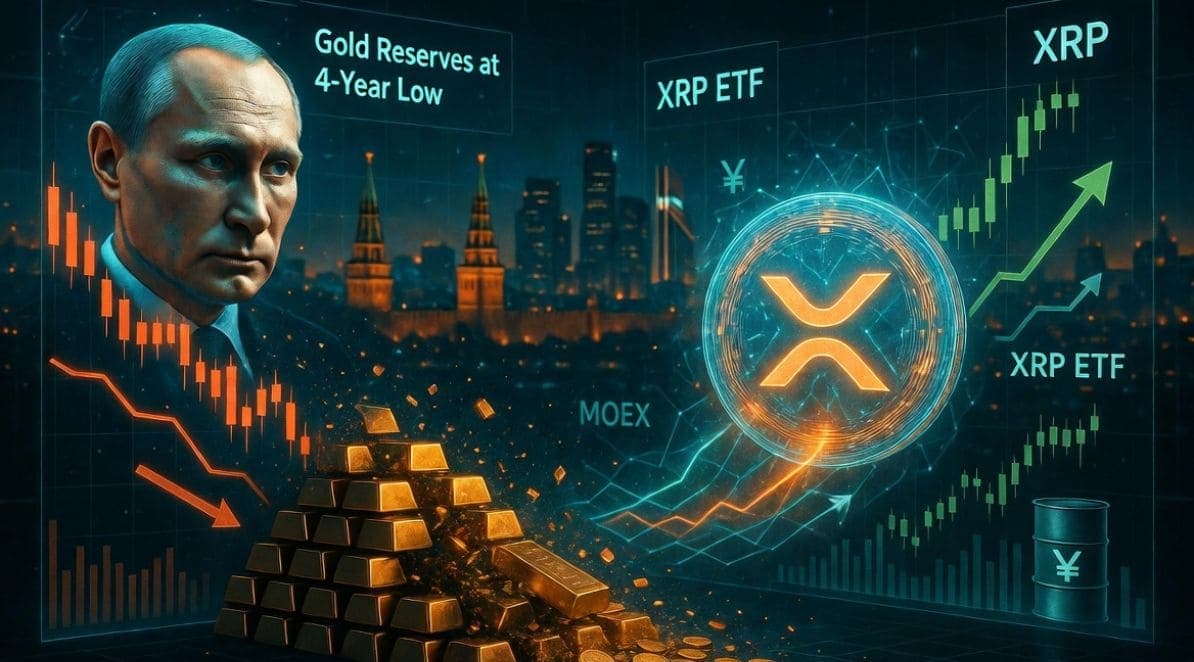
Russia spent over a decade deliberately building one of the world’s largest sovereign gold reserves. Starting in 2007, Moscow forced domestic gold producers to sell directly to the Central Bank, accumulating bullion as a sanctions-proof financial buffer, an asset held outside Western banking systems and immune to dollar clearing restrictions.
By the time the Ukraine war started in February 2022, those reserves were near peak levels. Four years later, the Russian government is selling that same gold at pace. At the same time, the Moscow Exchange listed XRP futures in mid-May 2026 and is racing toward a July 1 crypto legal deadline.
Russia’s Gold Holdings Drop to 73.9 Million Ounces
The Bank of Russia reduced its gold holdings by roughly 900,000 ounces in the first four months of 2026, bringing total reserves to approximately 73.8 million ounces, the lowest level since early 2022.
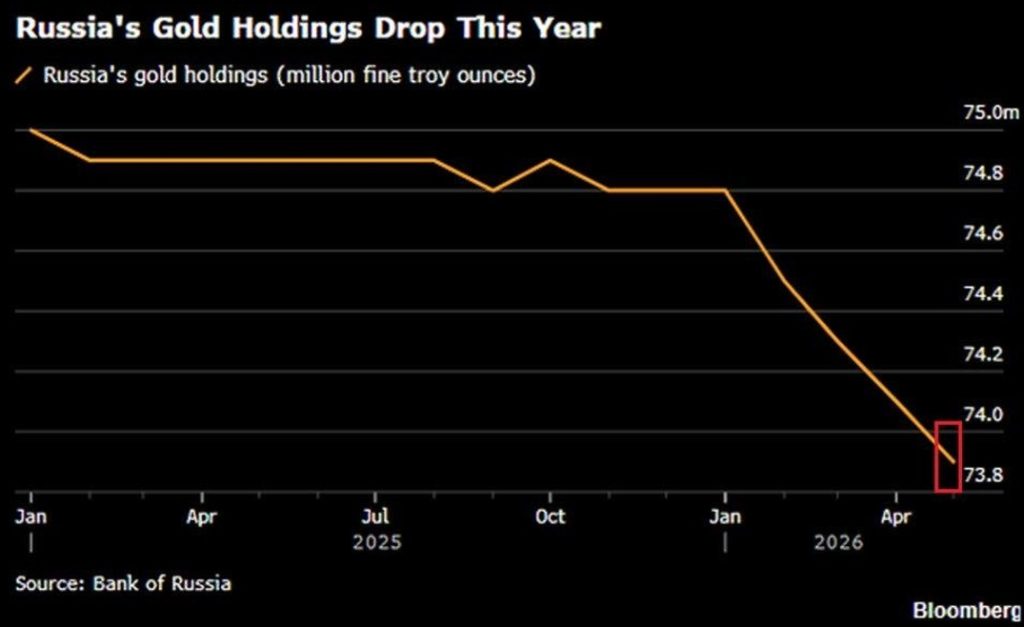
According to analysts at BNE IntelliNews, Russia may sell as much as $15 billion worth of gold in 2026, following estimated sales of up to $30 billion in 2025, which would make it one of the largest sustained sovereign gold disposals by a major economy in modern history. “The scale of gold sales suggests that reserve depletion is accelerating under sanctions,” one economist warned, adding that the trend limits Russia’s ability to absorb future shocks.
MOEX Goes Live With MOEXXRP: XRP Futures Hit Russia’s Biggest Exchange on May 14
Starting May 13, 2026, MOEX began publishing four new cryptocurrency indices: MOEXSOL, MOEXXRP, MOEXTRX, and MOEXBNB. XRP futures contracts followed on May 14, with June, July, and August 2026 expiries available exclusively to qualified investors.
Maria Patrikeeva, Managing Director of the Derivatives Market at Moscow Exchange, stated: “We provide Russian investors with access to the largest cryptocurrencies without the need to access foreign exchanges and bear infrastructure risks.” Over 62,000 derivatives market clients had already traded crypto contracts on MOEX before XRP launched.
On X, crypto commentator @TheCryptoSquire noted that Russia has pushed forward a bill to classify XRP as property and enable its use in cross-border trade, a move that, if finalized, would formalize what the MOEX listings are already beginning to reflect.
The Real Problem: How Russia Settles Oil Payments to China and India
Russia continues exporting significant oil volumes to China and India. A Carnegie analysis found that Russian banks held $68.7 billion in yuan in 2023, and yuan became the most-traded currency on the Moscow Exchange. Yet Russia-China trade in 2025 still slipped to $228.1 billion, marking the first annual decline in five years and pointing to a payments channel that has been degrading.
Crypto-facilitated international trade from Russia reached approximately 1 trillion rubles, roughly $11 billion, in 2025. Cryptocurrency pipelines offer a route that doesn’t require access to U.S. dollar clearing. XRP’s architecture, with transactions settling in seconds without SWIFT or correspondent banking, directly fills that gap. As we covered in our piece on Ripple’s RLUSD trajectory, cross-border settlement is the core contest for Ripple’s entire ecosystem right now.
Russia’s July 1 Crypto Deadline: XRP Gets a Regulated Home
Russia’s comprehensive crypto legislation passed its first reading in April 2026, with key provisions expected to take effect from July 1. Under the proposed rules, individuals will be able to buy and sell crypto through licensed brokers, exchanges, and trustees. The framework caps non-qualified investors at 300,000 rubles ($4,000) annually while granting qualified investors unrestricted access. Crypto payments for domestic goods remain banned, but digital assets in foreign trade settlements are explicitly in scope.
Russia is not replacing gold with XRP. But it is selling gold to cover costs that its blocked access to Western finance can no longer absorb, while simultaneously building regulated digital asset infrastructure with XRP at the center of it. For further context on XRP’s broader institutional momentum, see our earlier coverage of the XRP ETF inflow surge in early 2026
Author: Ayanfe Fakunle
See Also:
Why Did Goldman Sachs Dump $154M in XRP ETFs? | Disruption Banking