Binance posted new rules for market makers. The problem is that market makers are the most important users on the exchange; Binance completely depends on them to make Binance’s markets appear liquid in the first place. What reads like a consumer protection notice is, in reality, an admission about how the system works.
Words fail to convey how dishonest some of the statements sound. Binance has absolutely no intention of enforcing any of these rules, especially not on their largest counterparties (more on this below). The “new rules” should be read as a delayed response to repeated failures that Binance could no longer contain.
For example, one of the last paragraphs reads as follows: “At Binance, we’re committed to ensuring transparency and integrity across the crypto industry. We actively monitor market-making activity to enforce the highest standards and will take swift, decisive action against any misconduct, including blacklisting market makers who breach our rules – because protecting our users and maintaining a fair, trustworthy trading environment comes first.”
All that sounds so utterly fake. We would bet money that nobody on Binance’s compliance team can read it with a straight face.
Follow the Liquidity
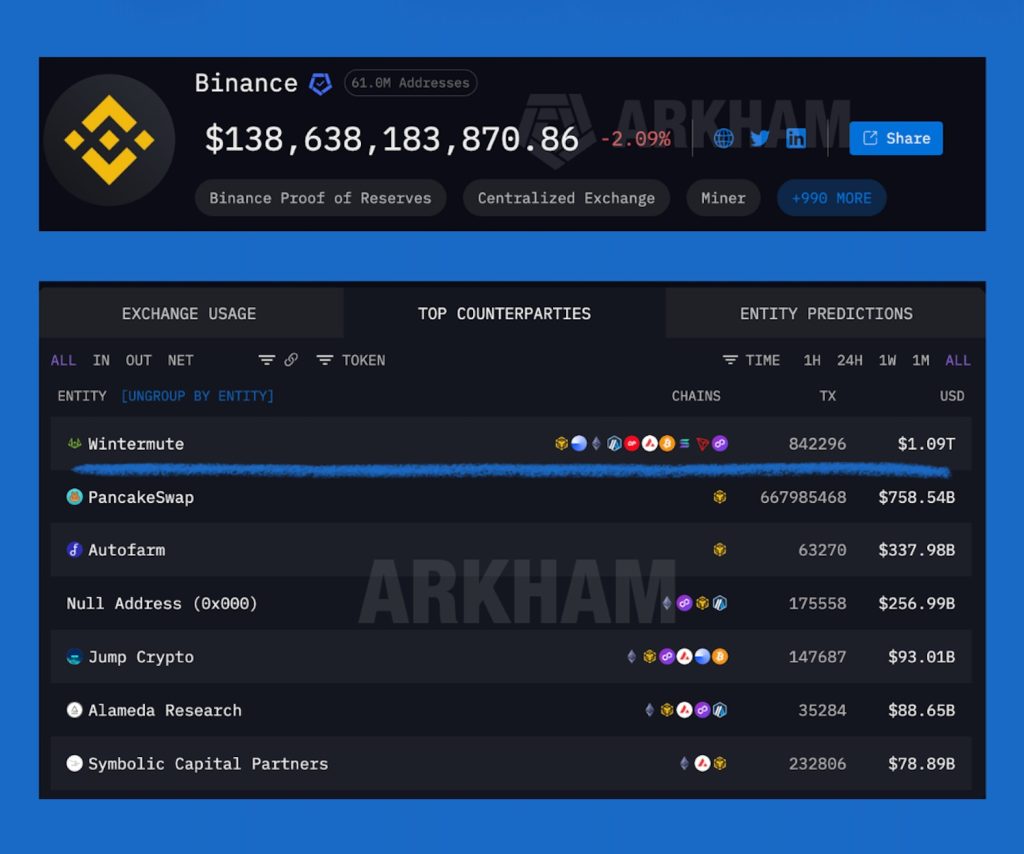
Remind us: Is this the same platform that allows market makers Wintermute and DWF Labs to run wild? This is the same Binance whose largest counterparty is Wintermute, with total transactions over $1 trillion worth of cryptocurrency, as shown in the ‘top counterparties’ section on the left below.
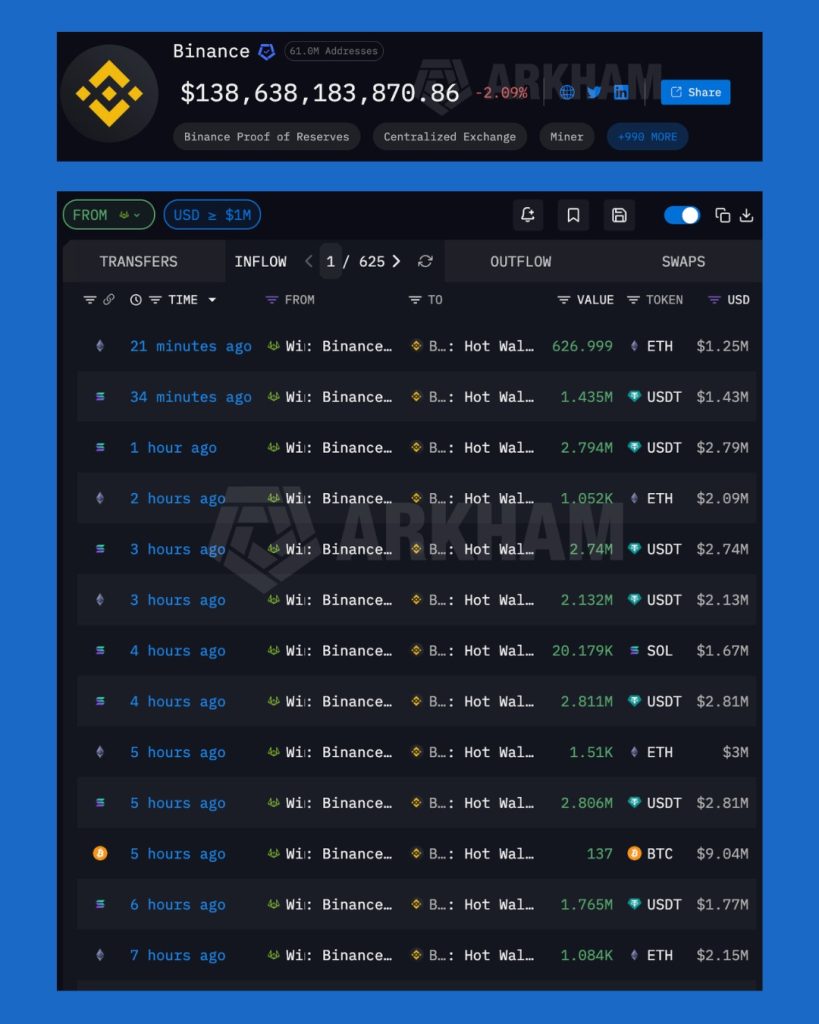
Binance received inflows of $36.7 million from Wintermute in the 7 hours before this reporter happened to check on Arkham Intelligence. And that was with all transactions under a $1,000,000 USD excluded.
When Enforcement Gets Fired
If memory serves, this is also the same Binance that fired its own investigator for uncovering market manipulation (pump-and-dump schemes and wash-trading) by DWF Labs, one of Wintermute’s main competitors.
It’s hard to capture the irony. It’s like a casino putting up a sign warning that the house is rigged right in front of the cage where they hand out chips. No, that’s not it. Binance is even more cynical than that somehow. Let’s think of a better, more biting metaphor.
“Users should remain mindful of market conditions, especially for newly listed or volatile assets, and be aware of potential signs of non-organic activity when making trading decisions.”
That has an odd ring to it. It’s sort of vague and ambiguous. It has a whiff of “you’ve been warned.” One thing it doesn’t suggest is that Binance is in any way accountable for policing market makers.
Maybe this is a better metaphor for the utter lying bad faith of Binance with these oxymoronic “rules”: It’s like a carnival barker telling you that the games are fixed, while still trying to sell you a ticket to play.
That’s closer but still short of a bullseye.
Timing Is Not Accidental
Naturally, the question arises: Why now? Many retail investors and market observers blame Binance for the October 10th market meltdown, referred to as “Crypto Black Friday,” which shaved $19 billion of leveraged bets off the market.
Although Trump caused some of the volatility with a post about tariffs (of course), Binance and other exchanges experienced disruptions during which users could not access their funds. People accused Binance of benefiting from the trading freeze, profiting from peak volatility.
Changpeng Zhao (CZ) later said the allegations were “far-fetched.” Whatever. CZ is an ex-con, only pardoned because of his business relationship with Trump’s new family business entity, World Liberty Financial (WLF), which later rented Binance’s team to design the backend of their stablecoin, USD1. Most of the USD1 in circulation is held on Binance, incidentally.
Wintermute and DWF Labs have had a hand in simulating demand for USD1, it turns out, as well. Are we seeing the pattern yet? Disruption Banking has chronicled the deep ties between market makers, WLF, and Binance here and here.
The timing of the new “rules” suggests less a philosophical shift and more an attempt to regain control of the narrative after a market structure failure.
A Checklist No One Can Use
Now, Binance outlines six red flags that users should watch out for, but the problem is that Binance can see the red flag behavior much more easily than users, but Binance does not commit to notifying users by naming market makers who have been blacklisted.
Let’s go through the red flags and see whether users have a realistic capacity to avoid them.
- Token unlock violations = No/Unlikely
Requires insider knowledge or forensic tracking of wallet flows. Unless someone is monitoring on-chain vesting wallets and mapping them to exchange deposits, retail investors have no visibility. - Persistent one-sided sell pressure = No/Unlikely
You can see order books and trade flow, but distinguishing organic selling from coordinated market-making activity requires pattern recognition over time and across venues. Most users don’t have the tools for that. - Repeated sell-side pressure without buyers = No/Unlikely
Same issue: visible in fragments, but attribution is impossible. We plebes see the effect, not the actor. - Simultaneous multi-exchange selling = Impossible w/o professional tools
This is almost completely invisible unless you’re using professional aggregation tools or doing cross-exchange data analysis in real time. - High volume, no price movement (wash trading signal)= Maybe
This one is the most detectable. But even here, users can’t prove intent, just suspicion. And Binance controls internal matching data. - Thin liquidity causing sharp moves = Maybe
Visible, but misleading. Users often interpret this as “volatility,” not structural illiquidity supported by artificial volume. - Volume not supported by order book depth = Impossible w/o professional tools
Detectable if you’re actively comparing metrics, but again, that’s more dudes with six screens in dark mode, not typical user behavior.
Visibility Is Not Equal
Users can observe symptoms, but cannot verify causation or identity. So, Binance preserves its business relationships while shifting the burden of risk-management to the users.
A Binance spokesperson said in an email to Coindesk, The rules are “intended to help projects conduct stronger due diligence on their market-maker partners and remind users to be mindful of market conditions,” adding that Binance wants to foster “a fair and efficient marketplace, and we do not tolerate misconduct.”
Binance can claim it monitors and enforces internally, but there’s no external audit trail. They are describing a system that only they can see clearly, warning users to protect themselves within it, while continuing to profit from its opacity. Basically, Binance is telling retail investors, “Trust me, bro!”
Not the Spark—But the Fuel
The CEO of Wintermute, Evgeny Gaevoy, said, “There are so many misconceptions about what we do. For example, if you go on Crypto Twitter, you’ll see people blaming market makers for causing price crashes, which is just not how it works. There’s this huge misunderstanding about what market makers actually do, how we operate, and how we provide liquidity.”
Gaevoy is full of crap, but to be fair, I would mislead people to defend my hustle, too, especially if it were making as much coin as Wintermute, come what may.
Market makers aren’t a peripheral feature of crypto trading; they are the mechanism that sustains it when real demand disappears, which is a lot of the time since Wintermute and DWF Labs came on the scene. To put it another way: the market maker is often not just making the crypto market; they are the crypto market’s primary seller.
It may be technically accurate that market makers don’t always cause crashes, but they can, after creating the illusion of stability and liquidity, pull the rug out from under the market when it matters most.
@MastrXYZ posted the following on X, “#Binance has repeatedly failed users through opaque risk management, aggressive leverage incentives, and exchange-specific pricing anomalies. It centralizes price discovery while denying responsibility for systemic damage caused by its own liquidity structure. Abnormal wicks, forced liquidations, and USDT pair distortions have wiped out users without fair market conditions. Risk is socialized to traders while profits are privatized by the platform.”
The Referee Who Won’t Blow the Whistle
Binance has full visibility into the flows, agreements, and investor behavior, yet the company refuses to name the actors responsible and continues to rely on them to sustain its markets, while users have a fragmented view.
It’s like when a frat house warns guests that drinks are being tampered with, insists it’s not the brothers, but won’t say who’s behind the bar or why they’re still there.
The result is a system where risk is pushed outward; accountability is kept internal, mostly by firing investigators and compliance staff. Meanwhile, the illusion of a fair market remains just convincing enough to keep the game going.
Asked whether it will require Wintermute to disclose information or notify users if Wintermute is blacklisted, Binance did not immediately respond to a request for comment.
Binance isn’t warning users about manipulation. Binance is documenting the mechanics that keep its market functioning.
Author: Tim Tolka, Senior Reporter
#Crypto #Blockchain #DigitalAssets #DeFi
The editorial team at #DisruptionBanking has taken all precautions to ensure that no persons or organizations have been adversely affected or offered any sort of financial advice in this article. This article is most definitely not financial advice.