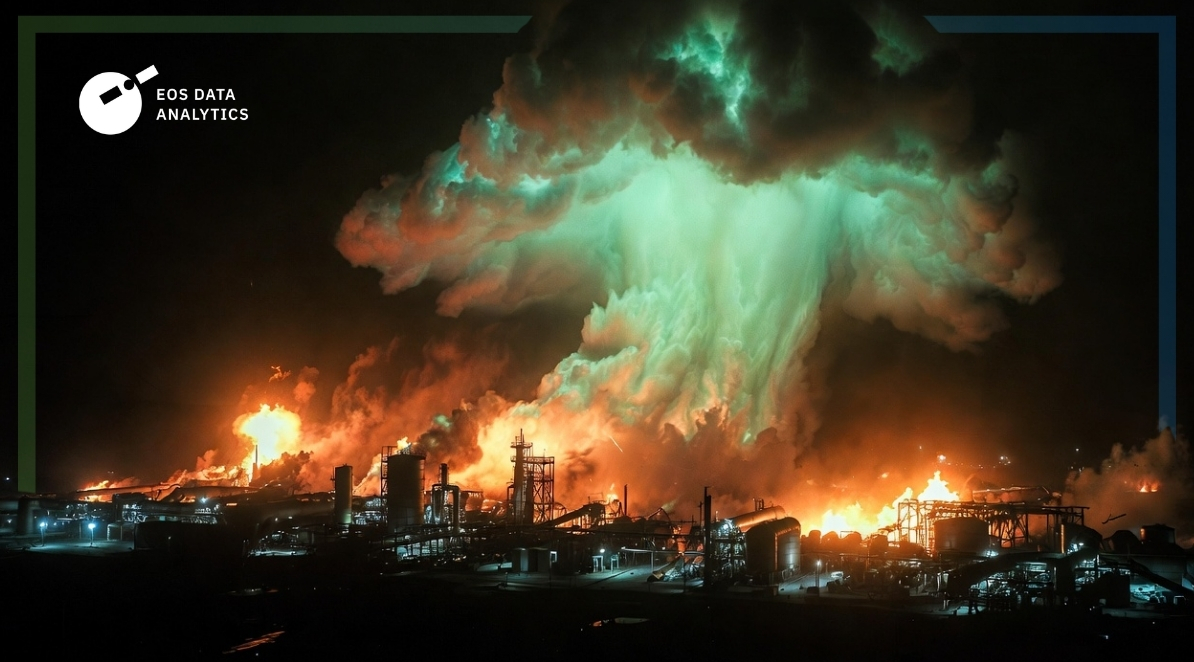
While missiles fly and oil blasts past $100, satellites are capturing a far more explosive story in real time. What we are seeing is how the Iran conflict has turned the Gulf’s energy infrastructure into a massive, involuntary greenhouse gas emitter.
Here’s the brutal reality beaming down from orbit:
- Iran’s blockade of the Strait of Hormuz has paralyzed LNG and oil exports.
- Tankers sit idle. Terminals are jammed.
- Gas fields and plants keep producing associated gas with nowhere to send it.
Under the circumstances, operators are doing the only thing they can: flaring it or burning off billions of cubic feet in roaring flames that light up the desert and spew huge plumes of methane (80–100x more potent than CO₂ over 20 years) plus CO₂ straight into the atmosphere.
Live satellite imagery updates (via Bloomberg Green) reveal clear, dramatic spikes in flaring across the region. One of the most glaring surges hit after the Iranian missile strike on Ras Laffan, which is Qatar’s flagship LNG hub. This flaring jumped to more than double the 2025 average, releasing an estimated 6,200 metric tons of CO₂-equivalent in a single day. Similar elevated heat signatures are showing up at Iranian sites like Kharg Island, UAE facilities, and beyond. What was already a high-flaring zone in places is now consistently worse because normal export routes are severed.
The Winners & Losers of the CO₂ debacle in the Middle East
This isn’t a minor environmental footnote anymore. It has become a live demonstration of how geopolitical shockwaves create vicious market and emissions distortions:
Short-term winners include volatility traders, spot oil/gas players, and anyone who can reroute or monetize stranded molecules fast. It is also a big win for hedge funds in the catastrophe bonds space.
Medium-term pain will be felt by LNG exporters watching long-term contracts fracture, ESG portfolios will take an invisible hit, and carbon accounting may become pointless.
Carbon market fallout will lead to involuntary “carbon leakage” on an industrial scale. Facilities that were slowly decarbonizing under investor pressure are now flaring like it’s the early 2000s again.
For sharp investors, the real opportunity isn’t just riding the obvious oil spike. It’s betting on the second- and third-order chaos which will include the following:
Flare-reduction tech, rapid-deployment gas-to-power systems, and mobile LNG solutions that can capture and monetize stranded gas in war zones.
Satellite-based methane detection and monitoring companies which is the new must-have “picks and shovels” for energy conflict and transition risk.
Specialty reinsurers pricing war + climate crossover risk.
Accelerated projects in alternative corridors (US LNG, East Africa, Red Sea pipelines, floating regas).
The conflict in the Middle East appears to have forced some oil and gas companies to directly burn off more natural gas than usual at their facilities, releasing planet-warming pollution into the atmosphere https://t.co/6bA6VMJ4vZ
— Bloomberg (@business) March 23, 2026
Inflation for Energy and Emissions
War has always been inflationary for energy. This one is also inflationary for emissions. And it’s that toxic combination which is minting asymmetric opportunities in 2026.
The Strait of Hormuz isn’t merely an oil chokepoint anymore. Thanks to what satellites are now showing us in stark detail, it has become a chokepoint for the entire global energy transition story.
Markets reward those who see the hidden flows of capital, molecules, and now methane plumes.
Position accordingly.
See Also:
Why Hedge Funds Are Betting Big On ‘Catastrophe Bonds’ | Disruption Banking
Climate Emergency on the Agenda for Wall Street | Disruption Banking