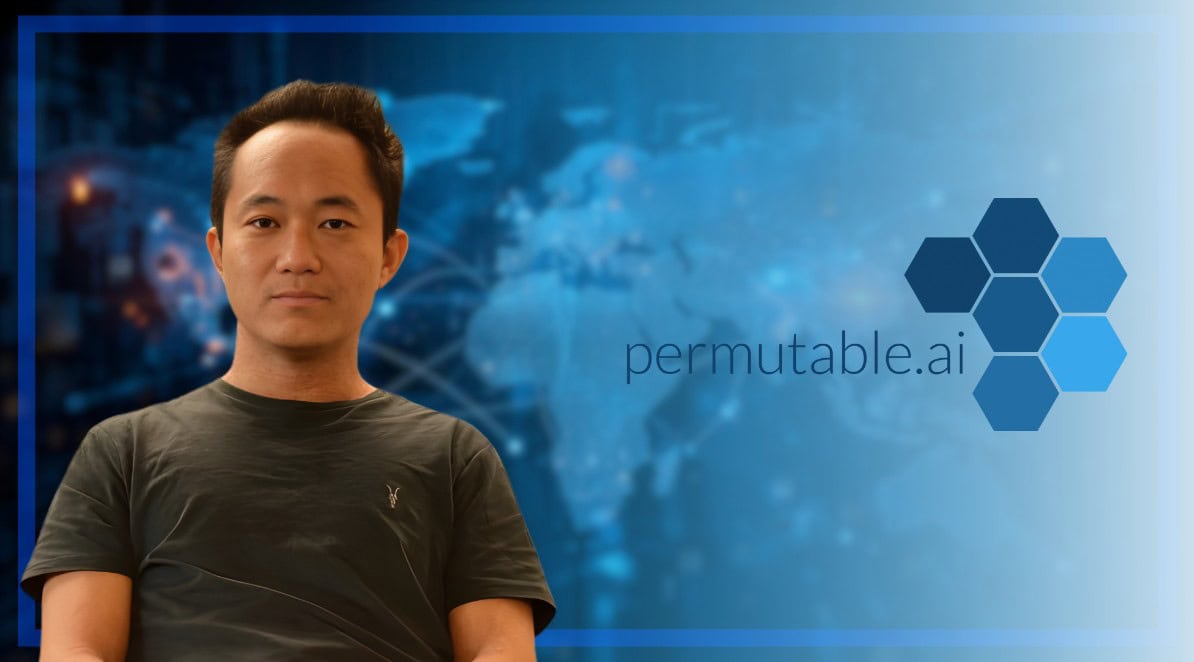
There has been a huge shift in how the best portfolio managers invest, and Wilson Chan has been paying attention. As Founder and CEO of Permutable AI, a startup providing real-time intelligence across commodities, energy, and currencies, Wilson sees the pressure firsthand.
Today’s high interest environment, coupled with the rise of blockchain and artificial intelligence, has created a new reality for investors. The 60/40 portfolio has been slowly dying since the pandemic hit. In the meantime, the largest asset managers have been ramping up tech expertise. Many of them are competing with big tech firms to try to get an edge over the competition.
Investors, traders, and quants everywhere are looking for the same thing: alpha. It doesn’t matter who you are, the priority is the same. And, with AI growing in popularity alongside algorithmic trading, there are more ways to find alpha than ever before. However, margins are down, so the hunt for alpha has increased in significance too.
We sat down with Wilson to explore how Permutable AI is turning market perception into a measurable edge – and why he believes the future of trading belongs to those who can read the world in real time.
BlackRock, ETFs, and the End of Human Outperformance
The first thing we discussed is how BlackRock has taken advantage of a growing ETF market. In a market where price pressure is constant, these ETFs are low cost and provide the same index exposure as you would get by working with a portfolio manager. McKinsey puts the value of global assets under management at a record $147 trillion. Meanwhile, hedge funds manage almost $5 trillion of assets.
With increasing interest in moving up to 10 percent of a portfolio out of traditional fixed income products into ‘alternative assets’, the industry is going through massive change. Wilson shared how he sees gold, digital assets, private equity and even venture capital as new areas that portfolio managers are looking at.
To highlight the shift, if 2 percent of global portfolios were held in digital assets, then the value of assets under management would be approximately $3 trillion, the same as the combined total of digital assets in circulation today. This is why the ETFs driving adoption are of such significance to many investors.
In the meantime, the performance of the S&P 500 or the Dow Jones over the years has also been something that individual investors have noticed. Gone are the days of high fees and big wins, today the market is all about beating the largest indexes.
As an example, the Dow Jones has, on average, since 2010 given returns of 10.3% per year. The S&P 500 has done even better, delivering a 13.58% compound annual growth rate. On further examination, a handful of stocks like Nvidia, Apple, Microsoft, or Amazon have all delivered over 20% compound annual growth rate. This data is now far more widely available. It all adds to the pressure that portfolio managers are feeling today. Can’t outperform the Dow Jones? Why do you expect a bonus?
The Path to Permutable AI
All these topics and more form part of the reason why Wilson decided to leave his career in capital markets to focus on Permutable AI. In the past he had been Co-Head of Asset and Liability Management Structuring at Merrill Lynch. He later advised sovereign wealth funds across Asia at Citibank. But this wasn’t the path he wanted to take.
“I started working with machine learning very early,” Wilson said. When it comes to Permutable AI, he explained how the company was using “transformers, before transformers were a discussion point.” Transformers are a type of artificial intelligence model that learns to understand and generate human-like text by analyzing patterns in large amounts of text.
When Wilson was considering the type of business he wanted to run, he considered all options. At first, though, the company focused on ESG.
“We wanted to make an impact,” Wilson explained. ESG had become a very popular trend by the late 2010s, and the company was hoping to collaborate with corporates who were looking at a sustainable future.
But the market was already looking past ESG, Wilson shared. “We realized that the technology we were building wasn’t getting the recognition it deserved, and we started to point it back towards trading.”
This was when Permutable AI started to scale. It almost grew a life of its own, Wilson added.
Today the company has big ambitions. In 2026 the next iteration will be the priority. For this the company will need new people, funding, and new partnerships.
Inside the Perception Engine
Unlike the traditional hedge funds, quantitative trading firms or asset managers, Permutable is looking to be a transparent business. Although it has powerful technology that can help portfolio managers find alpha more easily, it is not there to just make money for a committee or to give even more returns to ultra-high net worth individuals. It is there to be shared.
The vision starts with the people building it.
“The best AI engineers want to change the world,” Wilson explained. “We will help with that by creating new transparency.”
This wasn’t the case 20 years ago, he highlighted. The brightest minds in quantitative finance worked for banks and hedge funds. Today, they work for tech companies. They are drawn by missions that extend beyond maximizing returns. Wilson has structured Permutable AI to compete on that terrain.“I think that’s the only way you can actually get the very best people,” Wilson added.
The problems Permutable AI is solving certainly qualify. Wilson used causation as an example. “How does this event that’s happening in the economy, or with politics; how does it affect assets?” These are intellectually interesting problems to solve. But that’s not all. Wilson added how these questions also lead to a better understanding of how the planet works, how events cascade through interconnected systems, and how well anyone can predict the timing and impact of those cascades. One of the biggest takeaways for Wilson has been how perception, like sentiment, can be as real as reality itself. Wilson has watched this trend play out across markets for years. He highlighted how “perception drives markets,” has never been truer than it is today.
“Perception could well be the new reality for a number of years,” Wilson said, “in which case perception could be all that matters in this market environment.”
Measuring Perception
It’s not just that perception influences markets, though it always has. It’s that in an age of algorithmic trading, instant news dissemination, and AI-powered decision-making, perception and reality have collapsed into the same thing. What traders believe about supply disruptions, geopolitical risk, or demand forecasts moves prices just as powerfully as the underlying fundamentals themselves. Sometimes more so.
This is what Permutable AI measures.
“We measure perception,” Wilson explained. “And we think that perception actually drives everything.”
That measurement isn’t sentiment analysis in the traditional sense, tracking whether headlines are positive or negative. Permutable’s system maps how narratives form, spread, and influence market participants in real time. It identifies which stories matter before they’re priced in. It traces causality across geopolitical events, policy shifts, and commodity flows. It turns the chaotic noise of global information into structured intelligence about what the market is about to believe.
In a world where perception is reality, the edge belongs to whoever can read perception faster and more accurately than everyone else.
The $1 Billion AI Arms Race
Permutable AI is offering a product that can outperform the majority of portfolio manager returns today. As part of a quantitative strategy, it can help companies stay ahead of the curve. But there is still the small matter of the AI budgets that companies like Hudson River Trading (e.g., $1 billion/year) and others have to spend.
Wilson pointed out how many clients today work as part of a systematic fund pod, which is made up of several individuals. The average assets under management for these pods is about $1 billion AUM. People see Permutable AI as an extension arm of themselves.
“Like an AI arm,” Wilson added.
In a market where the cost of human capital is being scrutinized more than ever. Where artificial intelligence is now far more than a buzzword. Where ETFs are trading 24/7. It’s not enough to just do what we did yesterday. The tools that are emerging, and the talent that is in such high demand, are proving that tomorrow will definitely not look like today. Let alone yesterday.
In a market like this, who are you going to turn to?
2026 and Beyond: Building the World Simulator
Permutable AI has built reasoning models designed to understand relationships and causality, not just correlations. The architecture adapts continuously to new macro conditions, news flows, and geopolitical developments. That adaptive layer is core to Permutable AI’s philosophy: if you want to anticipate markets; the system must evolve as fast as the world itself.

Source: Permutable AI
Permutable AI’s system scans hundreds of thousands of articles in real time and surfaces the ones that matter. It embellishes this with analysis generated almost instantly. It goes far beyond what a standard search-enabled LLM can produce. It’s essentially a live reasoning engine that sits beside every trader, constantly updating its read on the world.
Every model output is fully traceable down to the exact article, timestamp, and source. Permutable AI reduces hallucinations by tightly controlling the task boundaries of each model. Everything comes with a built-in audit trail with transparency embedded into the core architecture.
Wilson left a comfortable career in capital markets because he saw what was coming. In a world where passive ETFs consistently beat active managers, where margins compress relentlessly, and where the best talent wants to solve problems that matter, not just maximize returns for committees, the old model was breaking down.
Permutable AI represents his answer: a transparent, reasoning-based system that measures what matters most in modern markets – perception. As we look toward 2026 and beyond, one thing is clear: the tools are changing faster than the institutions built to use them. The question isn’t whether AI will reshape trading – it already has. The question is whether the next generation of market intelligence will be hoarded by the few or shared with the many.
Wilson has made his choice. Now the market will decide if he’s right.
Author: Andy Samu
See Also:
Permutable’s Explainable AI Strategy Outperforms S&P500 This Year | Disruption Banking